Showing posts with label moon. Show all posts

Wednesday, 12 August 2026

eclipse time

We debated whther to go to Spain or Iceland to see today's total eclipse of the sun, but in the end remained at home, to see the 96% eclipse visible from here.

We scoped out yesterday where would be a good place to view from.  As it is late afternoon/early evening, it turns out that it's not quite visible from our garden: just too low.  But it is visible from just across the road.  So we set up a viewing station on the pavement there, with just five instruments this time.

The carboard telescope we got for the 1999 total eclipse; the solar binoculars with built in filters; the SeeStar telescope with its solar filter; a collander, and a bottle of water (not a viewing instrument, but needed because, despite being early evening, it was hot).  Not shown: a pair of solar viewing glasses.

Because we were out in public, there were several passers-by.  We encouraged them to look through the binoculars, first explaining that these were special safe ones, and they should never use ordinary binoculars.  We spent a lot of time looking through them ourselves. Definitely a good investment.

The cardboard telescope produced its usual slightly fuzzy result.


And the collader produced an array of slightly fuzzy images.

It took a bit of adjusting to get the collander at the right distance for good images.  The holes are probably a bit too big.

But by far the best images are from the SeeStar.  It was a bit tricky to use, as we needed to view the tablet to set it up and capture images.  And since the sun was very bright, the screen was hard to see.  But we got a lot of great images from it anyway.

colour and size changes are due to fiddling with the telescope controls

The day did get noticeably cooler, and a bit dimmer, close to maximum.

So a good eclipse experience.  But we know it's nothing like the experience of a total one.


Saturday, 20 June 2026

stacking up

I thought yesterday's SeeStar shot of the moon was good.

But my other half also took a SeeStar video of it.  Why would you take a video of a static scene?  To enhance the view.  He spent today fiddling around with AutoStakkert!, software to stack multiple frames to get a better image.  The result is great, much crisper:


Why not just use the SeeStar to integrate over a longer time, like with other images?  Well, it doesn't do that for solar system objects, so we just have to try harder.

He also played around with a solar video taken at the end of May.  Here's a simple image:

2026/05/29, 17:48 BST

And here's the result of processing the video, with much more detail visible on the sunspots:


Friday, 19 June 2026

further and further

 Another day, and the moon and Venus are even further apart.

Venus just visible on the far right. Photo taken with a Pixel 10 camera; 22:14 BST


This time we were ready with the SeeStar telescope, although, of course, it couldn't get both in the same frame!  The moon looks better with the right focus and exposure:

SeeStar S50 photo, 250mm, f/5, 1/100s exposure; 21:50 BST


Thursday, 18 June 2026

what a difference a day makes

Yesterday, the moon and Venus were close in the sky.  Today, less so.  It really emphasises how fast the moon moves realtive to the rest of the sky.  Venus moves too, relative to the "fixed" stars, but much more slowly. 

Venus is on the far right, just above the stalks.  Photo taken with a Pixel 10 camera; 22:15 BST

The phone camera makes the sky look a lot pinker than it appeared to the naked eye.

We spent some time observing the moon through binoculars, and the craters stood out well, especially on the terminator.  I must learn how to take phone photos through binoculars...

Wednesday, 17 June 2026

moon and Venus cosying up

The moon and Venus were close in the sky this evening.  Given the time of year, even though it was past 10pm BST, the sky was still quite bright.

Canon EOS R7 with 400mm lens, f/5.6, 1/60s exposure; 22:19 BST

Squnting at that pic, it looks like the whole disc of the moon is (just) visible; it seemed plausibly so to the naked eye, too.  

We can test that.  Ramping up the contrast to a ridiculous level confirms:


Wednesday, 22 April 2026

Jupiter pinwheel and moon

More fun with the SeeStar telescope this eveneing.

A nice shot of the moon:


An overexposed Jupiter and four moons:

clearly, we need to learn more about adjusting the exposure

The Pinwheel galaxy, M101, 11 minute exposure:


The same image with some simple postprocessing:

clearly, we need to learn more about postprocessing


Saturday, 12 April 2025

moonlighting

While I was up in Scotland enjoying the spring sunshine, my other half was enjoying the clear night, using the 8" telescope and a Raspberry-Pi camera to photograph the nearly-full moon.


Definitely better pictures than using my phone camera.

Saturday, 29 March 2025

Eight ways to observe the eclipse

We watched the partial solar eclipse quite closely this morning, with eight different instruments.


Going counterclockwise, we have:

  1. A pair of solar viewing glasses from the 1999 total eclipse.
  2. The SeeStar telescope with a solar filter.
  3. The new solar binoculars.
  4. The digital SLR with zoom lens, and, of course, solar filter.
  5. The cardboard solar projector telescope, bought for the 1999 eclipse
  6. The 5" Meade telescope with, you guessed it, a solar filter.
We used all the instruments, but the 5" gave the best view, and the SeeStar got the best pictures, overall.

Just starting: see the big sunspot near the limb. 
There are some smaller, fainter spots towards the top-middle of the disc.

Near maximum, and the smaller sunspots are close to the edge of the moon.

Nearly over

I snapped the sky with my phone to show that it was getting somewhat cloudy. 


The sun is completely overexposed, of course.  But wait. What's that spot on the dome?  (In case you are wondering, we couldn't use the 8" telescope in the dome for this event, as we don't have a solar filter for it.)
Look at that reflection!

So that's the seventh way we could see the eclipse (although we didn't notice it at the time, only when looking at this photo).  

What about the eighth?  Well, that's the same as the way we "observed" a partial eclipse 10 years ago, with our solar PV:

The big dip: that's no cloud, that's the (partial) eclipse)


The device to attach a phone camera to the 5" telescope arrived in the post later in the afternoon.  Oh well.  In any case, a well observed eclipse.


Friday, 14 March 2025

partial lunar eclipse

A photo, with a digital SLR and an ordinary lens, of the partial lunar eclipse this morning, looking nice and red:

By the time a longer lens was fitted to the camera, low cloud had bubbled up and hidden the moon.  (We should have been better prepared: we will be for the partial solar eclipse in a fortnight.) In fact, the moon was nearly set anyway, as can be seen by "enhancing" the picture above, making the horizon visible:


A bit later, the sky was light, with an amazing contrail disappearing into the distance, as if following the setting moon.


You can identify on this picture where the moon was above, by comparing horizon profiles.  (The spike pointing to the moon is the pylon on the right.)  And yes, that position is still in cloud.


Saturday, 11 May 2024

SeeStar, or rather see moon and galaxies

Last night we finally had a night clear enough (although still somewhat hazy) to have a play with our latest telescope.

It's computer controlled, and calibrates its position automagically, presumably using GPS to get everything it needs.  It has a range of preprogrammed things to look at, and can autotrack (this is cheating, really, but great fun!).

First, of course, is to have a look at the crescent moon.  Everything is controlled through a phone app, including taking pictures of what it sees.  So here's a screenshot:

lovely craters along the terminator

We then moved on to looking at some galaxies.  M51, the Whirlpool Galaxy, is always an interesting view.


When we first looked at the phone screen, there was very little to see.  But this image is after integrating the view for 5 minutes.  Nothing seen here was visible with the naked eye: the Plough could be seen through the faint haze, but not much more.  This is really impressive.  Also, there is a satellite track across the image, visible early on in the integration, but here integrated away by the time we took this one.

We're looking forward to a properly clear night, when we should get much better images.  And we'll need to get a tablet for better pictures, too!


Saturday, 18 March 2023

There were giants in those days

The UCNC conference series is one I try to attend most years, but I don't always make it.  I made it this year for three reasons: my team got four papers accepted, I was running the TEMC workshop at the conference, aaaaand the conference venue is a 2 hour drive from the Kennedy Space Centre.

I found some other delegates at the conference who wanted to visit (including someone who had a hire car!), so this morning four of us piled into the car, and drove down the coast.

It started with a small forest of rockets near the entrance:

I had been raving about seeing a Saturn V.  One of the group saw the rocket on its side, and asked if that was it.  No, I said, much too small! 

Gemini twins: the early capsules were so small, they needed tiny astronauts...

We had a quick look at a few exterior exhibits, but I made a beeline to the bus line for the Apollo/Saturn V centre.  We were led through some exhibits:

the Apollo landing control room

And then, finally, the reason for being here.
the Saturn V first stage rocket nozzles, each over 12ft (3.7m) in diameter

It's indoors, so it's hard to get a feel for the sheer size of this thing, 363ft (111m) long/tall.

view from the bottom

View from the top.  The very top component is the launch escape system.  The conical part at the bottom of this covers the command module, the only part of this behemoth that returns to Earth.  The command module is about the same size as one of the first stage rocket nozzles..

Apollo 14 command module

After marvelling at this monster (and probably annoying my travelling companions with my gushing about remembering the moon landing, and what at least I think are interesting facts about the rockets), and then having a not-that-inspiring lunch in the cafeteria, we returned to the rest of the exhibition near the entrance.

The other main exhibit is the Atlantis shuttle.  The entrance has the main fuel tank and SRBs on display: they look quite small after the Saturn V.

Shuttle launch tanks.

We could then get up close with Atlantis; again, it feels small.  It is good to know that we can go into space in something less huge than a Saturn V.


The closest I'll get to being a shuttle pilot.

We then had a "shuttle launch experience", cleverly done to shake us about with the illusion of increased g forces on launch.  Astronauts say this is the most realistic launch simulation they have experienced: note the use of "simulation", though.

There were many other fun exhibits and activities, plus several merchandising outlets.  I bought a plushy Apollo command module and a NASA mug.

On the way back, we completed our USA experience by stopping for dinner in a diner.

What a day!  Flying home tomorrow.


Wednesday, 17 August 2022

low moon rising

The very low moon is peeking through the streetlights around the carpark.  Shot on my Pixel4a in "night" mode, 2x zoom, cropped, but otherwise untouched.

21:43 BST


Friday, 26 February 2021

moon and sun

 A lovely full moon close to the horizon (overexposed, because phone camera)

17:30 GMT, looking east

And, because it’s a full moon near the horizon, there’s a lovely setting sun 180 degrees away:

17:30 GMT, looking west


Sunday, 20 December 2020

’Twas the night before conjunction

The conjunction of Jupiter and Saturn is tomorrow.  But that means they are pretty close today, so we had a look. 

I spotted Jupiter immediately, and was looking for the fainter Saturn nearby, but couldn’t see anything.  So I looked through my binoculars at Jupiter, and Saturn popped out, so close, just above Jupiter!  Wow!  

I still couldn't see it with the naked eye, even knowing where to look, because it was so close to Jupiter it was being drowned out.  (My other half could see it, but he has better eyesight than me.)

Here are a couple of (highly cropped, but unenhanced) photos, taken with a Canon EOS 20D and a Canon EF 100-400mm zoom lens. 

17:32 GMT looking west; 400mm focal length; f/5.6; ISO-1600 equivalent;1s exposure

17:35 GMT looking west; 260mm focal length; f/5.6; ISO-1600 equivalent;1s exposure

When we saw these photos, we went, “Wow, are those Jupiter’s moons?”  Then we zoomed in, and saw a very faint dot to the right of Saturn, almost invisible, but in the same place on both photos: “Wow, is that Titan?”

So we went to Stellarium to find out.

17:30 GMT: Jupiter, its four Gallilean moons, and a star in line to the left, below Saturn and Titan.

So, yes! We had indeed seen Jupiter (naked eye), plus very close-by Saturn (binoculars), and then plus Callisto, Ganymede, Europa, and Titan (photography).

And tomorrow is conjunction, so Jupiter and Saturn will appear even closer together in the sky!


Tuesday, 31 March 2020

the moon

This is a photo of the moon tonight, taken with my phone camera, just hand-held, through a 40mm eyepiece on our new telescope, an 8" Schmidt–Cassegrain.  So, a proper camera, properly mounted, is going to be great!

raw image, not post-processed; 21:51 BST

It was a beautiful sight to see: the seas and more craters were much more visible to the eye, which has better dynamic range.

Saturday, 20 July 2019

one small step

So, it’s 50 years since the first moon landing.

I have two very vivid memories of the Apollo programme.

First was watching the moonlanding on television.  Not live, but the next day at school.  Our headmistress invited the class to watch on her (gasp!) colour TV.  The rest of the class was excited by seeing a colur TV for the first time; I was excited by seeing the moon landing.

The second memory is during Apollo 13 – sitting around in the cloakroom at school with all the other kids, all being very worried.

I have lots of other memories of the whole programme, but I don’t know if they are memories from the time, memories of repeat showing on TV, or just memories of memories.

Thinking back, one thing that strikes me is how impoverished our information sources were then: TV (real time only), newspapers (whichever one was read in the house), and the odd special isue of a magazine.  No videoing late night programmes to watch later, no iPlayer catchup, no YouTube clips, no NASA website, no googling for more info.  How did we survive?

Since Apollo we’ve learned so much more about our solar system.  Other vivd memories are the pictures from the surface of Mars sent back by Viking (these images really made the hairs on the back of my neck stand up: pictures from the surface of another planet that is just a mere dot in the night sky), and the pictures of all the moons of the outer planets sent back by Voyager.  And, of course, the recent Pluto pictures from New Horizons.

The solar system is a much richer, more detailed place than it was 50 years ago.

But 50 years on from Neil Armstrong and Buzz Aldrin, we still don’t have a moonbase.

I blame you for the moonlit sky
And the dream that died with the eagle’s flight
I blame you for the moonlit nights
When I wonder why are the seas still dry?

Don’t blame this sleeping satellite

Did we fly to the moon too soon?
Did we squander the chance in the rush of the race

— Sleeping Satellite, Tasmin Archer, 1992

Saturday, 13 October 2018

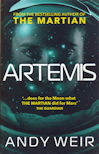
book review: Artemis

Andy Weir.
Artemis.
Del Rey. 2017

The moon has a small town, Artemis, population 2000. Most of the inhabitants are either super-wealthy, or the ordinary blue-collar people keeping the town running, and working as tourist guides. Some are criminals. Jazz is a bit of both: a legitimate porter, and a smuggler to keep the wolf from the door. But she’s making no headway in saving to pay off a big debt, so when one of her super-wealthy smuggling customers offers her what looks like a great deal for some sabotage, she decides to take it. But the job doesn’t go as planned, and soon Jazz is on the run, and the worst is, she doesn’t even know who’s after her! She will need all her moon-smarts just to survive, let alone win out.

This is a fast paced romp, essentially based on a huge McGuffin, but with plenty of engineering know-how needed to solve all the problems. Jazz is a drop-out, which is why she wants money; she also has a well-developed business ethic, which is why she gets into trouble in the first place; she also happens to be an engineering genius, which is how she gets even deeper into trouble.

The book superficially has a YA vibe, but Jazz is not a teenager, she’s in her mid-20s. So occasionally the story and the vibe clash somewhat. However, this is an interestingly-drawn world, both the politics of Artemis, and its Earth-based back story. I enjoyed the grunge-tech feel to life on the moon (although I’m sure there are holes in the engineering, and in the chemistry). And I particularly appreciated how the ending panned out.


For all my book reviews, see my main website.