Showing posts with label Dublin. Show all posts

Monday, 16 December 2024

view from a hotel window

I've just arrived in Dublin for a project meeting.  Yes, I know I'm supposed to have retired, but I'm finishing off a few existing commitments ... before I start some new ones.

This will be our last trip to Dublin on this particular project, so we need to wrap up who's writing which paper, have a nice meal, and say goodbye to some great colleagues.


Tuesday, 27 February 2024

view from a hotel window

I arrived in Dublin yesterday evening, ready for a two-day research project meeting.  The hotel room has an ... interesting ... layout.

Which way round are you supposed to sleep?

The bed takes up the entire end of the room.  The "wardrobe" is three coat hangers on the wall.  There is a perfectly normal en suite next to where I'm standing to take the photo.  The two wall switches by the bed raise and lower the blinds on the window.

I slept across the bed, so I didn't have to scramble across it (except to grab a pillow), and could have my phone (aka alarm clock) by my head.  It was perfectly comfortable.

What's outside the window?  In the morning light, I could see out (after scrambling across the bed again):

a view into an office block

Now off to hear about progress on our interdisciplinary computational synthetic biology project.


Wednesday, 4 May 2022

view from a hotel window

I flew into Dublin this evening, for a meeting at TCD tomorrow: it’s for our new joint research project between computer science, physics, and microbiology, on DNA supercoiling.  Watch this space!

The view isn’t particularly scenic, but the weather this evening is very nice.


Amusingly, I discovered that the hotel I'm staying in is literally next door to the one we stayed in for the Worldcon in 2019.  However, this one is very electronic: lots of mysterious black touch panels.  I’m not entirely sure how the lights work:


Once I figure out how to turn them on or off, I’m off for dinner with my colleagues.

Tuesday, 20 August 2019

Wicklow Mountains coach tour

The Worldcon is over, and we have an extra day to enjoy Ireland.  Yesterday evening we went on a bus tour of Dublin; today we went on a longer coach tour, to the Wicklow mountains.  We had tried to book the Newgrange tour, but it was sold out.  As we were wondering whether to take the Wicklow tour instead, another customer in the Tourist Office, who had also been at the Worldcon, highly recommended it.  Thanks!  You were right!

First stop was the Glencree Cemetry and Barracks, for a cuppa and a loo break.  There was also the Glencree Grotto down in a beautiful small valley.

everything is so green

Next stop was a photo-op at the "P.S. I Love You" bridge.

the bridge that features in a film I have never heard of

Then another photo-op, at the Guinness Lake.

The Guinness Lake -- so called not because it is made of Guinness, or used to make Guinness, but because the land was owned by the Guinness family (until recently)

Then the main stop -- Glendalough ("Glen of the two Loughs").  We had two hours to walk round the loughs; it didn't start raining until we were nearly back!

walking along the woodland path, along the south side of the smaller Lower Lough
between the loughs: view across the larger Upper Lough, with the rain clouds beginning to thicken
view from the boardwalk along the north side of the Lower Lough: a magnificent Rowan, laden with brilliant red berries, with the Lough in the background
mossy branches; the boardwalk was well clear of the very boggy ground
an impressive range of lichens
The rain set in quite seriously at this point, but we were nearly back at the coach, so no problem.

Then off to our final stop at Avoca Village, and a late lunch at Fitzgerald's pub.  The exterior of this pub starred in the TV series Ballykissangel (which I have heard of, and seen, although long enough ago I have no memory of the pub).

After that, we returned to Dublin along the motorway, rather than via the windy backroads we had travelled down.

A great day out.

Friday, 16 August 2019

how tall is that?

Walking back and forth in Dublin over the last couple of days, we noticed a strange construction in O’Connell Strret.

It’s difficult to get a picture of the whole thing on a mere phone camera.  Here’s the base:

a spike with a shiny base (and, apparently, a bit of my finger).

And here’s the rest of it:

all the way to the top

How tall is that?  It seems to go up forever.  It’s a cunning optical illusion, though: The Spire of Dublin is “only” 120m tall, but the way it tapers gives a false perspective view that makes it look a lot taller from the base.  Neat.


Wednesday, 14 August 2019

view from a hotel window

We have arrived in Dublin, for the Science Fiction Worldcon.  We didn’t manage to book a room in a nearby hotel (they were sold out about 10 minutes after booking opened), so have a bit of a trek from Parnell Street.

We got the airport bus to the hotel, and checked in.  We then walked to the Convention Centre, to pre-emptively register for tomorrow’s start, and then walked on to the Science Galley for a panel discussion: “Oppy or Armstrong? Autonomous vs human space exploration”.  The panel unanimously agreed we need to send both humans and robots.  We then walked back to the hotel.  We had also done a bit of walking around airports earlier in the day, and my phone’s step counter is registering an impressive (for me) 15100 steps.

That local Tesco will be useful for stocking up on carbs needed to keep going through the weekend.  The trams clang their warning bells as they go past: I hope that doesn’t go on all night!


Sunday, 13 August 2017

Worldcon 75: Sunday

The last day of the Worldcon: how time flies!

I first went to a panel on Book Blogs; I have been known to post the occasional book review. The biggest reason by far that people buy a book is because they have read and enjoyed something by the same author.  Next is because it was recommended by someone they know and trust, which might be a blogger.  Blogs can affect sales, but only the big blogs like BoingBoing seriously affect sales.  Great bloggers, like Jo Walton, start conversations others want to join.  Is there a pressure to write only good reviews, lest the publishers stop sending you ARCs?  No, that would be really stupid of them, because you would write about it!  Some authors don’t understand how the internet works, and push back against poor reviews.  Fans can be worse!  There’s a difference between legitimate bad reviews and just shit-posting.  Bad reviews can be easy to write, and be entertaining to read, but have no influence on the reader’s choices.  Moderate your comments: there is a population of badly behaved commenters – if you let their comments stand, you will lose the thoughtful, engaged commenters.  You can always make a video of the worst comments: they are very popular, and make money!  If you want to build and maintain an audience, you have to put material out with some regularity.  Why do people make video reviews of books?  You can read a text review much faster!  It’s just a different medium for different people: there are 25 minute long reviews of beds, with 50k views.

Next off to a panel on Systems of Magical Healing.  There is usually some cost involved in healing: to the healer, to the patient, to a third party, to the land.  There needs to be some limitation or jeopardy: maybe you can heal others but not yourself, or only one person can do it, or a rare artefact is needed, or a lot of training and knowledge is needed.  The approach used in role playing games is necessary for the game dynamics, but is inherently ridiculous, so doesn’t translate to books.  Is the insistence on limitations a reflection of how healthcare is a limited resource in the real world?  What if there was unlimited healing available?  What if old age and death can be healed?  Vampires!  Excalibur’s scabbard could heal all mortal wounds, but it’s not used much.  The only place with a cure-all is hell, so that the torture can continue.  Research into medieaval healing herbs, but for the poisonous ones, make those up, so that no-one can use them in real life!  If you know how to fix someone, you know how to take them apart: healers can do damage, too.

On Wednesday I went to a panel on Obsolete Science Ideas.  This neatly book-ended my next panel, on Tomorrow’s Cool SF Physics.  Certain physics ideas get used a lot: many words, wormholes, hyperspace, time dilation, etc – but what other physics might make for cool stories?  Wheeler’s “It from (qu)bit” programme, that everything is information at the bottom, has potential.  New materials, meta-materials built from artificial atoms, might actually allow deflector shields, invisibility cloaks.  They are good for deflecting waves: what if you could deflect gravity waves?  What if you could transport gravitons along special “wires”?  Most of the matter in the universe is dark matter: what are its properties?  Could there be dark matter stars, planets, creatures, civilisations?  And what if we could communicate with them?  String theory has more dimensions, the extra ones we can’t see are “small”, but could support parallel universes “close” to ours; these are very different from many worlds type parallel universes.  Talking of extra dimensions, what about more timelike dimensions?  What if we are living in in a simulation?

After lunch I went along to Writing about Plants, Landscapes, and Nature.  Finland has lots of forest, with huge rocks: there are so many words in Finnish for rocks, many types and sizes of rocks.  Setting can be treated as a (secondary) character in its own right, or as a place for the characters to inhabit.  It’s much easier to write a setting like the ones you know, otherwise you have to do a lot of research to get the details right.  The USA has a detailed soil database: for every location, it has information on the soil type: what colour, what it smells like, what it feels like like, what’s blooming.  You can go down the research rabbit-hole just to get the sentence: “the soil was red”.  The Manual of Woody Landscape Plants is a huge book with descriptions of every woody plant in the US, useful for getting exactly the right kind of oak with flashy fall colours.  It has no pictures!  You have google for the pictures.  There’s nothing like physically experiencing the setting to get the feel: you don’t necessarily need to go to a jungle, just to a suitable botanical garden.  Don’t just rely on visual descriptions – use the other senses too, to see the world through different “eyes” – go into a forest and close your eyes and listen.  Landscapes change depending on time of day, on time of year; wild animals have their own rhythms.  There’s a tradition of Finnish nature magazines, with long articles describing the environment – they don’t write like journalists or fiction writers, but somewhere in between.  As ever, the problems are the things you don’t know are different elsewhere: in New England, fireflies are part of the summer landscape – they are “lower stars” (or actually lower planets, because they move) – but you can’t transplant them to a European setting, where you have glowworms on the ground.

Next up was the panel What Science Fiction Gets Wrong About… My Profession.  The professions represented on the panel were: anthropologist/archaeologist, quantum physicist, infectious diseases physician, and behavioural geneticist.  Most professional life is email, teaching, answering questions from students, reading documents, writing reports, meetings, ethics panels, coding, checking data, public outreach – other people tend to do the hands on work.  Not all anthropologists work in obscure isolated places, they might also work on things like the cultural anthropology of My Little Pony fandom.  Brendan Fraser Mummy movies: boy is the archaeology wrong! They are picking up artefacts with their bare hands! They are removing things from their context!  We do things differently now: past archaeologists kept only those artefacts bigger than 2 inches, now we keep everything.  Every show gets computer use wrong.  Seanan McGuire’s (as Mira Grant) Newsflesh series has very plausible science. Orphan Black gets clones right: they are not duplicates, but different people.  Don’t write veterinarians who don’t have pets.

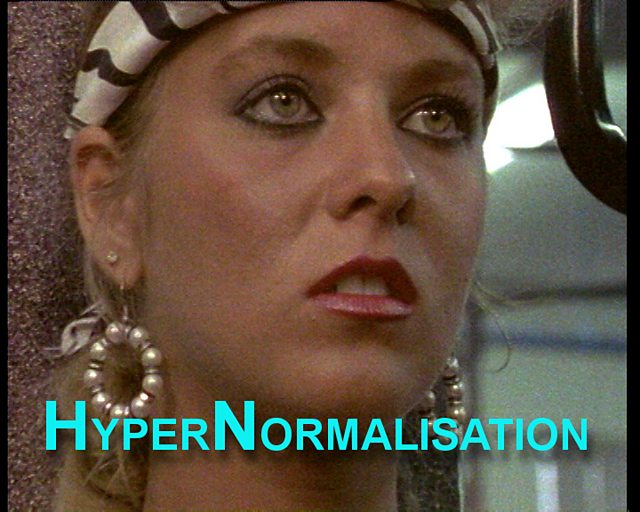
Adam Curtis documentary
The final programme event was Allen Stroud’s presentation on Defamiliarising Europe.  This was a lecture based on an Adam Curtis 2016 documentary HyperNormalisation.  The talk wove together mythology, Brexit, and fractured dystopian Europe SF.  Dystopian fiction is based on something gone wrong in society, and is designed to reinforce support for the status quo, because the alternative is the dystopia.  When reality is systematised and simplified [the thesis of the documentary], then some things, some people, are left out of that smaller “reality”; a mythology evolves at the margins, which might one day come back as the truth. But truth itself is complex.  Some people are very direct – they make strong statements – “X means X” – and move on before their statements can be questioned.  They can race ahead of the thoughtful. Criticism comes too late, because the argument has already moved elsewhere.  Curtis’ documentary is itself just another very direct narrative, however.

And finally: the Closing Ceremonies.  Lots of thanks and applause.  We discovered that this Worldcon was the second largest ever (second only to Loncon3), with, by the end, over 10,000 memberships, and nearly 7000 attendees.  This was many more than expected, which explains some of the crowding issues on the first day.  Dublin has won the site selection for 2019: I hope they are taking note in their planning that the European Worldcons are getting record-breaking attendances, otherwise we will be queuing again in two years’ time!

So, another con ends.  Now to get ready for the flight home tomorrow.


Saturday, 15 April 2017

Innominate Eastercon - Saturday

To start our Saturday at Eastercon, we visited the Art Show and the Dealers’ Room.  It is noticable how over the years there is a higher proportion of tables in the Dealers’ Room selling various artefacts—clothing, jewelry, models, etc—rather than books.  We also assured the Helsinki and Follycon tables that we were already members, and bought a pre-supporting membership for Dublin’s 2019 worldcon bid.

The first event was the BSFA lecture, an annual talk about “ideas of interest to SF fans, but not SF”.  These have been uniformly brilliant, but I was concerned about this one, as it was about Revolutions and Revelations in Hamilton, and I haven’t seen Hamilton the musical, and didn’t know much about it, not even that it was hip hop, or that it casts across race and, sometimes, gender.  [Yes, I do live under a rock, it seems.]  I needn’t have worried, prior knowledge was not a requirement, and Dr Sarah Whitfield gave a excellent presentation: informative, funny, and thought-provoking.  The talk included several YouTube clips, demonstrating how the work follows traditional musical theatre structures, such as the I Want song—illustrated with a clip from the Buffy musical episode unexpectedly accompanied by an audience sing-along—and also references many earlier hip hop songs.  In addition to lauding the staggering success of Hamilton, Whitfield was also careful to point out some of its shortcomings: its minimal coverage of Hamilton’s bisexual reputation; its “whitewashed” version of history, ignoring the contribution of people of colour at the time; the fact that it being lauded as “the most diverse musical ever” wipes out the extraordinary racism of Broadway and the history of PoC in early musical theatre.  This layered history, combining the historical events being depicted and the history of the medium in which they are depicted, provided a nice parallel with Will Tattersdill’s talk on dinosaurs the previous day.

Next off to Colin Harris’ Guest of Honour talk about his Life in Pictures: how he became an SF art collector, and his role in various SF conventions.

The panel Timeless Speculative Technology. Or Not discussed when tech in SF becomes outdated, and how to write about the near future without running into problems.  There are parodies that describe real life as if it were SF: how you walk up to a door, press a lever, push to open, and so on.  [I was tempted after this to write a parody of hotel breakfast buffet tech, such as how if one passes a slice of bread through the provided bread warmer multiple times, it eventually gains a gently singed surface.]  Tech should not be over-described – it should be real and almost invisibly embedded in the culture – but should also be somehow dreamlike, to evoke a different feel. It is easier to predict tech than its knock-on consequences: it is easier to predict the car than the traffic jam, and once you have predicted the ship, remember that there is now the possibility of shipwreck.  In Galaxy Quest the aliens had to reverse engineer the tech from what the actors were doing.  Computers are difficult for visual drama: hacking into a bank, doing taxes, and writing a love letter all look exactly the same.  MS-Word has the wrong metaphor, of a giant scroll: it encourages over-editing at the top of the scroll, rather than allowing more even attention across the document that you get with individual pages. The mobile phone, once magical tech, has now become so ubiquitous that there is a resurgence of period crime drama, to a time before so many plot tropes became unrealistic. That past was different: 25 years ago, think what would happen if you said “I have 500 people following me...”  The future is looking bleak, though.  However, Kim Stanley Robinson’s novels show how to imagine a way out of climate change; they demonstrate a responsibility to synthesise something positive, not wallow in dystopia.

Next was the George Hay Lecture, a science-themed talk at Eastercons.  Prof Debbie Chachra, a materials scientist, talked on 3D Printing, Biology, and Futures for Materials.  3D printed materials can be carefully designed to have even loading and strength just where it’s needed, and then they can come out looking remarkably organic.  Biological materials are fascinating; they have structure on all levels from atomic to macroscopic, and each level’s structure contributes to the overall properties. For example, spider silk is not only stronger than steel, it absorbs impacts, otherwise flying prey would just trampoline off a web.  Biology provides a form of nanotechnology: not the precisce atom-by-atom placement of The Diamond Age, but a more stochastic yet reproducible model where biological machinery creates organisms from the bottom up with many levels of structure.  We can engineer biology on the nano-scale, too. CRISPR allows DNA editing.  DNA codon degeneracy (64 triplets code for 20 amino acids, plus punctuation)  allows us to design in new amino acids.  We can create new DNA bases beyond ACGT.  This is all highly complex machinery, and we are only just beginning to understand what is possible.  However, materials are the infrastructure of design.

Bill and the Doctor running through corridors
Then everyone trooped into the plenary room, to watch The Pilot episode of Doctor Who, which introduces new companion Bill Potts.  This is very much an introductory episode, educating new viewers on the Doctor, the Tardis, and Daleks.  The Doctor is in hiding, from what we don’t know, teaching at St Luke’s University, Bristol, where he has an academic office larger than that inhabited by many Vice Chancellors, and gives a lecture course that has probably not had its official learning outcomes approved by any sort of Teaching Committee.  Once it was over, we flooded back to the fan food room – which had stopped serving 10 minutes earlier, because there was no-one around.  So off for a short walk around Pendigo Lake to find dinner: a lamb, avocado, and chorizo burger at the Gourmet Burger Kitchen; yum.