Showing posts with label holiday. Show all posts

Tuesday, 20 August 2019

Wicklow Mountains coach tour

The Worldcon is over, and we have an extra day to enjoy Ireland.  Yesterday evening we went on a bus tour of Dublin; today we went on a longer coach tour, to the Wicklow mountains.  We had tried to book the Newgrange tour, but it was sold out.  As we were wondering whether to take the Wicklow tour instead, another customer in the Tourist Office, who had also been at the Worldcon, highly recommended it.  Thanks!  You were right!

First stop was the Glencree Cemetry and Barracks, for a cuppa and a loo break.  There was also the Glencree Grotto down in a beautiful small valley.

everything is so green

Next stop was a photo-op at the "P.S. I Love You" bridge.

the bridge that features in a film I have never heard of

Then another photo-op, at the Guinness Lake.

The Guinness Lake -- so called not because it is made of Guinness, or used to make Guinness, but because the land was owned by the Guinness family (until recently)

Then the main stop -- Glendalough ("Glen of the two Loughs").  We had two hours to walk round the loughs; it didn't start raining until we were nearly back!

walking along the woodland path, along the south side of the smaller Lower Lough
between the loughs: view across the larger Upper Lough, with the rain clouds beginning to thicken
view from the boardwalk along the north side of the Lower Lough: a magnificent Rowan, laden with brilliant red berries, with the Lough in the background
mossy branches; the boardwalk was well clear of the very boggy ground
an impressive range of lichens
The rain set in quite seriously at this point, but we were nearly back at the coach, so no problem.

Then off to our final stop at Avoca Village, and a late lunch at Fitzgerald's pub.  The exterior of this pub starred in the TV series Ballykissangel (which I have heard of, and seen, although long enough ago I have no memory of the pub).

After that, we returned to Dublin along the motorway, rather than via the windy backroads we had travelled down.

A great day out.

Friday, 21 September 2018

bits of ancient history

We drove from Westonbirt to Avebury, to see the the largest megalithic stone circle in the world.
some of the stones are big, taller than a person, ...
... some are smaller, and some are missing, marked by little concrete obelisks (like the one nearest the camera)
it’s possible to walk all the way round the circle (with some small detours), and to touch the stones; some people were clearly deeply communing with them (maybe because it is the autumn equinox today?)
here we can see the ditch and the bank (in the left foreground; I’m standing on the bank to take the photo)

Having walked round the circle, we followed the "Avenue" of stones (by car) down to Silbury Hill, the tallest prehistoric man-made mound in Europe.

this is as close as we were allowed to get
Over the road is the West Kennet Long Barrow, a Neolithic tomb.

view from the road: the barrow is that little line on the horizon
wow, we’re allowed just to walk into it
it’s dark in there (although there are a couple of skylights recently drilled through the rock ceiling)
view of Silbury Hill from the barrow
That’s enough tramping round the past: we’re off to our next B&B for some modern comforts.


Westonbirt, The National Arboretum

We poodled down from Hay-on-Wye to the Westonbirt Arboretum, arriving in time for an early lunch in the visitors’ centre cafe.  Then we set out on the “Autumn trail” (backwards, as we started from the cafe end, not the main entrance), which is a mile long.  The map says “allow 1–1.5hrs”; that’s because you will keep stopping to commune with so many marvellous trees.  Add yes, we took an hour to walk a mile.

the weather is considerably better than yesterday’s storm
gorgeous autumn colours
unretouched photos taken from roughly the same spot with two different cameras:
left, a Canon EOS 20D, right, a Samsung Galaxy S7
I love the fine tracery that the branches make
a beautiful pairing of colours and shapes
a magnificent specimen; it is hard to get a scale, but the point where the trunk narrows and the first branch comes outwards the camera is over 6 feet high, and something weird is happening there ...
... inosculation 
plane tree weirdness: this isn’t two branches growing up out from the ground; it is a single branch where the left part is growing down into the ground
another weirdly shaped tree
an absolutely magnificent birch

Highly recommended.  There’s a second, longer trail, which we did not tackle, since we were next off to Avebury for a spot of ancient history.


post storms Ali and Bronagh

Yesterday was very wet and windy: storm Ali hit the UK.  We spent some time driving around the Brecon Beacons, and some in Hay-on-Wye's famous bookshops.  (We bought only eight books.  The days of filling the back of the car with second-hand purchases are over, due to already having a lot of books, having already got them via Amazon.)

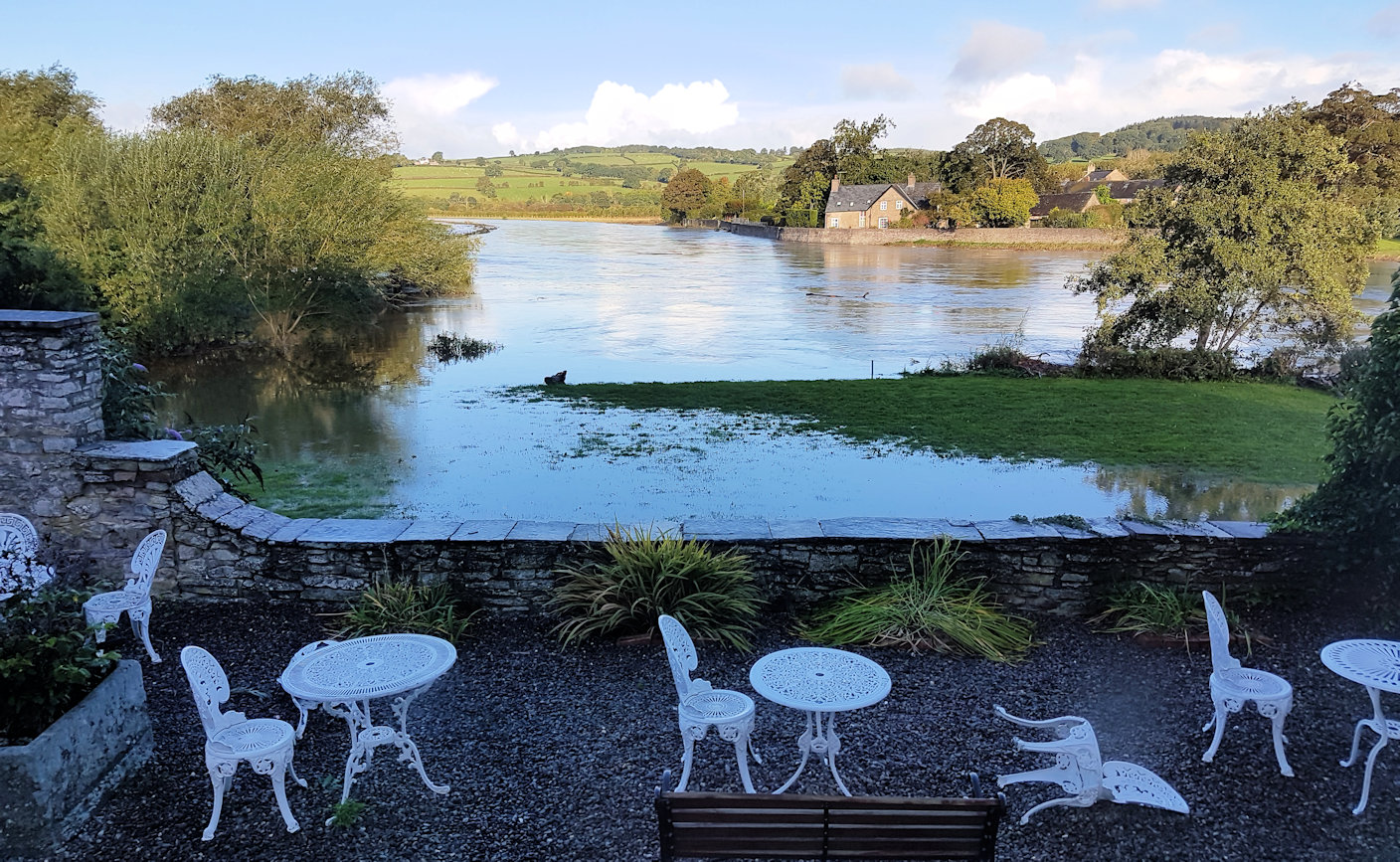
This morning, we saw some of the effect of the storm: the river Wye was somewhat higher than when we arrived, having flooded "the lower field".


The B&B proprietor said the river sometimes flooded that field, in winter, or in spring, but they had never seen it flood in September.


Wednesday, 19 September 2018

view from a car park

We have just arrived in Hay-on-Wye, for a short holiday.  Here is the evening view across the Wye, from the B&B car park.


Monday, 28 March 2016

Mancunicon Eastercon - Monday

The last day of the Mancunicon Eastercon started (after the traditional mushroom-rich breakfast) with a panel on The Deeper the Grief, the Closer to Life?, or “the cheerful panel”, about grief, death, and other forms of loss.  Grief is due to loss; death is the most common loss, but you can be grief-stricken over the loss of a pet, some much loved artefact, or separation from a person or place, or even in anticipation of loss, especially due to slow dying and dementia.  The loss is a loss of a part of yourself, and you have to restructure yourself. Hence rituals for death: funerals, wakes, provide community support.  Revenge is a plot device to avoid dealing with grief.  The classic five stages of grief are: denial, anger, bargaining, depression, acceptance.  SF tries to deny death with immortality or time travel, but this can lead to grief due to the inability to die.  Death is a subtext of all the new Doctor Who.  Much of Tolkien is the world grieving for a lost way of life. Authors can feel loss on finishing writing a book: leaving all those characters behind.

Then our final item was Farah Mendlesohn in conversation with Guest of Honour Dave Clements.  This covered his professional life in astronomy, and his fannish life in conrunning.

We debated whether to stay for a final item, but decided instead to hit the road and drive home.

So, another Easter, another con.  As ever, this one was full of fun, interest, cleverness, and unexpected information.  Next year, in Birmingham!

Sunday, 27 March 2016

Mancunicon Eastercon - Sunday

The first item for Sunday at the Mancunicon Eastercon was a panel on Terraforming Planets and Living in Space in SF, excellently chaired by Helen Pennington, who used a sequence of well-designed questions to move her panelists through an interesting discussion.  The scope gradually increased, from bases in orbit, to the moon, solar system planet, and beyond.  Ian McDonald is taken with the idea of moon bases, because people on earth would be able to look up and see the lights on the moon.  We could try terraforming Venus with earth extremophiles: take a few litres of silt from the deep sea tranches, and see what happens; it could destroy any Venusian life, thereby following a long earth tradition.  The discussion moved on the economics of generation ships, travel between colonies, and how to contain diseases (you can’t).

The panel If You Don’t Scream You’ll Laugh discussed how to blend horror and comedy. There were varied attempts to define both horror and comedy, which led on to a definition of cognitive dissonance.  Both horror and comedy are a tone that can be used in any genre.  By adding a layer of comedy, it is possible to go deeper into the dark, and laughter can be a reaction to unease: black humour is daring the audience to laugh.  Horror can sometime be unintentionally funny when it just gets ridiculous.  Humour is cultural: Americans laugh at Hamlet.

Next came a panel on Book Reviews in the Age of Amazon.  Since I’ve been reviewing (nearly) all the book I read for (nearly) 20 years, I was interested to see what people thought of reviews. One of the panelists writes his reviews for exactly the same reason I write mine: to help us remember what we have read.  The panel drew a distinction between an opinion, a review (a supported opinion), and a critique (a more objective, analytical review).  You don’t have to enjoy, or even read, a book to enjoy a good critique of it.  (So my own pieces range from opinions to reviews, and are definitely not critiques.)  Blog reviews aren’t important for sales: a terrible review in the New York Times will sell more books than a great review on a blog.  But some Amazon reviews are in fact critiques: seek these out; the 1 star and 5 star reviews are telling you what the reviewer thinks; critiques will tell you whether you will like it.

Next was Kari Sperring in conversation with Guest of Honour Aliette de Bodard.  This covered a range of topics from demons in her fictional Paris, to Vietnamese language and cooking.

This segued nicely into a panel on Food, Glorious Food – Cooking in SF&F.  One panelist, describing moving house: I had 120 boxes, 115 were books, half of which were cookbooks; the other 5 boxes were kitchen equipment.  Aliette de Bodard noted that the recipes on her website get as much traffic as her books.  Even when fiction includes food, which it doesn’t often (books can include not a single meal), it rarely talks about cooking it.  There are some earth species that eat infrequently: maybe some aliens eat only once a week?  What about cooking in zero g?  Most cooking techniques rely on gravity.  And, of course: To Serve Man.

After this, it seemed appropriate to round off the day with a nice meal with friends.

Saturday, 26 March 2016

Mancunicon Eastercon - Saturday

Saturday at the Manchester Mancunicon Easter science fiction convention started in the traditional way, with a cooked breakfast including a generous serving of mushrooms.  We then made the mistake of returning to our 4th floor room, to pick up our stuff for the day.  It was a mistake, because the 23-floor hotel has a paltry three lifts and no (usable) stairs.  After a 20 minute wait, seeing lifts fly by, or full lifts stopping, we finally managed to squeeze in one.  But because of this we arrived late for the 10am session (Dave Clements’ talk on How Space Science Happens), to find the room packed to overflowing.  So we went to the Art Show instead.  And didn’t make the mistake again of trying to use the lifts during the day.

So the first talk of the day for us was Rachel Dickinson’s BSFA lecture on Crafting the Future: Ruskin, Textiles and Visions of Futures Past.  As usual at EasterCons, the annual BSFA lecture was excellent.  Ruskin was all about individual making aesthetically good and beautiful choices, particularly through choice of textiles and clothing: a universal interest, for everyone wears clothes, which should be comfortable, functional and attractive.  He contrasted individual-based craft work with the mass produced products of the grim, dark textile mills blighting the landscape around Manchester.  What was fascinating was the reaction of the mill owners: some wrote to Ruskin explaining that they would go out of business, with accompanying loss of employment for their workers, if they followed his approach.  He was aware of the issues, and wanted people to follow the overall picture, if not all the details.  Is this a more realistic vision today?

After the BSFA lecture was the annual George Hay memorial lecture, sponsored by the Science Fiction Foundation.  This year Colin Wright spoke on The Mathematics of Juggling.  Hilarious, brilliant, a technical tour de force (complex juggling while talking!), and with some deep maths to explain the patterns, leading to the deduced need for a time-travelling ball.  He’s going to be a hard act to follow.  The admiration was a two way street: he complimented the audience for getting all his technical and SF jokes.

Next came a talk by Verity Allen, on Designing the Supercomputer for the World’s Largest Radio Telescope.  The radio telescope is the proposed Square Kilometre Array, and it will produce a truly prodigious amount of data: 5 thousand Petabytes/day (1 PB = 1000 TB) initially, then up to 100 thousand PB/day if phase 2 gets built.  This amount of data offers interesting engineering issues, covering input, storage, buffering, memory bandwidth, and processing.  And they need to architect the system for hardware that hasn’t been invented yet.

Then off to hear Ian Whates in conversation with Guest of Honour Sarah Pinborough.  This included discussion of why she went into teaching (the grant was better than the alternative wage) and her pupils’ reaction to being shown The Texas Chainsaw Massacre, her ex-father-in-law coming to live with her while he was dying, and, sometime, her books.  Hilarious and eye-opening.

The Ecology of Doctor Who had Smuzz talking through how stories in Dr Who were alternately mirroring, or pointedly ignoring, a variety of ecological issues happening in mundania, backed by relevant clips (once the technology started working).

And continuing the Dr Who theme, we wrapped up the Saturday with  An Adventure in Time and Space: 53 Years in 53 Rels: the entire Dr Who canon performed by five people in 53(ish) of your earth minutes.  Rib-achingly funny, and clever.  The Reduced Shakespeare Company has a lot to answer for!

Friday, 25 March 2016

Mancunicon Eastercon - Friday

We left our friends to drive into the centre of Manchester to the Easter science fiction convention.  The con is in the Deansgate hotel, which recommended the snappily-named adjacent NCP Manchester Great Northern Warehouse car park for parking, at the special con rate of only(!) £12/day, reduced from the standard £20.50/day.  This car park is accessed from Watson Street.  We discovered there is another Watson Street, in the suburbs, thanks to the sat nav.  So we arrived a little later than planned, but still in good time.

The first session I attended was a panel I was on: the Comma Press sponsored (Don’t) Ask the Scientist.  This revolved around bad science in SF, and whether the author has a responsibility to get the science right.  I caused a minuscule amount of controversy by saying they didn’t – but I did add that they do have a responsibility to be honest.

Next was a panel on Twisting the Story: about the different kinds of plots twists, and how to do them well.  One writer revealed their secret: “I once discovered I needed a twist.  So I went and read the book as it was so far, reading as if I knew author had set up a brilliant twist. And I found one!”

Ian McDonald at Mancunicon
Guest of Honour Ian McDonald was interviewed by Peadar Ó Guilín.  He spoke about how he sets his novels in places where he can go and do tax-deductible research: Brazil, India, and the like. His latest novel is set on the moon…

The panel Revealing History, Revealing Now examined whether the history in historical fantasy or alternate history fiction needs to be right.  (Clearly “being right” is a perennial theme in the SFnal community.)  And if you make a change, particularly to introduce a fantastical element, you need to think through the consequences of that change: it will affect the rest of the world, too.  The important point is that the real history is usually much richer and more diverse and stranger than the history we are taught, and that is enough to make readers think the author has it wrong.  Beware governments who try to control the history curriculum: look carefully at what they want the children to believe about where they and others have come from.

In the evening we had the panel What’s the Worst That Could Happen?, or, good ways to kill a lot of people.  After the panel introduced themselves, they realised a problem: none of the panellists is really an expert in mega-death.  Or maybe that’s not a problem…  The discussion riffed off solar flares, disease, revolutions causing famines, resource exhaustion, asteroids, nuclear war, bioweapons, climate change, ice ages, super-volcanoes, rogue black holes, gamma ray bursts, and Vogons.  We don’t have the ability to reboot civilisation after a global catastrophe, and so we need to colonise space to avoid most of the problems.  Just your standard apocalyptic scenarios, then.

We rounded off the evening watching a session of Whose Line is it Anyway?, with various improvised scenarios.

Thursday, 24 March 2016

to Pluto, and beyond

Before going to the science fiction Eastercon in Manchester, we are staying with some friends. The weather forecast for Thursday was essentially “heavy rain all day” (both the Met Office web site and BBC weather app were in agreement on this), but as we looked out of the window, we saw no rain.  So if we wanted to go anywhere, we needed something that would allow us to dodge possible showers.  Our friends naturally have local knowledge, so suggested Jodrell Bank: it has a visitor centre (sorry, Discovery Centre), and some nice gardens.  We piled into the car.

When we arrived, it still wasn’t raining, so we walked round the radio telescope itself.

the Lovell Telescope

There were some outdoor exhibits, including a pair of large parabolic dishes a 100 metres or so apart.  Speak into one, and you can be heard at the other, as clearly as if you are standing right beside the person.

Around this point we noticed some small metal discs embedded in the grass with the names of  the inner planets by them: I can now say that I have stood on the moon!  These discs were to scale in size: further off we could see Jupiter and Saturn were not metal discs, but large circular flower beds of daffodils.  The discs were also to (a different, much smaller) scale in distance; we knew we would have to walk far to find Uranus and Neptune.  So we strolled off to find the outer planets in the gardens.

We were in for a pleasant surprise:

Pluto on the planet path trail: yay!
And not just Pluto.  As the map shows, Eris is also included.  However, we declined to travel off-path to this particular Trans-Neptunian Object: it was too muddy.

Neptune, Pluto, and Eris: red dots not to scale on the map!
Although it still wasn’t raining, it was definitely cold, so we went into the visitor centre.

a gorgeous room-size hand-crankable orrery:
Mercury, Venus and Earth are visible; the other planets are at the ends of ever longer rods
Then we had a cup of tea, and went to the gift shop, where we discovered that Pluto wasn’t for sale:

Pluto’s been erased
As it turned out, it never really rained all day: excellent weather forecasting there!

Wednesday, 23 March 2016

get thee to a rockery

On our way from York to Manchester, travelling to the science fiction Eastercon via friends, we stopped off at Chatsworth House in the Peak District national park in Derbyshire.  We didn’t go in the house itself, but wandered round the gardens (which I find much more interesting).

The formal gardens have a magnificent cascade.

looking up the cascade

looking down the cascade from inside the folly; the house to the right is covered in picturesque scaffolding
Although much of the house was covered in scaffolding, certain nearly-scaffolding-free views could be glimpsed.

the beech hedge hides the scaffolding
There was a lot of magnificent beech hedging.

beech wibbles off into the far distance

English stately home gardens usually go in for a lot of yew hedging, rather than beech.  Here the yew had its own idiosyncratic style.

I found these somewhat disquieting; they are clearly waiting to pounce
In addition to the cascade, there was a huge kinetic metal water feature, that opened and shut as the water ran through it.

‘Revelation’ kinetic water sculpture by Angela Conner; open state
For all this, the part I liked best was the rock garden.  With big rocks. Very big rocks.

scrambling through the rock garden
looking up at the rock garden
As can been seen from the photos, the gardens haven’t started flowering yet (although there were hosts of daffodils), and the weather was somewhat grey.  Yet the gardens were gorgeous. I’m sure they are stunning later in the year.  And a lot busier.

Tuesday, 15 September 2015

one thousand miles

I’m now back home in the UK, after a lot of sitting in planes.

Here is almost, but not quite, a map of the travelling I did while in New Zealand.


Google maps gives me a “route cannot be modified further”, so I cannot put in the precise route from Dargaville to Whangarei.

Now I didn’t actually drive all of that myself: the trip to Cape Reinga was in a coach.  But hey, I travelled about a thousand miles.  Well, plus the 20 thousand plus miles to get there and back!

I saw so many stunningly beautiful and amazing things.  And yet the map shows how little of the country I actually covered: less than half of North Island, and none at all of the larger (and I am told, even more beautiful) South Island.  Next time…


Sunday, 13 September 2015

Hamilton Gardens

Today was another relaxed day with my friends, breakfasting on duck egg and honey pancakes, chatting, then pottering around their smallholding.  In the afternoon we visited the nearby Hamilton Gardens.  This has a variety of different areas: we explored the Paradise Collection, the Fantasy Collection, and the Productive Collection, leaving the Cultivar Collection for another time (maybe!).

These collections were individual gardens in a variety of styles.  Interestingly, these gardens were not linked by a continuous path, but each was reached through a small "portal" area, which acted like a palette cleanser between one garden and the next.

Google Earth view of the various gardens.  The three "portals" are visible as walled circles (left, centre), and a hedged square (right).  The circular "snail" towards the centre top is the entrance to the entire collection.
First we went to the Paradise Collection, accessed through the square hedged portal.

portal area to the Paradise Collection
panorama: Japanese Garden of Contemplation
view through a ceramic bamboo screen: Chinese Scholars Garden
the 1.4m long, 250kg, bronze Celestial Yuan of Taihu
view down to the Chinese Scholars Garden
a riot of spring colour in the Indian Char Bagh Garden
Italian Renaissance Garden
The Paradise Collection also included an English Flower Garden (which brought it home to me more forcefully that it is barely even spring here at the moment), and a Modernist Garden (hmm, yes, well).

Then it was off to the Fantasy Collection, through its circular portal.

the Tudor Garden -- although it reminded me more of Portmeirion
pavilion: Chinoiserie Garden
There was also a Tropical Garden in this collection, but since I was in sub-tropical rain forest earlier in the week looking at massive trees, I was not as taken with it as the others.  Further gardens are being prepared, including a Surrealist Garden,  We glimpsed parts of this in skeletal form through a hedge; a suitably surreal experience.

Finally, the Productive Collection, through its circular portal.  This portal was rather interesting.

Google Earth view of the portal: there seem to be strange curved lines running across it.
the portal from the ground, showing the various curves in closeup
My friend asked me "do you know what this is?"  I stared at it for a while, and it was the asymmetrical figure eight shapes that gave it away, especially combined with the spike casting a shadow (out of view).  The figure eights look like analemmas, the shape traced out in the sky by the sun at a given time of the day over the year.  Here it's the path of the shadow cast by the sun.  There were three analemmas, for the path traced at noon, and at an hour before and after noon.  The long curves going across the picture are the paths traced by the shadow of the spike over a day, for several different days of the year.  What a wonderful concept!  An it might get incorporated into a future plan for our own garden, to complement the armillary sphere we got a few years back.

Finally, it was the Productive Collection.

traditional Maori productive garden: Te Parapara Garden
The collection included a Herb Garden, Kitchen Garden, and Sustainable Backyard, all interesting ideas, but probably better viewed in the summer, when there is more growing.

Then after dinner, the sky was dark, and clear again, so I went out to gawp at the alien stars. And tonight, it was even darker than yesterday, and I spotted both the Large and Small Magellanic Clouds!  Perfect.