Showing posts with label tiger. Show all posts

Monday, 14 December 2020

the eyes of the tiger

Back several decades ago, Esso had a TV ad with the most breathtaking pictures of tigers, including a fantastic final shot.

I was desperate for a copy of that pic, so actually wrote to Esso.  They were kind enough to send me a poster (I think they had many requests!), but it was the wrong picture.  It was a poster titled “The Cat’s Whiskers”, and was a lovely picture of a tiger, but wasn’t that picture.

The Cat’s Whiskers

Then yesterday we were watching an episode of Neil Brand’s short TV series on the music of TV; the episode was about adverts.  AND THERE IT WAS...

screen shot

That expression!  Those eyes!  “Look on my Face, ye Puny, and despair.”

I did a Google image search, which matched a few eBay sites that only led through to “The Cat’s Whiskers”.  So this fuzzy screenshot is the best I’ve got for now.  But still better than I had. 


Thursday, 23 April 2020

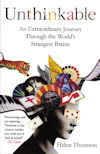
book review: Unthinkable

Helen Thomson.
Unthinkable: an extraordinary journey through the world’s strangest brains.
John Murray. 2018

The brain is amazing, and amazingly complex. One way to learn about how it works is to study it when it goes wrong, or behaves differently from normal. Here Thomson, following in the footsteps of Oliver Sacks, provides multiple different windows onto different brains. Each of the nine main chapters is based on a single person with a particular difference, with a personal conversation, discussion of other similar cases, and some suggestions of what is going on, or not going on, in these different brains.

We get a man with a perfect autobiographical memory, a woman who can’t find her way around (Developmental topographical disorientation), a colour-blind man who sees people with colourful auras (synaesthesia), a man whose personality changed after an electric shock and is now compelled to paint all day (sudden artistic output syndrome), a deaf woman who constantly hallucinates music (Musical ear syndrome, an aural version of Charles Bonnet syndrome), a schizophrenic man who thinks he is a tiger (clinical lycanthropy), a woman completely detached from her feelings (depersonalisation disorder), a man who thought he was dead (Cotard’s syndrome), and a man who can feel what other people feel (mirror-touch synaesthesia). The fact that these disorders have medical names shows that these people are not unique: there is something reproducible and systematic going on here.

The colour-blind synaesthete tale sparks a question. The chapter starts off recounting an experiment demonstrating that people can’t actually see “auras”, and goes on to explain the particular subject’s perception of colours in terms of his synaesthesia. Putting these together: maybe most of those people who claim to see auras aren’t lying, aren’t con artists; maybe they are just mistaken, misinterpreting their own synaesthetic perceptions?

Several of the other chapters make me want to build some sort of unified brain model (I will resist the temptation). This thought initially started on reading Dennett’s Intuition Pumps, which made me wonder if blindsight recognition and Capgras delusion are just two sides of the same coin: emotional and rational perceptions being out of synch. Many of the descriptions here are similar: the brain is a mass of different models – rational, emotional, perceptual, proprioceptual, predictive, generative, and more – and it needs to integrate all of these coherently for “normal” cognition and feeling. If one or more of these models fails to be properly integrated, there appears to be something out of kilter with the world. The brain desperately tries to make sense of these contradictions, and “explains” the situation the best it can, with bizarre consequences. Different models failing to integrate give different problems, helping us understand how they do usually integrate. (So much for simple rational-only models of artificial intelligence.)

So there is much food for thought here, told in an accessible style.


For all my book reviews, see my main website.

Sunday, 9 February 2014

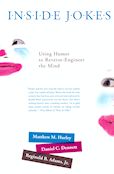
book review: Inside Jokes

Matthew M. Hurley, Daniel C. Dennett, Reginald B. Adams, Jr.
Inside Jokes: using humor to reverse engineer the mind.
MIT Press. 2011

This started life as Hurley’s dissertation, but fear not: it is not some dull stodgy academic treatise. Despite being peppered with jokes, however, it is also not a side-splitting read. It is instead a clearly written in-depth account of the authors’ evolutionary cognitive theory of humour. The overarching argument is (roughly):
  • All our behaviour, including thinking, is guided by emotions: without some emotional prod we would never make any actual decisions.
  • Our emotions have evolved to produce rational behaviours (most of the time).
  • Our thinking and decision-making usually needs to be done in real time: we need to react to the tiger now, not once we’ve finished evaluating all the possibilities.
  • If we reason speedily with limited and uncertain information, we will make mistakes.
  • These mistakes need to be fixed, to stop our mental space becoming clogged up with incorrect inferences.
  • Correcting mistakes is hard work, so we have evolved an emotional "reward": mirth, which we experience when we consciously recognise an unconsciously committed incorrect belief (modulo some further conditions).
  • This emotion, like others, can be exploited to new ends: here, humour and comedy.
This thesis is introduced in the context of an emotional and cognitive model of how we think. Emotion is clearly important in things like “fight or flight”, but also for many other aspects of our life. Certain forms of brain damage that inhibit emotions make it difficult or impossible for those people to make decisions: not because they can no longer reason, but because they have no urge to make a decision. Thinking itself is such hard work, we need emotions to encourage us to do so.
p79. Boredom has its place in driving us out from cognitive malaise. Though curiosity inspires our cognitive apparatus into detailed exertion surrounding particular as-of-yet-unexplained regularities, we would scarcely commence toil at all without the dull pain of boredom to keep us from the simple irresponsibility of just doing nothing. If there is no pressing topic to think about, we still think, and incessantly so, because it hurts not to.
Although we think incessantly, at times we need to think quickly, and to make a decision before we have all the information. There is an evolutionary advantage to literally jumping to conclusions: those that pondered more deeply were eaten. But if we don’t have all the information, inevitably we will make mistakes, no matter how well evolution has honed our conclusion-jumping heuristics into rational emotional behaviours.
p82. Choosing how to behave under uncertainty requires a heuristic choice process. Good heuristics give excellent approximations much of the time. But, in the (restricted-by-design) areas where they fail, they give predictably—even pathologically—poor results. The emotions are rational, but the system is a heuristic driver of behavior that operates on incomplete information; so we must accept that the emotions will fail us in some ways, such as overreactions and addictions, that are irresolvable.
Mistakes can be dangerous, as they will include false information about the world, which later will pollute the very reasoning we need in order to survive. So we have evolved mechanisms to help us correct these mistakes.
p120. The need, then, is for a timely and reliable system to protect us from the risks entailed by our own cleverness. Discerning and locating these mistakes would have the immediate payoff of allowing current reasoning to progress without an error (before we act on such errors), but would also provide a legacy for the future, keeping a fallacious conclusion from becoming registered as verity in long-term memory. A mechanism for consistency checking is indispensable for a system that depends crucially on data-intensive knowledge structures that are built by processes that have been designed to take chances under time pressure. Undersupervised and of variable reliability, their contributions need to be subjected to frequent “reality checks” if the organism that relies on them is to maintain its sanity.
However, this error correction is expensive, and is competing for the same resources that the original thought uses. Something expensive needs some reason to happen. This is the key to the authors’ model: the reason is the evolved reward mechanism of mirth. Sweet foods are not intrinsically “sweet”; we experience them as sweet (a pleasant emotional response) because we are evolved to find them so: sugar was a rare and valuable energy source. Similarly, jokes are not intrinsically “funny”; we experience them as funny (a pleasant emotional response) because we are evolved to find them so: error correction is a valuable cognitive function.

Having introduced their thesis, the authors then subject it to various challenges. It needs to account for the diverse range of things we find funny, and yet should also explain why closely related things are not funny. They do this in considerable detail, picking apart and analysing a wide range of humorous and related event. Of course, picking apart a joke destroys its humour; interestingly, the theory even explains why it destroys the humour.

This is a fascinating and well-argued account of a particular aspect of our evolutionary heritage. Recommended. (Some of the example jokes included are even funny.)


For all my book reviews, see my main website.