Showing posts with label research. Show all posts

Saturday, 23 May 2026

It was 30 years ago today...

 … that my first fully dated item appeared on my website: a review of Clannad’s 1996 tour at the Cambridge Corn Exchange, attended a week earlier.

I blogged about this piece of history 10 years ago.  What's changed since then?

Back in 2016 I was working at the University of York.  I have since retired, although I still have Emerita status there.

To date, on my website I have 623 non-fiction book reviews, 1094 science fiction reviews, and 82 other fiction reviews.  That's about 5 reviews a month averaged over the 30 years, although it had been decreasing, and was particularly low in 2016.  Over the last 10 years, that's a further 189 non-fiction, 250 science fiction, and 7 other fiction reviews, so a reading rate of about 3-4 book per month over that time period.  I hadn't decreased my reading, just my reading of books, as reading research papers took up a lot of my time at York.  There's a visible spike in number of book reviews last year as retirement kicked in, back to the previous rate of 5-6 a month.

There haven't been any major changes in the design of the website, just more material, mostly in terms of reviews, research publications, and solar power statistics.  So, maybe just more of the same in 2036, too?  Let's see!


Friday, 10 October 2025

ALife 2025 day 5

The final day of the conference: it's been a great event.  The day yet again started with some parallel sessions of contributed papers, and I went to the session on Cellular Automata. I was chairing the session, so couldn't take a full set of notes, but I remember the talks being interesting.

Then the final keynote, by Anna Ciaunica, a philosopher, on the importance of embodiment: why we need our toes (and the rest of our body) to think.  We associate the mind with the brain; why not with the rest of the body? Why is the brain not a part of the body? Why do we have a "Brain and Body Institute", but not a "Liver and Body Institute"?  Why do we imagine Mary in her black and white world not understanding seeing red, rather than not understanding eating a red apple?  Why do we have an adult-centric neuro-centric bias, a male embodiment bias?  Think about pregnancy, not just from the mother's point of view, but from the point of view of the embryo: pregnancy is a universal experience, we have all been inside another person.  The opposite of death isn't life, it's birth.  We should think beyond autopoiesis to co-poiesis.  Currently our philosophical tools have been mostly invented by male philosophers.  Consider a parallel world, with a Renée Descartes, who is pregnant.

Well, after that mind-altering experience, it was time for the final boxed lunch.  And then the closing ceremony, bast paper awards, and thanks to everyone!

Next year, in Waterloo! 


Thursday, 9 October 2025

ALife 2025 day 4

The day again started with some parallel sessions of contributed papers: this time I went to some interesting ones on cellular automata and related topics.  Then was the day's keynote, by Blaise Agüera y Arcas, who, with colleagues at Google, is working on in silico ALife ideas.  He related some of their results to ideas of symbiogenesis from biology, with a strong dash of physical processes and lots of tasty equations.

one of Blaise's denser slides

Then another efficient lunch box distribution was followed by two further contributed paper sessions.  Here I chose one on Evolution, followed by one on Morphological computation.  Lots of interesting ideas I need to assimilate.

These were followed by a Panel session, where I was the moderator. I got to interview Emily Dolson, Dominik Chen, and Hiro Iizuka about all things ALife.  I enjoyed it; I hope the panellists and audience did too.

Then a bunch of us went to dinner.

Shop name spotted on the way back from the eatery


Wednesday, 8 October 2025

ALife 2025 day 3

The day started with some parallel sessions of contributed papers: I went to some interesting ones on evolution.  Then was the day's keynote, by Chris Kempes.  He covered a variety of physical constraints on living organisms: physical laws limit what life can be.  Scaling laws, metabolic rates and growth rates, the way proteins are more dilute in larger cells, the physics of the small: these are all consequences of physics, and so may be universal laws.

On to lunch, and then the excursion!  On registration, we were given a choice of several excursions to a variety of local temples.  I had little to guide my choice, except I saw the words "bamboo forest" on one, so chose that.  On the bus on the way there, the guide taught us to count to ten in Japanese (knowing what little I know of Japanese, I expect the reality is much more complicated than these ten little words!)

We walked from the bus park along a road of very touristy shops, to the temple complex.  We went in the main temple, after removing our shoes.  There was a magnificent painting of a dragon on the ceiling, with a gaze that followed you around the room, but sadly, there was also a no photography rule.  After that, shoes back on, we walked through the complex, admiring the outside of buildings, the raked gravel, and the carefully tended trees.

If you look carefully, you can see three guys up in this tree, pruning it. (Click to embiggen.)

We carried on around the garden, to a lovely lake, also carefully curated.  It's just a little too early in the year for the full spectacular autumn colours.

If you look carefully, you can see a big carp in the bottom right corner.

We carried on up around the garden, to a vista point.

Temples below, mountains in the distance, framed by trees. The tree on the right has amazing spikey leaves

spikey

On to the bamboo forest.  I wouldn't want to make my way through that; fortunately there was a nice wide path.

impenetrable
Bamboo is a kind of grass.  A special kind of grass.
a colleague providing a hand for scale

After exiting the forest, we descended back down the valley, and made our way back to the bus via an ice cream shop in the touristy road.  

The bus then took us directly to the conference dinner, held in a huuuuuge and very modern convention building.  We had a delicious buffet, and wonderful conversation.  There was a bus to take us back to the starting point, but the little group I was with decided to walk back down instead.  It made a very pleasant 30 minute stroll on a warm evening to finish off a great day.


Tuesday, 7 October 2025

ALife 2025 day 2

Tuesday, and the full conference gets going.  

We started with a great keynote from Hector Zenil, on using Kolmogorov Complexity measures.  Just because it is uncomputable doesn't mean it is useless.  Most of mathematics is undecidable, but that doesn't stop us using maths!  We shouldn't just give up and use simple lossless compression algorithms. We can do better, and getter better bounds, better approximations, by trying harder and harder (running the search algorithm for longer), which means we can be better at filtering out randomness from things that superficially look random, but that have algorithmic patterns.  It was a fascinating talk.  I've had Hector's book on Algorithmic Information Dynamics on my to-read pile for a while now -- I need to bump it up nearer to the top.

Then on to the contributed papers.  During one of these, on Synthetic Ecosystems, I became one of today's "Lucky 10,000", when I discovered that until relatively recently, Ascension Island was an essentially lifeless desert.  Darwin stopped there on his way home, and decided it needed "greening".  Today, after a lot of work, it has a lush, totally artificial, ecosystem!

The poster session has lots of interesting work on display, including a contribution by my student.  There were also some beautiful "Analogue Atomic Automata": large, carefully grown bismuth crystals, by Solvi Arnold:


In the evening we had a fascinating online keynote from Michael Levin, on biological embodiment, agential material, and bioengineering.  It might have been 8pm for us, but it was 7am for him!  (We live on a sphere.)


Monday, 6 October 2025

view from a Kyoto hotel window

Today was the first day of the Artificial Life conference in Kyoto.  I took the obligatory photo out of my window, then joined my colleague at breakfast.


Then off to find the conference venue, and join the registration queue (at essentially midnight UK time, but I felt fine, having slept reasonably well).  Queuing also involved saying hi to many friends and colleagues I hadn't seen since last year.  This first day was dedicated to workshops. I went to an excellent Neuroevolution tutorial in the morning.  The lunch queue was long, but moved quickly, as pre-packed food boxes were being briskly handed out.  

In the afternoon I went to a workshop on Generative ALife with a wide range of talks.  I was quite fascinated by the various talks using LLMs to implement the very simple agents in Minsky's Society of Mind.  Now, I'm an LLM mega-skeptic: these stochastic parrots are most definitely not "intelligent".  However, the whole point of SoM is that intelligence emerges from lots of unintelligent agents communicating. These researchers are using LLMs as SoM's internal agents, communicating via natural language. There are agents controlling the "mouth", which talks to/at people through a robot avatar; (these conversations still have typical "hallucination" issues), other agents are attached to the "ears", "eyes", etc, and more are just internal agents, making up the whole internal society.  In addition to the transcript of the robot/people conversations, the researchers can also get transcripts of the internal conversations between the internal agents, giving insight into how the agents are interacting to give the resulting output.  I found this an interesting novel use of these devices.

Then a bunch of us went out for dinner.

A great first day!

Friday, 3 October 2025

Towards Origins of Virtual Artificial Life

I have a new paper, "Towards Origins of Virtual Artificial Life: an overview".  This is in a special issue of PhilTransRoySocB, on Origins of Life.  I am also one of the three editors of that SI (but this paper was still properly peer reviewed, handled by one of the other editors, I hasten to add!)  

abstract:

The field of artificial life (ALife) studies ‘life as it could be’, in contrast to biology’s study of ‘life as we know it to be’. This includes a wide range of potential physical substrates, from synthetic biology (new genes), through xenobiology (new amino acids and DNA bases), inorganic chemistry (different structural elements), soft and hard robotics (new kinds of bodies) and also virtual life (existing inside a computer). Since any such life forms are artificial, the originating mechanisms can be similarly artificial, or can attempt to emulate natural mechanisms. Given the wide range of possible substrates and origins, it is crucial to have good definitions, and well-defined ways to detect and measure life, if and when it originates. This overview examines the current state of the art in ALife in defining, detecting and originating its subject matter, with its main focus on virtual life. After discussing common properties of several definitions of life, the overview synthesizes an engineering-focussed definition, in terms of abstract requirements, generic designs and specific implementation mechanisms, and then reviews the current state of the art through this lens. Although virtual ALife that satisfies all these requirements is yet to be exhibited, significant progress has been made on engineering individual mechanisms and, arguably, partially alive systems.

I had fun writing it, thinking about ALife in the context of origins of life.  Given it is artificial life, that implies an artificer, so it has to be an engineering origin rather than a natural origin.  So I get to exercise my Requirements Engineering knowledge.

It's open access, and can be found at doi:10.1098/rstb.2024.0298


Wednesday, 6 August 2025

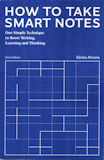
book review: How to Take Smart Notes

Sönke Ahrens.
How to Take Smart Notes: revised edn.
self published. 2022


This book is aimed at students, academics, and any others who need to read a lot of material written by other authors, and build on it, or argue against it, or otherwise incorporate it into their own work. It is based on the approach used by Niklaus Luhmann, the renowned and extremely productive social scientist. He used his Zettelkasten (slip-box) technique, comprising an enormous set of linked notes, eventually numbering 90 thousand, to systematise his sources, thoughts and ideas. (He was also a bit of a workaholic, by all accounts: his success was down to working smarter and harder). He did this with real physical slips of paper (in lots of slip-boxes); nowadays there are many tools such as Obsidian available to do the linking (if not the related thinking).

Ahrens states that “writing is the only thing that matters”, that is, all the rest of the work (reading, note taking, thinking) is for the purpose of writing. This is aimed more at non-experimental subjects, as it does not cover experimenting, but is nevertheless a key aspect of all academic disciplines (publish or perish) and student work (essays and dissertations). It is essentially about the generation and publication of new knowledge. The publication side is important: Ahrens says that there is “no such thing as private knowledge in academia”, that is, secret knowledge isn’t (academic) knowledge. As such, all the rest of the work needs to support the work of writing, and in particular, the prior reading needs to be structured so that its contents can be organised, assimilated, and repurposed for the subsequent writing. Hence taking good notes, and organising them well for later use.

Ahrens spends most of the book discussing the psychology of reading, learning, thinking, and writing. This includes discussion of why the common student practice of highlighting text while reading is almost useless: the reader gets a quick feeling of satisfaction as the line of text become yellow, but nothing much changes in their brain. Note-taking must be an active process: instead of merely highlighting text, make a “fleeting” note comprising the text rewritten in your own words (to force you to think), plus any thoughts it sparks (to make links). Then, soon after writing these fleeting notes, review them, and for ones that still seem worthwhile, make a “permanent” note for the Zettelkasten, and – here’s the crucial bit – link that note to other related notes. (Luhmann had a numerical system to do this by hand; this is where computer support really comes into its own.) The rich network of linked notes provides added value: the “sum of the slip-box contents is worth much more than the sum of the notes”.

Ahrens points out that it is difficult to know what to write about until you have done a lot of reading, and built up a mental database of the subject area. The topic of the to-be-published essay, thesis, or book, emerges from the linked structure of notes in your Zettelkasten. So it is important to review its contents continually, to notice emergent clusters, and hence potential topics. This may be one place where physical notes are better: they can be removed from the box, placed on a table, and moved around to form a structure for the writing. Returning them to the box in the correct place (imagine misfiling one of your 90,000 notes: it would be gone forever!) is presumably a bit of a chore.

There is a lot of good material here, from the theory of learning to practical advice for choosing and working on projects. One thing missing is specific examples of notes and their links: there are some example notes from Luhmann’s own Zettelkasten, but these are so compact and densely written, that it is hard to extract the principles from them. Never mind, the web comes to the rescue: the Zettelkasten site has great examples and advice.

I have started using this approach, and have already made one link between parts of my reading that I probably wouldn’t have thought of otherwise. I doubt whether I’ll ever get up to 90,000 notes, but I intend to keep reading, and thinking, in this new way.


For all my book reviews, see my main website.

Wednesday, 23 July 2025

goodbye MARCH

I've been up in York for the last couple of days, visiting colleagues, discussing projects, and, sadly, saying goodbye to MARCH, an EPSRC funded-project involving York and Sheffield, which has been running since February 2021.  It started during lockdown!  The amazing team has done some wonderful work, with some more publications still in the pipeline, and we'll be sad to see it finish.  But there are many follow-on irons in the fire, so it's not really the end.

On my way home this evening, my train passed through March station.  So this felt like an appropriate photo: March in the distance, with a ghostly me in the foreground!


Thursday, 10 April 2025

views from two hotel windows

I travelled up to Glasgow yesterday, via Edinburgh, for a project team meeting the day before a workshop we ran today, in Edinburgh.  So yesterday evening I travelled back from Glasgow to Edinburgh, to overnight here before the workshop.

A nice sunny morning in Edinburgh. 
Some reflection of the double glazing, which was a foot deep and not openable.

We held the workshop -- about 20 people discussing quantum optics and photonic computing -- and then the team travelled back to Glasgow, ready for a project debrief tomorrow (to be followed by me travelling home in the afternoon, via Edinburgh).

A nice sunny evening in Glasgow.


Sunday, 23 March 2025

Engineering Persuadable Matter

My latest publication, commenting on a paper about agential chemistry, from my own computational perspective.  This topic falls in the intersection of Artificial Life and Unconventional Computing, forming a research area I am intensely interested in.

Susan Stepney. Engineering Persuadable Matter: A Comment on Armstrong’s ‘Life, Mind and Matter’. Social Epistemology Review and Reply Collective, 14(3):33-42, 2025.

Rachel Armstrong (2024) advocates for a new approach to ‘agential chemistry’, a form of ‘new materialism’ that allows matter to take an active role. Here I comment on some of these ideas through a computational lens: the consequences if agential chemistry can perform computation to advance its own agenda; how it might provide the structure and dynamics needed for computation, and the metadynamics for open ended systems; and how it opens the possibility of a new technological discipline of engineering ‘persuadable’ agential matter.


While searching for an image to use to spice up this post, I came across an interesting Medium piece that forms a nice overview of some of the issues, from a neural AI perspective.  And has the pretty image I use above (click to embiggen). 


Saturday, 15 March 2025

Reservoir computing benchmarks: a tutorial review and critique

Our latest paper, reviewing a bunch of standard benchmarks for Reservoir Computing, digging into their histories, and why some of them might not be the best approach to be using.

Chester Wringe, Martin Trefzer, Susan Stepney. Reservoir computing benchmarks: a tutorial review and critique. International Journal of Parallel, Emergent and Distributed Systems, 1-39, 2025. doi:10.1080/17445760.2025.2472211

Reservoir Computing is an Unconventional Computation model to perform computation on various different substrates, such as recurrent neural networks or physical materials. The method takes a ‘black-box’ approach, training only the outputs of the system it is built on. As such, evaluating the computational capacity of these systems can be challenging. We review and critique the evaluation methods used in the field of reservoir computing. We introduce a categorisation of benchmark tasks. We review multiple examples of benchmarks from the literature as applied to reservoir computing, and note their strengths and shortcomings. We suggest ways in which benchmarks and their uses may be improved to the benefit of the reservoir computing community.

If you don't subscribe to that journal, you can find the same text (if not as prettily typeset) on the arXiv, at   arXiv:2405.06561 [cs.ET]


Tuesday, 18 February 2025

view from a hotel window

I'm in Glasgow, visiting some colleagues at the University of Strathclyde, for our new LoCoMo project that started after I retired!  Yesterday afternoon we had a good chat about a paper (from a different project) that has been stalled since pre-Covid times, and figured out how to solve the issue.  I have been tasked with writing the new section we agreed on, as I now have the time!  Today we talked about the new project.  Tomorrow I'm looking forward to a lab tour, to see what the experimentalists are up to in quantum computing with Rydberg atoms (we are doing some vaguely related theory, but looking at cool kit is always fun).

Meanwhile, this is the view from my hotel room window (nice hotel: very quiet!)


Monday, 6 January 2025

Raman SOM

Daniel West, Susan Stepney, Y. Hancock.  Unsupervised self-organising map classification of Raman spectra from prostate cell lines uncovers substratified prostate cancer disease states.  Scientific Reports, 15:773, 2025. doi:10.1038/s41598-024-83708-6

This started out as a feasibility study, to see if Kohonen Self-Organising Maps (SOMs) could be used to cluster minimally preprocessed Raman spectroscopy data taken from individual cells.  SOM an unsupervised learning approach, and can cluster high dimensional data (here, over 1000D) down into a 2D visual representation.  We had Raman spectra of prostate cells, some cancerous, some not.  Could a SOM distinguish these two classes?

We blinded the data, so that the system did not know which spectrum was in which class, to ensure this was truly an unsupervised exercise.  After some fiddling about to understand what values several parameters should be, we fed the data in, and looked at the resulting map.  We could see three clusters.

Had it worked?  We unblinded the data, and yes, one of the clusters was the non-cancerous cells, and the other two clusters were cancerous cells.  Why two clusters?  Well, it turns out the mapping process had managed to discover two distinct classes of cancerous cells.  Further research is underway to investigate these differences.

So yes, it works, and better than we had hoped!


Monday, 16 December 2024

view from a hotel window

I've just arrived in Dublin for a project meeting.  Yes, I know I'm supposed to have retired, but I'm finishing off a few existing commitments ... before I start some new ones.

This will be our last trip to Dublin on this particular project, so we need to wrap up who's writing which paper, have a nice meal, and say goodbye to some great colleagues.


Saturday, 16 November 2024

Physical reservoir computing: a tutorial

Susan Stepney. Physical reservoir computing: a tutorial.
Natural Computing, 2024. doi: 10.1007/s11047-024-09997-y

A decade ago (I was going to write "a few years ago", then looked at the date!) my colleagues and I wrote a paper entitled "When does a physical system compute?", which gives a framework to distinguish systems that are computing, from ones that are just doing their thing.

Recently, I was invited to write a tutorial for Natural Computing on Physical Reservoir Computing.  That's about using weird physical materials, like a glob of carbon nanotubes, or a sheet of magnetic material, or whatever, to compute directly, according to the "reservoir computing" model, which is a form of neural network.

I decided to use the framework we previously developed to structure the tutorial.  This framework provides five things you need to consider: (1) the abstract computational model, here, reservoir computing; (2) the physical computing substrate, here, the purported reservoir computer; (3) how to encode abstract inputs and physically inject them into the computer; (4) how to observe physical outputs and decode them to abstract results; (5) and last but certainly not least, how to validate that the physical system is faithfully implementing the abstract model.

If you want to see more of the details, have a look at the paper: it's open access.


Saturday, 2 November 2024

retired

As of yesterday, I am officially retired, and now Professor Emerita at York.  The "Emerita" status grants me facilities that will help me continue to do research more readily: I keep my IT account (email, cloud storage, Overleaf, PaperPile, ...), library access, and a form of affiliation with the University.  In exchange, they get to claim any publications of mine as associated with them.

So what did I do on my first day of official retirement? Well, I went for my daily walk, and got a bit of a fright.  But the rest of the day I spent on zoom, on an interview panel.  A colleague and I recently won an Aria "Nature Computes Better" project called LoCoMo (Lossy Computational Models).  This was submitted before I had decided to retire, and awarded after.  As Emerita, I can still work on the project ... for free!  Yesterday we were interviewing for the two PostDocs.

So, starting as I mean to go on!


Wednesday, 23 October 2024

view from a hotel window

I'm in Sheffield for G2W: Genomics to Whole Cell workshop, being run as part of our TORC EPSRC-SFI research project.  This will be my last project workshop before I retire, and it should be very informative. 

the hotel has nice grounds


Wednesday, 2 October 2024

exaugural lecture

I'm retiring at the end of the month.  I'm planning an "academic retirement", in that I want to spend more time with my research.  Here's a recording of the talk I gave today describing the area in which I wish to do more work.