The garden is looking gorgeous at the moment


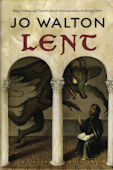
Girolamo Savonarola was a Dominican friar who preached in Florence, and was burned for heresy in 1498. Nearly the first half of this novel is the story of the six years leading up to this event, with the only fantasy overtones being that Girolamo can see and cast out demons. The novel makes him a sympathetic character, rather than the somewhat puritanical zealot of history. But on his execution, the novel takes a highly unexpected turn. For this Girolamo Savonarola is not human.
For me, the story got much more interesting once the fantasy aspects are foregrounded. As I said, that’s nearly half the way through. Up until then, it can be read (apart from the demons) as a relatively straightforward dramatisation of an historical figure. This is well done, but not my usual fare; however, I like Walton’s work, so I persisted. And it was worth the wait.
The rest of the book, which I can’t describe without massive spoilers, has the same historical feel, although the context has changed dramatically. It gives a wonderful view of life in Italy at this time, through a fantastical lens, and keeps you guessing until the end. I thought the ending was very slightly rushed, but everything fit together perfectly.

In the near future, genetic engineering has led to bioforms, animals with increased intelligence, size, and strength, bred for war. They have embedded obedience chips, so they can’t go rogue. But what happens when they are obedient to a war criminal? Who is to blame for their actions? Will a terrified public demand they be destroyed? How can they fight for their freedom without terrifying the public even further?
This is an excellent view inside the minds of uplifted beasts, told from the point of view of Rex, a dog-form, in charge of a group that includes a bear that is rather more intelligent that she should be, a giant lizard who prefers lying in the sun to shooting enemies, and the hive-mind Bees. There are lots of plot twists just when you think you know how things will play out, and a view of humanity whose only salvation may lie in the hands, or paws, of its own creations.
The latest batch:

Our new paper published today:
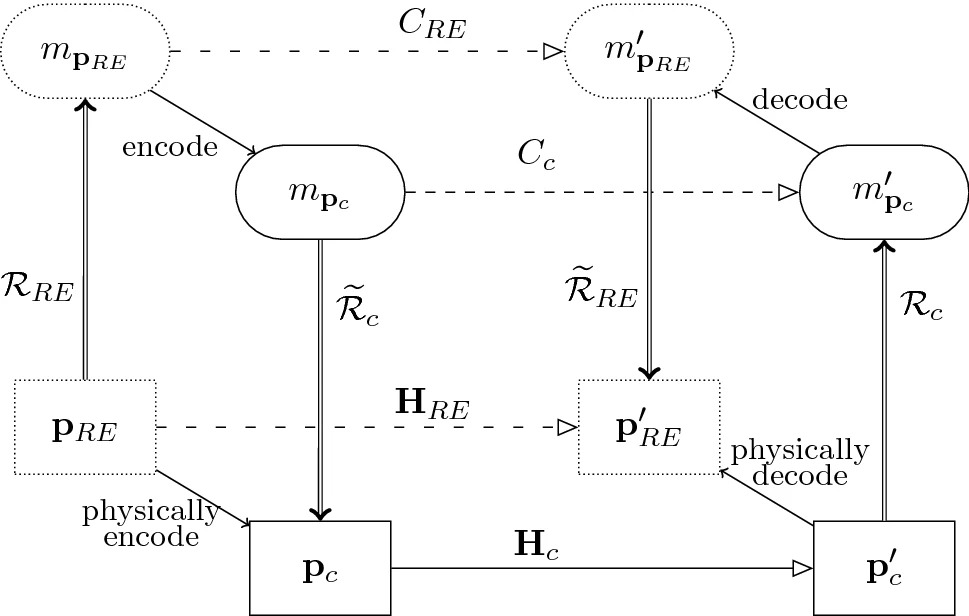
Susan Stepney, Viv Kendon.Many systems are claimed to compute, from spaghetti, to slime moulds, to the universe itself. But how can we tell if a system is computing, or just “doing its thing”?
The representational entity in physical computing
Natural Computing, (online), 2020
Abstract: We have developed abstraction/representation (AR) theory to answer the question “When does a physical system compute?” AR theory requires the existence of a representational entity (RE), but the vanilla theory does not explicitly include the RE in its definition of physical computing. Here we extend the theory by showing how the RE forms a linked complementary model to the physical computing model. We show that the RE does not need to be a human brain, by demonstrating its use in the case of intrinsic computing in a non-human RE: a bacterium..
Our new paper published recently:
Penelope Faulkner Rainford, Angelika Sebald, Susan Stepney.
MetaChem: An algebraic framework for Artificial Chemistries
Artificial Life Journal, 26(2):153–195, 2020
Abstract: We introduce MetaChem, a language for representing and implementing artificial chemistries. We motivate the need for modularization and standardization in representation of artificial chemistries. We describe a mathematical formalism for Static Graph MetaChem, a static-graph-based system. MetaChem supports different levels of description, and has a formal description; we illustrate these using StringCatChem, a toy artificial chemistry. We describe two existing artificial chemistries—Jordan Algebra AChem and Swarm Chemistry—in MetaChem, and demonstrate how they can be combined in several different configurations by using a MetaChem environmental link. MetaChem provides a route to standardization, reuse, and composition of artificial chemistries and their tools.