Sunday, 20 September 2020

bacteria computing in cubes

Our new paper published today:

Susan Stepney, Viv Kendon.
The representational entity in physical computing
Natural Computing, (online), 2020

Abstract: We have developed abstraction/representation (AR) theory to answer the question “When does a physical system compute?” AR theory requires the existence of a representational entity (RE), but the vanilla theory does not explicitly include the RE in its definition of physical computing. Here we extend the theory by showing how the RE forms a linked complementary model to the physical computing model. We show that the RE does not need to be a human brain, by demonstrating its use in the case of intrinsic computing in a non-human RE: a bacterium..
Many systems are claimed to compute, from spaghetti, to slime moulds, to the universe itself.  But how can we tell if a system is computing, or just “doing its thing”?

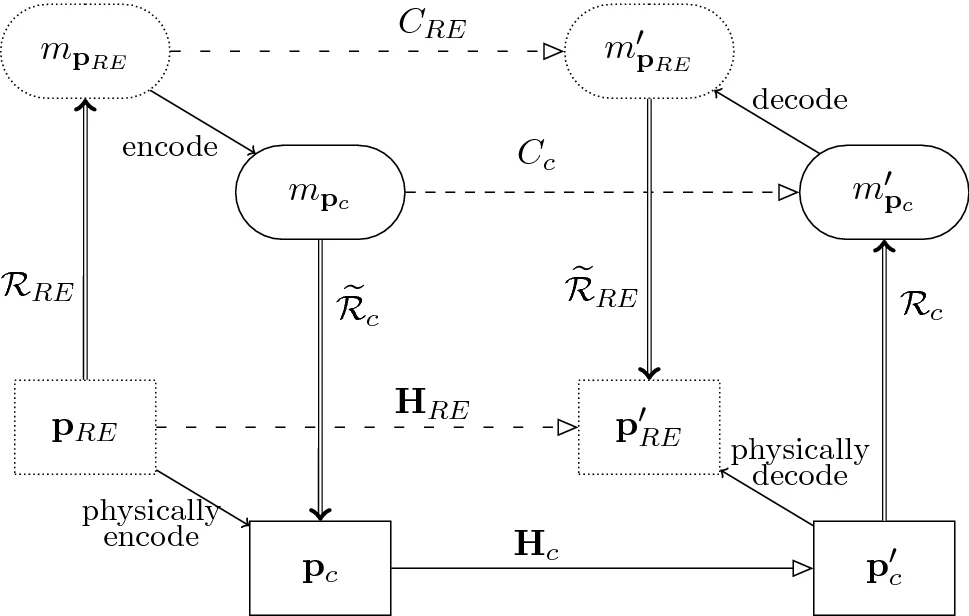
We have been working on the snappily named “abstraction/representation theory” for a while to clarify this issue.  In a nutshell, one part of the requirement for a system to be computing is that what it is doing has to represent something else in the world.  And that representation is in the eye of the (also snappily named) repesentational entity (RE) that is using the computer.

Up until now, our definitions have only referred to the RE, but not included it in the overall model.  No longer.  Here, we add the RE to the model, which adds a new dimension, and the definitoin moves from requiring a commuting square to a commuting cube.  (See the paper for lots more pictures of these cubes...)


Sunday, 30 August 2020

shepherds are delighted

looking NW, at 20:02BST


Sunday, 23 August 2020

Artificial glassware for artificial chemistries

 Our new paper published recently:

Penelope Faulkner Rainford, Angelika Sebald, Susan Stepney.
MetaChem: An algebraic framework for Artificial Chemistries
Artificial Life Journal, 26(2):153–195, 2020

Abstract: We introduce MetaChem, a language for representing and implementing artificial chemistries. We motivate the need for modularization and standardization in representation of artificial chemistries. We describe a mathematical formalism for Static Graph MetaChem, a static-graph-based system. MetaChem supports different levels of description, and has a formal description; we illustrate these using StringCatChem, a toy artificial chemistry. We describe two existing artificial chemistries—Jordan Algebra AChem and Swarm Chemistry—in MetaChem, and demonstrate how they can be combined in several different configurations by using a MetaChem environmental link. MetaChem provides a route to standardization, reuse, and composition of artificial chemistries and their tools.

Artificial chemistries – computational systems that link together abstract ‘molecules’, inspired by the way natural chemistry operates – are fascinating ways to explore the growth of complexity, and underpin some aspects of Artificial Life research.  Most AChem research focusses on designing the molecules and reactions of the artificial system.

We have been working at the level of the artificial ‘glassware’: the system whereby different molecules are brought together under different conditions.

Our new paper explains how this MetaChem system works, and how it can be used to underpin essentially any artificial chemistry – it can even use whole chemistries at one level to be the molecules at another level.

The python code is available on GitHub for anyone to use in their own AChem systems.

Sunday, 2 August 2020

TV review: Devs

Beautiful nonsense

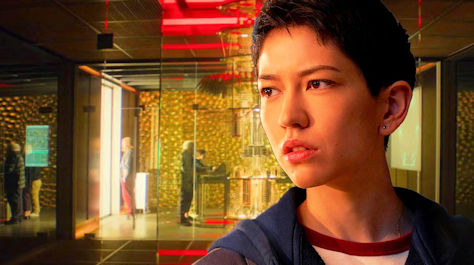
Lily Chan and her boyfriend Sergei Pavlov are software developers at the high tech Amaya company in San Francisco. Sergei is reassigned to the secretive Devs project, disappears, and then security video of his suicide turns up. Lily is initially distraught, but then suspicious. She starts to investigate, and discovers the Sergei was murdered when he tried to steal Devs code. Her own life is at risk as she works to discover what the Devs project is actually trying to do.

The whole premise is bonkers. SPOILER: the Devs team are developing quantum computer code that can retrodict the past from the current state of the world. (It can also predict the future, but the team are forbidden to use it to do that. Yeah, right.) My first snort of derision was when Sergei asks how big the quantum computer is, and Forest answers “a number that it is meaningless to state”, while they are looking at a machine that has about 50 qubits in the real world.

At one point we see a crystal clear rendition of an episode from tens of thousands of years in the past. This is, of course, all impossible, for so many technical reasons. At another point one of the team asks Lily to name something that in not determined by something earlier: everything she says is refuted. The one thing she doesn’t suggest is Schrödinger’s cat, or some other quantum process. (And even if we ignore quantum mechanics, the very technology central to the plot, we know that chaos means that even a deterministic system can’t necessarily be predicted, or retrodicted, because of sensitive dependence on initial conditions. Okay, I’ll stop the dynamical systems lecture now…)

Also, everyone works on the assumption that the computer’s predictions of the future (because, yes, of course they do use it for that) are inevitable. There’s a scene where the predictions are running a couple of seconds ahead of a group of people watching the prediction; no-one even tries to do something different. Lily, apparently, is the only person who can do something different from the prediction. It all ends nonsensically in a computer simulation.

So why do I say it is “worth watching”? Because the slow calm pace (even of a couple of murders!), the beautifully shot soft, rich, misty San Francisco, the amazing soundtrack, all add up (even with occasional shouting at the screen) to a dreamily beautiful experience.

Even if the premise is bonkers.


For all my SF TV reviews, see my main website.

Friday, 10 July 2020

book review: Because Internet

Gretchen McCulloch.
Because Internet: understanding how language is changing.
Vintage. 2019

Linguists study language in all its forms. Spoken language is the primary form, but written language is also of interest. Whilst most spoken language is informal, spontaneous, conversational, most written language is formal, studied, edited. Well, that was the case until the internet, with the explosion of informal writing in emails, texts, chats, and so on. This has provided linguists with a rich resource, with no recording and transcription required. McCulloch’s book covers a wide range of investigations into this informal internet language, and how it has been changing over time.

McCulloch explains why a full stop at the end of a text appears passive-aggressive, the evolution of emojis and why they aren’t a language, why the internet has enabled videophones when previous attempts failed, and multiple other fascinating insights into this new form of language.

This isn’t the post-literate world; this is a differently literate world. Because Internet.


For all my book reviews, see my main website.

Thursday, 9 July 2020

book review: Adam's Task

Vicki Hearne.
Adam’s Task: calling animals by name.
Akadine Press. 1986

This is a book about taking domesticated animals seriously: training them, respecting them, and treating them as creatures with their own complex, non-human internal lives. It provides a deeply fascinating account of how domesticated animals relate to humans, and of our responsibilities to them. It is mostly about mostly dogs and horses, told through a series of in-depth stories of particular animals Hearne has trained, plus a chapter on how different cats are.

It is also a book about building a philosophy of communication with domesticated animals. No behaviourism or anthropomorphism or sentimentality, but instead a deep understanding of their existence and differences.

This is a difficult book to summarise, but it is an engrossing read. I was completely hooked, and devoured it in just two sittings. It is an inspiring view into minds simultaneously alien, and yet co-evolved with our own, so that we can communicate meaningfully, if we take the time to learn how.


For all my book reviews, see my main website.