The latest batch:

The latest batch:
We have solar PV and a battery. If sunny, we can use the PV during the day and export any excess. We can charge the battery overnight on cheap rate (6.4p/kWh) for use during cloudy days and in the evenings, when power is more expensive (24.2p/kWh). We can also charge the battery off any excess production during the day. And we have an electric car, which we can charge off excess production, or off the grid.
Up until now, we have been trying to balance things so that we minimise our import from the grid. This means charging the battery as much as possible off excess generation during the day, only topping it up overnight if needed, and even using it all through the night if it has enough charge. In the winter, this means we have been charging it overnight, but in the summer we have been using it all through the night, and charging it off excess during the day, therby having essentially no grid import at all.
This is all well and good, but there are two issues. First, and most complicated, is that we need to know how much sunshine there will be tomorrow in order to know whether to charge overnight or not. We have been making this decision manually, because the automatic system is not very good at predicting the weather. This is better than the automatic system, but it doesn't always work, and in early March this year we didn't charge one night when the weather forecast promised sun the next day, but the sun never appeared. This meant the battery went flat mid evening and we had to import from the grid at the expensive rate. This cost us about £1, so, more irritating than anything else.
The second, and more economic point, is that overnight grid power on our current tarrif costs 6.4p/kWh, whereas we are paid 15p/kWh for export. This means that it makes financial sense to charge the battery (and the car) on cheap overnight electricity, and export all the excess during the day. That feels wrong, somehow, because we are using more grid electricity than we need to. But, presumably, the electricity company prefers to provide us electricity at night, and use ours during the day. We can timeshift, at a profit.
So we have started a new PV/EV strategy. From late March we have started charging the battery and car, and using grid power, overnight, then exporting all surplus generation during the day now that we are no longer charging the battery off the PV. We'll try that for the rest of the year, and have a look at the various bills to see if it makes any significant financial difference. It is certainly easier to "program": we just set and forget.
The latest batch:

If you follow my book reviews over on my website, you may have noticed several reviews for Great Courses lecture series. Each course is 12-48 lectures, on DVD, accompanied by a coursebook. These make great watching while, say, eating lunch. We wait until interesting courses are on special offer, and have watched many of these, from science and economics to literature and history.
Recently, Great Courses decided to discontinue several of their DVDs, leaving only streaming options. We dislike this, so have bought up a load of cheap courses while they are still available. These should last us a while!

The latest batch:

The latest batch:

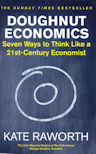
Modern economics is clearly not fit for purpose. It is based on false axioms like unbounded rationality, and individual optimisation. It is too narrow a model, not including many important and linked systems, like the family, the state, and the biosphere. It requires continual exponential growth, which is physically impossible, and is destroying the planet. And its predictions have been repeatedly falsified, from repeated financial crashes to ever-increasing wealth inequalities. So what to do?
Raworth lays out a plan for a better economics, based on the visual image of the doughnut. The outer edge represents an upper level of activity, beyond which activity is unsustainable, due to climate change, biodiversity and habitat loss, pollution, etc. And the inner edge represents a baseline activity, below which people cannot thrive: the need for food, water, shelter, healthcare, education, equality, justice, etc. (I would have liked some acknowledgement that it is necessary to demonstrate that the inner edge is indeed inside the outer edge!)
The doughnut forms a useful image to illustrate the goal of the new economics; Raworth then carefully unpicks the requirements to achieve this, identifying seven facets of the new approach. Each chapter digs into a particular facet, such as the goal of economics, the need for systems thinking, the issue of growth, and more. Starting with a brief review of the historical development of the current theories, Raworth shows how they came about, how that often the originators emphasised they were mere approximations or idealisations, yet that they have subsequently come to be been set in stone. This background serves to demonstrate that changing the models is not somehow going counter to some established truth, but is rather correcting old fundamental errors. So next Raworth outlines how to correct the errors, giving a new model and new requirements. And just when each chapter gets to the point where you are thinking “yes, this is all very well and good, but it would never be possible to make that change”, Raworth gives examples of how that change is already happening in certain (albeit often small and local) cases.
So this is informative, constructive, and hopeful. Everyone should read it, and act on it.
The latest batch:

The latest batch:

The latest batch:

The latest batch:


How the Boeing 737 Max Disaster Looks to a Software Developer
So Boeing produced a dynamically unstable airframe, the 737 Max. That is big strike No. 1. Boeing then tried to mask the 737’s dynamic instability with a software system. Big strike No. 2. Finally, the software relied on systems known for their propensity to fail (angle-of-attack indicators) and did not appear to include even rudimentary provisions to cross-check the outputs of the angle-of-attack sensor against other sensors, or even the other angle-of-attack sensor. Big strike No. 3.
I believe the relative ease—not to mention the lack of tangible cost—of software updates has created a cultural laziness within the software engineering community. Moreover, because more and more of the hardware that we create is monitored and controlled by software, that cultural laziness is now creeping into hardware engineering—like building airliners. Less thought is now given to getting a design correct and simple up front because it’s so easy to fix what you didn’t get right later.
It is likely that MCAS, originally added in the spirit of increasing safety, has now killed more people than it could have ever saved. It doesn’t need to be “fixed” with more complexity, more software. It needs to be removed altogether.


