The latest batch:
Sunday, 26 January 2025
Wednesday, 25 December 2024
sequestering carbon, one Christmas at a time XII
His'n'hers Christmas presents (oh, there was also a soldering iron and mat, but they're not books...)
Friday, 13 December 2024
sequestering carbon, several books at a time CXLVI
If you follow my book reviews over on my website, you may have noticed several reviews for Great Courses lecture series. Each course is 12-48 lectures, on DVD, accompanied by a coursebook. These make great watching while, say, eating lunch. We wait until interesting courses are on special offer, and have watched many of these, from science and economics to literature and history.
Recently, Great Courses decided to discontinue several of their DVDs, leaving only streaming options. We dislike this, so have bought up a load of cheap courses while they are still available. These should last us a while!
Wednesday, 4 May 2022
view from a hotel window
I flew into Dublin this evening, for a meeting at TCD tomorrow: it’s for our new joint research project between computer science, physics, and microbiology, on DNA supercoiling. Watch this space!
The view isn’t particularly scenic, but the weather this evening is very nice.
Amusingly, I discovered that the hotel I'm staying in is literally next door to the one we stayed in for the Worldcon in 2019. However, this one is very electronic: lots of mysterious black touch panels. I’m not entirely sure how the lights work:
Once I figure out how to turn them on or off, I’m off for dinner with my colleagues.
Wednesday, 31 October 2018
view from a hotel window
And all set off by a glorious view of a frosty autumn morning:
Thursday, 18 May 2017
Semantic closure
Our “media friendly” summary is:
The ‘meaning’ of DNA lies in the act of translating a DNA sequence into a protein sequence. The mapping of DNA to proteins is identical in nearly all species, but some species have evolved alternative mappings. A new computer model uses an artificial chemistry to investigate evolutionary changes in these mappings, where the translating apparatus is encoded in the DNA and governs its own translation. As well as reproducing the known evolutionary mechanism of changing the meaning of DNA, the model predicts a novel mechanism for changing the mapping in biology that is not detectable by phylogenetic DNA sequence analysis.Our slightly less friendly paper abstract is:
Abstract: We present a novel stringmol-based artificial chemistry system modelled on the universal constructor architecture (UCA) first explored by von Neumann. In a UCA, machines interact with an abstract description of themselves to replicate by copying the abstract description and constructing the machines that the abstract description encodes. DNA-based replication follows this architecture, with DNA being the abstract description, the polymerase being the copier, and the ribosome being the principal machine in expressing what is encoded on the DNA. This architecture is semantically closed as the machine that defines what the abstract description means is itself encoded on that abstract description.We present a series of experiments with the stringmol UCA that show the evolution of the meaning of genomic material, allowing the concept of semantic closure and transitions between semantically closed states to be elucidated in the light of concrete examples. We present results where, for the first time in an in silico system, simultaneous evolution of the genomic material, copier and constructor of a UCA, giving rise to viable offspring.This is one of the key findings:
![]() |
| Figure 6. Semantic change without mutation of the genome. |
The paper is open access and can be found at doi:10.1098/rsif.2016.1033.
Wednesday, 13 July 2016
UCNC day 3
We started with a super invited tutorial on “Self-Assembling Adaptive Structures with DNA”, by Rebecca Schulman. Rather than trying to assemble arbitrary structures, let’s just look at what can be done with 1D systems: filaments of DNA nanotubes than can controllably be built into strings, trees, and network structures. She pointed out that it doesn’t make sense to build every structure from weaving pure DNA: a human-size object would need about 3 light years of it. But smaller things can sensibly be built this way. This approach doesn’t include only static structures: movement can be achieved by growing at the front and dissolving at the back. This is the way the cytoskeleton in cells works to move them around. DNA nanotube growth can be controlled by a variety of chemical processes, but it’s hard to design different systems: there’s no good enough model or simulation of how it all works. Currently things are a mixture of approximate yet expensive simulations, and lab experiments. But this is clearly a very powerful and rich area.
This was followed by the technical session: three talks related to DNA computing. The first was implementing a circuit model in a 2D gellular automaton. Next was another gellular automaton system: a maze solver. We finished the morning with a description of implementing a stack (the push-pop data structure) in DNA: the design is fascinating, and it has been implemented, at least for stack sizes of three. Again, this work is just a hint of things to come.
Then off to explore the wilds of Manchester…
Tuesday, 12 July 2016
UCNC day 2
First up was Masami Hagiya with an invited tutorial on “Gellular Automata”. These are a form of cellular automata implemented using gels and chemical reactions. The walls between cells can be “decomposed” or “composed” using chemical reactions – or instead can “swell” or “unswell” forming a valve. This allows chemicals to move between cells. There are theoretical results demonstrating these systems can in principle implement certain kinds of CAs. The tutorial moved on to talking about implementations. Most of the manipulations involve a form of DNA chemical computing: using complementary strands to form networks of polymers, or to control diffusion by attaching anchors. These processes can be controlled by the DNA technique of “strand displacement” that breaks the bonds between the complementary strands. There are some initial prototype implementations. These are still rather complicated, needing multiple chemical species to implement relatively simple state transitions. However, it is early days yet, and more efficient approaches may well be discovered.
Next was the workshop on Membrane systems (mostly P-Systems). Rudolf Freund started off with a tutorial, helping to introduce the concepts to people not that familiar with the area. Then on to the technical talks, covering a wide set of membrane computing topics.
Finally was the afternoon technical session. We started with a talk on Affine Automata: these use an underlying logic that is partway between classical probabilistic automata and quantum automata. Next was a talk about languages (sets of strings) arising from finite walks on Sierpinsky gaskets. And finally we had a talk on Matrix Ins-del (insertion deletion) systems (although I think a better name would be List Ins-del systems). These three combined nicely as a range of different ways of looking at language (in the CS sense) recognisers.
Then off to The Great Wall Chinese restaurant, for a very nice duck in ginger.
Wednesday, 6 August 2014
how long is a piece of DNA?
This is easy to check. Wikipedia says that one nucleotide [or base] is 0.33 nm long. The same page also says that human have “3 billion base pairs of DNA arranged into 46 chromosomes”. However, other sites say that the 3 bn base pairs is the genomic contents of the 23 individual chromosomes. (This demonstrates the value of checking several sites; I also checked the 0.33nm in other places.) Since you have two copies of these chromosomes in most cells, that makes 6 bn base pairs all together. And 0.33 nm × 6 bn = 2m.
That seems ridiculous: cells are too small to see with the naked eye, so how can there be a 2m long string of DNA inside?
Well, DNA is really really thin. Wikipedia says the width of a DNA chain is 2.2–2.6 nm (and this number is confirmed elsewhere; you can check). Assuming the chain is a cylinder, and taking a mid value of 2.4 nm, this gives a volume of 2m × Ï€ × (1.2 nm)2 = 9 × 10⁻¹⁸ m3, or (2 × 10⁻⁶ m)3, that is, a cube of side 2 microns. That can fit in a cell, all folded up.
I’ve known this 2m fact for several years. I’ve also known that there are over a trillion cells in the human body. What I’d never done, until challenged by a colleague recently, was put these two together, to calculate the total length of DNA in the human body, with 2m in each of those trillion-plus cells.
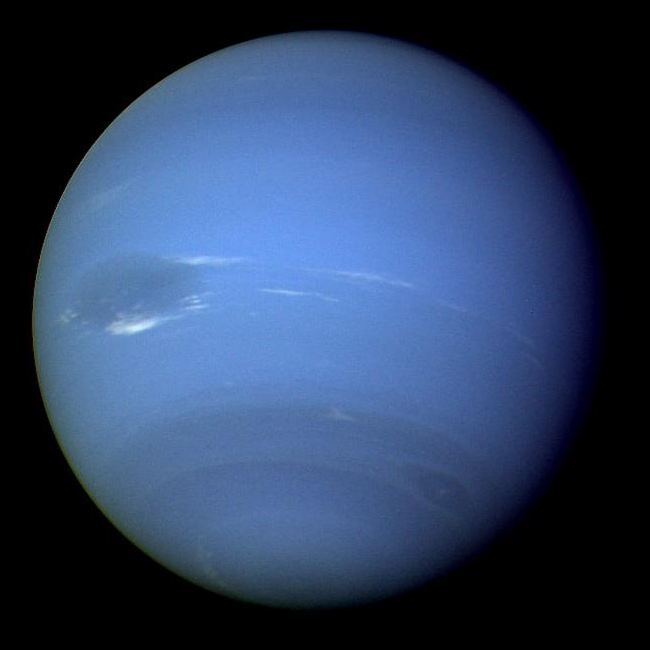
| Neptune: seems pretty close in comparison |
One astronomical unit, or AU, is the mean distance from the earth to the sun, about 150 million km, or 1.5 × 10¹¹ m. (I grew up knowing it as 93 million miles, but the world has changed units.) That means you have over 500 AU of DNA in your body. Neptune, the outermost planet, is 30 AU from the sun. Your total DNA is nearly 10 times the diameter of the planetary solar system!
Another way to look at it. Light travels at a speed of 3 × 10⁸ ms−1. Even at this colossal speed, it takes a while for light to get around the solar system: the moon is just over a light second away, and the sun is a full 8 light minutes away. Dwarfing these, your total DNA is 3 light days long!
And yet that astronomically long piece of DNA length has a volume of 40 trillion × 9 × 10⁻¹⁸ m3, or 360 cm3, just about the volume of a soft drink can. Really really really thin.
So, if anyone asks how much DNA there is in the human body, it’s 3 light days, or just over half a pint, depending how you want to measure it.