Showing posts with label sea. Show all posts

Sunday, 31 August 2025

view from a Nice hotel window

I've arrived in Nice for the UCNC conference starting tomorrow.  I went for a little explore, walking down to the sea (about 20 mins stroll).

There is a large plaza on the way.


And the sea is spectacular.

No wonder it's called the Côte d'Azur.  It was much brighter, and much bluer, in reality.

After I had found where the restaurant quarter was, I went back to my hotel to unpack, and wait for my colleague to arrive so we could go for dinner.

view from my hotel window


Saturday, 26 July 2025

Saturday, 10 May 2025

brains, bees, and sea

Several more days of neuromorphic fun.  There are lots of things we don't understand about the brain: very little of the brain is active at one time, neurons send other neurons encapsulated mRNA messages, split brain patients become functions extremely quickly, dendrite processing is an important process. I led a session on embodied physical reservoir computing.  A session on how LLMs work was illuminating.  There is work on building biotransistors which can be made on flexible substrates, and work in water.  The brain includes a "neuromorphic twin" model of the world, which it uses to predict sensory data; if there is a mismatch, there can be peculiar sensations.  The brain has as many glial cells, including astrocytes, as neurons; a model of these at one extreme of a spectrum of structure looks a bit like a dense associative memory, what capabilities might other places on the spectrum provide? AI basically hasn't incorporated any discoveries from neuroscience in the last 50 years.  Deep learning, with its billions of parameters, works because a particular Riemannian metric is more likely to exist in these high dimensions giving a unique global minimum.  Insects diverged from other animals before there were brains, so have rather different structures. Bee navigation establishes an absolute reference frame by using the sun and time of day.  

Whew!  That's been a lot.  I'm flying home tomorrow, so today I spent time walking, decompressing by watching the sea up close (it's profoundly weird to stand close to the shore for quite a while, and the tide neither comes in nor goes out), and a bit of paddling.

There's a lovely sandy beach in front of the hotel, which ends at these rocks.  Standing listening to the water gently lapping against them is incredibly relaxing.


Tuesday, 6 May 2025

more brains, and coastal views

We've had multiple days of great talks and conversations, and lots of walks.  We've heard about evolving computer programs to become replicators and machine learning programs, evolving self-organising developmental pathways, song learning in zebra finches, navigation and learning "place" maps (when you move to a different room, you switch to a different mental map; might that be why you forget why you moved to the new room?), computing with spikes, future neuromorphic hardware, making brain-like circuits with very simple components (resistors, capacitors, batteries and memristors), a mnemonic for understanding the effect of different operations and memories (if one bit is a 1 ft box, then an adder is a room, a multiplier is the whole hotel, the closest memory cache is down on the sea shore, DRAM is Corsica, a hard drive is in Rome, and the cloud is on Jupiter!). Today the focus was on robots with neuromorphic brains, and the key role played by the environment.

May brain is full to overflowing, and we've still got a couple of days to go!  To decompress a bit, I went for a walk along a costal path.  Low rocky cliffs, with a few beaches scattered along the length.

some of the coves are sandy; this one is splendidly rocky


Tuesday, 29 April 2025

view from a hotel window : CapoCaccia 2025

I arrived in northern Sardinia last night, for the two week Capo Caccia workshop on Neuromorphic Intelligence.  This morning I saw the view from my window: this is on the "non seaview" side of the hotel, which means the room is a little cheaper.  It's still a lovely view.


The restaurant looks over the sea, and the view is indeed stunning.

In the morning were some great "discussions" (more informal than lectures) on evolution of neural circuits, and emotions in fish.  I then had some excellent conversations with participants in the afternoon.  Then off for a stroll to photograph the sea view.

It promises to be a fantastic time: great talks, great conversations, great food, great venue, great weather!


Wednesday, 18 December 2019

view from a hotel window

I’m in Aberystwyth for a PhD viva.  I am reliably informed by the locals that Aber is most definitely not “the back of beyond”, nor even “the middle of nowhere”, but is rather “the edge of nowhere”.  It was a 7 hour train journey (with an expected stopover at Brimingham, and an unexpected stopover at Shrewsbury) to get here yesterday, and will be a 6 hour (hopefully) train journey back this afternoon.  It’s not that far, actually, it’s just that the local trains are so very slow.

But one advantage of being on the edge of nowhere is that I have a view over that edge: a lovely sea view from my hotel window (visible only after breakfast, once the sun had deigned to rise):

the view westward, out to sea

looking more to the south, along the bustling sea front (it is 8:40am, 25 minutes since sunrise)


Sunday, 29 July 2018

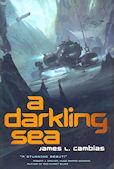
book review: A Darkling Sea

James L. Cambias.
A Darkling Sea.
Tor. 2014

Ilmatar is home to a newly-discovered alien species, that lives in total darkness under thick ice, at extremely high pressures and deadly cold, building a civilisation around the energy available from hot vents. Humans have a scientific base nearby, observing the aliens. But they are forbidden from interacting with them by the Sholen, another alien species that so nearly destroyed itself that it now insists on consensus in everything, and minimising any interference with new contacts. But then the meddling humans accidentally make contact with the Ilmatarans, which might lead to war with the not-so-unified Sholen.

This is an interesting view of three very different species: the relatively primitive Ilmatarans, the superior but reclusive Sholen, and the humans. None of these is a homogeneous culture: the plot is driven as much by conflicts within as between species. Not all the Sholens are that convinced of consensus and there are different political sub-groups to be considered; not all the Ilmatarans are civilised; not all the humans are very scientific. There's a semi-amusing thread running through, as the humans and Sholens keep incorrectly predicting how the others will react, based on completely incorrect stereotypes they have of each other.

The majority of the plot takes place in the dark cold ocean beneath a kilometer of ice, giving an extra claustrophobic edge to the tensions between the three species. The background is well drawn: the Ilmataran life-cycle, language and living arrangements are gradually revealed; how the humans can live below the ice is engagingly info-dumped. There are a couple of distressing deaths: these are not described in gory detail, leaving it to the imagination to fill in the blanks. Some of the humans seem to get much too worked up about events, while others seem surprisingly unemotional about everything. But on the whole, this is an interesting story about conflicts between species who have completely different philosophies that are partly a result of their completely different physiologies.


For all my book reviews, see my main website.

Thursday, 15 June 2017

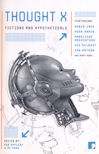
book review: Thought X

Rob Appleby, Ra Page, eds.
Thought X: fictions and hypotheticals.
Comma Press. 2017

Ra Page at Comma Press has commissioned several books with the same concept: a bunch of academics are paired up with a bunch of fiction writers; they share a technical concept, the writer uses it for a (usualy science fictional) story, the academic writes an after-word explaining the technicalities. I was involved in an earlier book (Beta-Life) themed on Artificial Life and Unconventional Computing; this book covers thought experiments and philosophical paradoxes. Caveat: because of my earlier involvement, the publishers sent me a free copy of this book, for review.

One of the reasons I read science fiction is for the way it can include technical information as part of the story. And as I was reading many of these, I was reminded of several other tales based on simlar concepts. The technical after-words cite technical papers for further reading; I thought that here I could reference other fiction (and a little non-fiction, I confess), for readers who want more.

Several stories are based on special and general relativity: apparent paradoxes from its non-intuitive nature, and thought experiments by Einstein, master of such Gedankenexperimente. We start with Adam Marek’s “Lightspeed”, based on the Twin Paradox, where a person who goes of in a spacecraft moving close to the speed of light will find on their return that they have aged less that those who stayed at home. Here the traveller is a husband and father, leaving his family ever further behind on each trip he takes. This form of time dilation is a staple in SF, including Robert Heinlein’s 1956 juvenile novel Time for the Stars, featuring actual twins, and Joan D. Vinge’s 1974 novella “Tin Soldier”, which pairs a slowly-ageing cyborg with a time-dilated space pilot.

The next topic is the Experience Machine: is it better to live in reality, or experience more pleasure in a simulated world? The argument applies to drug use, too. Zoe Gilbert’s “Tether” gives us a story where the experience may be a magical hallucination, or such advanced tech that it is indistinguishable from magic; either way, the bliss of flying as high as a kite is irresistible. Examples of Virtual Reality and consciousness uploading abound in SF. Tom Cool in his late 1990s novels Infectress and Secret Realms delves into full immersion VR, and shows how, rather than being utopia, it can be used as the most sophisticated torture device ever invented. A few years earlier Greg Egan was exploring uploading, in Permutation City and Diaspora. The trope is common in SF movies too: 1999 alone saw The Matrix and eXistenZ.

Sarah Schofield’s “The Tiniest Atom”, a story of loss in war time, takes on Laplace’s Demon working in a Newtonian universe, where if you know the position and momentum of every particle in the universe, you can perfectly predict the future. Recently, chaos theory has shown that determinism does not necessarily imply predictability, because of sensitive dependence on initial conditions; one consequence is the Butterfly Effect, which has made its way into science fiction literature, with Ray Bradbury’s 1952 story “A Sound of Thunder” (presciently killing a butterfly) and James P. Hogan’s wonderfully titled 1997 story “Madam Butterfly”.

Annie Kirby’s “Red” moves from the technological to the psychological, and the thought experiment of Mary’s Room: a scientist is raised in black and white world, yet knowing everything there is to know about light, and the colour red; how will she react when she first sees that colour? (I always worry about the protocol of this experiment: the first time Mary gets a paper cut, or bites her nails over-enthusiastically, it will ruin the setup.) Here the protagonist loses her colour vision, but red plays a key role in why. I don’t know any SF based on this thought experiment (although gaining a whole new sense might be related), but the philosopher Daniel Dennett has written an interesting chapter on Mary in his 2005 book Sweet Dreams.

Andy Hedgecock’s “XOR” is a clever little double-loop variant of the Grandfather Paradox, where you go back in time and kill your grandfather, or make some other change, that alters the future so that you are no longer in the position to go back in time to kill your grandfather. Science fiction is full of Time Patrols, and Time Police, and Time Guardians, to stop this sort of thing in its tracks, and full of Time Criminals refusing to be stopped. Robert Heinlein has a couple of variants on this theme, with the time travel actually creating, rather than destroying, the timeline: his 1941 five finger exercise “By His Bootstraps” and his 1959 masterpiece “All You Zombies—”. There are several films in the sub-genre: The fun Back to the Future (1985), the bonkers Looper (2012), and the twisty Primer (2004) are just three examples.

Mary Louise Cookson’s “Bright Boy” is inspired by Maxwell’s demon, a thought experiment attempting to break the second law of thermodynamics. Here a little boy appears to have uncanny control over information and entropy. I’m not sure I know any SF that is explicitly about breaking this law, although many blithely ignore it.

The Chinese Room is an old chestnut in the philosophy of Artificial Intelligence: a man who does not know Chinese sits in a room following an algorithm to translate input Chinese symbols into output Chinese answers: where is the understanding of Chinese? Annie Clarkson’s “The Rooms” features a woman employed to converse with human-like robots, to help teach them their roles. But she is following a prepared script. Who then is the robot? SF is full of robots, but their intelligence and interior life is usually a given (or at least as much of a given as the interior life of any of the other characters). Douglas Hofstadter and Daniel Dennett take a long hard look at the overall argument in their 1981 collection The Mind’s I.

Schrödinger’s Cat has long bothered quantum mechanics. Put a cat in a box with some poison that has a 50:50 chance of killing it. Is the cat dead, alive, or somehow both before you observe it? Here Margaret Wilkinson, in “If He Wakes”, has a protagonist who does not want to ask a fateful question, for fear of causing the very incident she is asking after. Greg Egan’s 1992 novel Quarantine explores different aspects of what happens when you open that box, and Jo Walton’s moving 2014 novel My Real Children explores a whole two lifetimes of superimposed consequences.

Several hundred years before Einstein, Galileo had a way with thought experiments. One, Galileo’s ship, shows that we could be enclosed in a ship and unaware of our motion relative to the sea; today we have this experience in cars, trains, and planes all the time. Claire Dean’s “People Watching” uses this idea to play games with the reader’s perspective: we are not where we think we are.

In “Monkey Business”, Ian Watson builds a world where the proverbial randomly typing monkeys are being monitored for their Shakespearean output. His world is growing more complex as a whole infrastructure is being built up to support the monkeys and the analysis of their outputs; there are even different factions of philosophical arguments about the success criteria. In 1941, Jorge Luis Borges published his story “The Library of Babel”, sufficient to file away all the monkeys’ outputs. William Goldbloom Bloch’s 2008 treatise The Unimaginable Mathematics of Borges’ Library of Babel captures the sheer Vastness of this endeavour, along with other bizarre properties.

Sandra Alland’s “Equivalence” is based on Einstein’s Equivalence Principle: enclosed in a lift, you can’t tell if the lift is stationary on the ground and force pressing you down is gravity, or if the lift is in space and accelerating upwards. In the story, an acrobat who performs drops with aerial silk is confined in a windowless room.

Robin Ince’s story “The Child in the Lock” is based (mostly) on the philosophical argument about The Drowning Child: if we saw a drowning child, we would save it, even at cost to ourselves, so why don’t we spend at least as much saving the out of sight starving millions? The protagonist comes to a different conclusion: they don’t save the child, for several mutually inconsistent reasons that sound all too plausible. Although this story borders on horror, Ince gets humour in early with the line “Tom had been an actor but decided to take a break from it as he’d always been keen to get into telemarketing”. The story also obliquely refers to The Spider in the Urinal, where the best of intentions can lead to the worst of outcomes, or, “the road to hell is paved with good intentions”. Meaning well is not enough. There is a small sub-genre of SF stories about going back in time to kill Hitler, which just makes things worse.

Adam Roberts, in “Keep it Dark”, is trying out a novel explanation of Olber’s paradox, or why is the sky dark at night? If the universe were infinite and homogeneous, every line of sight should eventually end on the surface of a star: although they look smaller when they are further away, there are many more of them. Roberts goes for a solution based on the latest physics. One famous SF story about the sky being dark at night, but not as dark as expected, is Isaac Asimov’s 1941 novellette, “Nightfall”. And Arthur C. Clarke’s 1953 story “The Nine Billion Names of God” has the night sky getting darker than usual, with one of the best last lines of a short story.

The book finishes as it starts, with another of Einstein’s thought experiments, here, chasing a beam of light, never catching it, but experiencing time dilation. Anneliese Mackintosh, with “Interia”, studies the time dilation of dying.

Thought X is a good entry in the long tradition of basing fiction on scientific fact. Here we have a wide range of thought experiments and paradoxes, with stories questioning, stretching, and interpreting them, then after-words explaining the scientific basis. The lucky reader thus gets the best of both worlds.


For all my book reviews, see my main website.

Sunday, 3 July 2016

out in the heat

I applied sun screen / insect repelant combo, and went for a stroll.  I managed half an hour outside in the heat (despite staying in the shade where possible) before I needed to return to the inside coolth.

I saw some interesting birds, that looked like slim blackbirds with longer legs, and a long triangular tail:

my Google-fu tells me this is probably a Great-tailed grackle

Also, what looked like some kind of parasite growing on a palm tree:
parasite? with fruits? growing half way up a palm tree
That was enough heat, and I returned to the hotel, and went up onto the roof, where there is better view than from my window:

view from the roof; turquoise and blue sea
After a chat in the hotel with some other conference goers, it was time to venture out again, for lunch.  Off to Mocambo, a Mexican seafood restaurant, with an "indoors" that was actually open, but under a thatched roof, with views over the sea, and accompanying welcome sea breeze.  Delicious food, a great view, plus pelicans flying by!


Monday, 7 September 2015

Wiapoua Kauri Forest

I enjoyed seeing the big Kauri tree so much yesterday that I changed my plans for today. Instead of heading south of Auckland, I went west, to the Waipoua Kauri forest.

First I drove across to the west coast.  As I drove along, I saw a sign outside a shop: LENS PIES (in block caps like that).  I spent a few moments wondering what sort of pies these might be; surely not made of lenses?  Then, I got it. Len’s Pies.  Anti greengrocer’s apostrophe problem.

I stopped at The Landing Cafe and i-SITE information centre, Opononi, for tree-oriented information and a coffee.

I was told that Ara Te Uru cape was also worth a visit, so I stopped off there first.

Google Earth view of Arai Te Uru cape.  Car park in bottom right corner.
The signs claimed a 5 minute walk to the view point.  I was there over half an hour, walking, standing, photographing, looking.
Arai Te Uru : looking north east along the river
Arai Te Uru : looking west to the Tasman Sea
Then off south to the trees.  First stop, Tane Mahuta, the Lord of the Forest, the largest Kauri still standing.  It is just a short walk into the forest from the car park.

Still impossible to get a sense of scale.  Tane Mahuta’s trunk’s girth is 45.2 feet, so the diameter is over 14 feet – nearly three times that of yesterday’s huge tree!
Then off another kilometer down the road to the next batch.

The path into the forest.  Not exactly wilderness, but there were no other people around, which made it wonderfully atmospheric.
First was a short tramp to The Four Sisters, a glade with four enormous Kauris growing close together in a clump,

A confusion of trunks.  The Four Sisters, plus some smaller siblings.
The Four Sisters
I stood alone with these mighty trees for a long time.  There was silence: no other people, no chatter, no footsteps.  Just the fractal drip drippity drip of past rainwater, the occasional chirping of a bird, and the distant susuruss of the wind.  The sunlight came and went, dappling the bark.  It was utterly peaceful and serene.

Eventually I moved off, a further 15 minute stroll deeper into the forest to Te Matura Ngahere, Father of the Forest, the second largest Kauri tree (by volume).

deeper in the forest the gravel path is replaced with boardwalk
The boardwalk had the occasional railing.  This wasn’t to protect walkers from the sometimes precipitous drop to the forest floor, but to protect a large Kauri next to the walk.  I learned to look for these, and to stop and stare at the trees so protected.  They were each magnificent.

another magnificent Kauri
And beautiful bark – some mossy, some patterned, some almost plain.

Then, a bend in  the boardwalk, and suddenly, about 100 yards ahead in a clearing was the big tree.

Whoever designed the walk had an eye for the dramatic
It is absolutely massive!  Although smaller (by volume) than Tane Mahuta, it has a trunk diameter of 17 feet, and it felt much bigger to me.

Like all the Kauris, the trunk goes straight up for ever before branching out into a whole separate independent world
I stood and stared.  And stared.

One the way back I barely glanced at any more trees.  This was partly due to the rain, which started in earnest as I headed back, but mainly due to the fact that all the trees along my route, Four Sisters included, now looked like mere saplings.

After that, I drove down through the forest (a stunningly beautiful drive), then to Dargaville, and dinner.

From Piahai to Dargaville, via Arai Te Uru cape and Wiapoua Kauri Forest, ~170km

Sunday, 6 September 2015

farther north

Today I took a coach tour up Ninety Mile Beach (which despite its name is more like 55 miles long; still pretty impressive!), which included several other sights as well.

I was picked up from my motel at around 7:30am, onto a bus with about 30 people already on board.  We picked up another few, then drove up to the south end of the beach, with a stop for coffee along the way, arriving about 9:30.  The coach drove out onto the sand, then sped northwards along the beach, giving marvellous views of the sea.

coach seat with a view
We saw fisher folk, birds, and seals along the way.

“get orf my beach!”
The view out the front windscreen shows the extent of the drive, and the fact that, yes, we really were on sand (the hard wet sand between the water and the dry crumbly sand).

Beware! No Road Markings!
After driving for about an hour (it didn’t feel anywhere near as long as that), we stopped on the beach for a paddle.

On the beach, channelling our inner toddler.
Yes, I’m barefoot, too
a rival tour bus speeds off into the distance
Yes, we really were on the sand.  The small white box
by the bus door is a step: the body is very high off the ground, for some reason...
More driving along the beach, then we turned off to drive up a river, to the Te Paki Sand Dunes, for some sand dune surfing (which is basically lying face down on a very slippery small board, and zooming downhill, whilst trying to remember the way to steer that doesn’t break your wrists; some of the party managed this while filming themselves using a selfie stick).

On the dunes, channelling our inner teenager.  I didn’t go right to the top (the sand was v loose, and the slope v steep, and it would have taken me rather more than the 5 minutes everyone else needed).  But I did surf down from the “nursery slopes” visible on the left.  Twice.
Then it was back on the bus, and off to Cape Reinga, the northernmost point, arriving about noon.  It was a short walk down from the car park to the lighthouse on the cape, where we could see the Tasman Sea meet the Pacific Ocean.

the Tasman Sea (west)
the Pacific Ocean (east)
Back on the bus, and off to lunch.  A further short trip, and around 3pm we stopped at "The Ancient Kauri Kingdom", which is a showroom for artefacts manufactured from “swamp Kauri” – 45,000 year old preserved wood.  There is an amazing staircase carved inside a single Kauri trunk.

looking down the stairs
the staircase from the outside: a massive tree trunk
There was a showroom with marvellous items (and a cafe with marvellous Boysenberry Ice Cream).  The photo above shows a table with a beautiful Kauri stand.  Handling some of the smaller items reveals the wood is surprisingly light.  There were other tables on display.

I really really really wanted to buy this stunning 50000-year-old-Kauri-wood table (NZ$16500 + shipping!), but didn’t for two reasons: (1) nowhere to put it; (2) NZ$16500
I’d never heard of Kauri wood, or Kauri trees, before,  These are massive trees that used to cover much of the Far North of North Island, but have mostly been felled for their excellent timber.  The final stop on our tour was the Puketi Kauri Forest, to see some living Kauri trees.

Looking up at a stunning Kauri tree.  It’s difficult to get a sense of scale.  The trunk is about five feet in diameter, and almost perfectly cylindrical (no tapering) up to where the branches appear.
beautiful Kauri bark patterns
Then back on the bus, and back to Piahai.  There was more lovely scenery visible, but, as one of my colleagues at the earlier conference said of his own sightseeing trip: “you see stunning scenery around every bend; eventually you don’t stop to photograph it unless it’s a volcano erupting rainbows!”

The day long tour, which included an excellent commentary and the “fush and chup lunch” (fascinating NZ vowel shifts throughout), cost NZ$145 (about £60).  Superb value for money.

The coach trip route (approximated along Ninety Mile Beach itself).  Round trip ~440km

Monday, 2 September 2013

Taormina

Monday: the first day of the European Conference on Artificial Life (ECAL). Sunday was all travel: from home to ECAL’s location in Taormina, Sicily, by taxi to the station, train to Kings Cross, tube to Victoria, train to Gatwick, shuttle to North terminal, plane to Catania, and taxi to Taormina, about 10 hours travel time.

It was dark on arrival, so my first view from the hotel window was in the morning:

looking out on the cacti
looking down to the hazy sea

Saturday, 6 October 2012

retrospective holiday diary day 3: Lindisfarne

Saturday 22 September, and the weather was still fine,

sunny holiday weather
so we decided to take advantage of the sunshine, and do Lindisfarne.

Although Lindisfarne (Holy Island) is an island, it is accessible by causeway when the tide is low, so we could drive there and back. The road wouldn’t be open until 11am, so first we took the opportunity for a little archaeology: Neolithic rock carvings near Routin Linn (or Roughtin Lynn, or many other variants). The rock itself can be seen from the air in Google maps. Close up, many "ring and cup" markings are visible:

today, we'd call that graffiti and vandalism
Then off to Lindisfarne, over the causeway, to the car park, and taking the hopper bus to the foot of the castle. First the tromp up to the castle itself:

Lindisfarne castle
Then we walked along to the shore, where we saw masses of carefully crafted little cairns. (We resisted the temptation to build one of our own.)

cairn as mini-castle?
We were really enjoying the beautiful weather: sunny, breezy, not too warm, but not yet “brisk”.

why is the sky that funny colour?
We walked round the back of the castle, and popped in to Gertrude Jekyll’s walled garden. Probably not one of her best, but then the location isn’t exactly perfect.

castle seen from Jekyll's garden
Finally, back to the village and a look round the priory.

the angled arch is part of the ceiling vaulting
The castle is just visible through this window:

a view of the distant castle
The red sandstone has weathered over the years into the most remarkable patterns.

natural carvings
On the way back to the mainland, we stopped off at the sand flats, and walked out a little way out, to get a better view of a load of seals sunning themselves on a sandbank in the sea.

distant seals in the sunlight
Then, just by the causeway on the way back, we saw a seal relatively close up.

closer seal, with a curlew at the back left,
and what a bird-savvy friend tells me is probably a juvenile oystercatcher at the back right
Marvellous day.