
Showing posts with label butterfly. Show all posts
Showing posts with label butterfly. Show all posts
Saturday, 3 August 2019
invasion of the butterflies
There are supposed to be millions of Painted Lady butterflies this year. We saw this somewhat bedraggled one in our garden today.


Thursday, 15 June 2017
book review: Thought X
Labels:
books,
butterfly,
philosophy,
review,
science,
science fiction,
sea,
spider
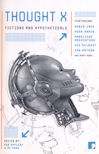
Thought X: fictions and hypotheticals.
Comma Press. 2017
Ra Page at Comma Press has commissioned several books with the same concept: a bunch of academics are paired up with a bunch of fiction writers; they share a technical concept, the writer uses it for a (usualy science fictional) story, the academic writes an after-word explaining the technicalities. I was involved in an earlier book (Beta-Life) themed on Artificial Life and Unconventional Computing; this book covers thought experiments and philosophical paradoxes. Caveat: because of my earlier involvement, the publishers sent me a free copy of this book, for review.
One of the reasons I read science fiction is for the way it can include technical information as part of the story. And as I was reading many of these, I was reminded of several other tales based on simlar concepts. The technical after-words cite technical papers for further reading; I thought that here I could reference other fiction (and a little non-fiction, I confess), for readers who want more.
Several stories are based on special and general relativity: apparent paradoxes from its non-intuitive nature, and thought experiments by Einstein, master of such Gedankenexperimente. We start with Adam Marek’s “Lightspeed”, based on the Twin Paradox, where a person who goes of in a spacecraft moving close to the speed of light will find on their return that they have aged less that those who stayed at home. Here the traveller is a husband and father, leaving his family ever further behind on each trip he takes. This form of time dilation is a staple in SF, including Robert Heinlein’s 1956 juvenile novel Time for the Stars, featuring actual twins, and Joan D. Vinge’s 1974 novella “Tin Soldier”, which pairs a slowly-ageing cyborg with a time-dilated space pilot.
The next topic is the Experience Machine: is it better to live in reality, or experience more pleasure in a simulated world? The argument applies to drug use, too. Zoe Gilbert’s “Tether” gives us a story where the experience may be a magical hallucination, or such advanced tech that it is indistinguishable from magic; either way, the bliss of flying as high as a kite is irresistible. Examples of Virtual Reality and consciousness uploading abound in SF. Tom Cool in his late 1990s novels Infectress and Secret Realms delves into full immersion VR, and shows how, rather than being utopia, it can be used as the most sophisticated torture device ever invented. A few years earlier Greg Egan was exploring uploading, in Permutation City and Diaspora. The trope is common in SF movies too: 1999 alone saw The Matrix and eXistenZ.
Sarah Schofield’s “The Tiniest Atom”, a story of loss in war time, takes on Laplace’s Demon working in a Newtonian universe, where if you know the position and momentum of every particle in the universe, you can perfectly predict the future. Recently, chaos theory has shown that determinism does not necessarily imply predictability, because of sensitive dependence on initial conditions; one consequence is the Butterfly Effect, which has made its way into science fiction literature, with Ray Bradbury’s 1952 story “A Sound of Thunder” (presciently killing a butterfly) and James P. Hogan’s wonderfully titled 1997 story “Madam Butterfly”.
Annie Kirby’s “Red” moves from the technological to the psychological, and the thought experiment of Mary’s Room: a scientist is raised in black and white world, yet knowing everything there is to know about light, and the colour red; how will she react when she first sees that colour? (I always worry about the protocol of this experiment: the first time Mary gets a paper cut, or bites her nails over-enthusiastically, it will ruin the setup.) Here the protagonist loses her colour vision, but red plays a key role in why. I don’t know any SF based on this thought experiment (although gaining a whole new sense might be related), but the philosopher Daniel Dennett has written an interesting chapter on Mary in his 2005 book Sweet Dreams.
Andy Hedgecock’s “XOR” is a clever little double-loop variant of the Grandfather Paradox, where you go back in time and kill your grandfather, or make some other change, that alters the future so that you are no longer in the position to go back in time to kill your grandfather. Science fiction is full of Time Patrols, and Time Police, and Time Guardians, to stop this sort of thing in its tracks, and full of Time Criminals refusing to be stopped. Robert Heinlein has a couple of variants on this theme, with the time travel actually creating, rather than destroying, the timeline: his 1941 five finger exercise “By His Bootstraps” and his 1959 masterpiece “All You Zombies—”. There are several films in the sub-genre: The fun Back to the Future (1985), the bonkers Looper (2012), and the twisty Primer (2004) are just three examples.
Mary Louise Cookson’s “Bright Boy” is inspired by Maxwell’s demon, a thought experiment attempting to break the second law of thermodynamics. Here a little boy appears to have uncanny control over information and entropy. I’m not sure I know any SF that is explicitly about breaking this law, although many blithely ignore it.
The Chinese Room is an old chestnut in the philosophy of Artificial Intelligence: a man who does not know Chinese sits in a room following an algorithm to translate input Chinese symbols into output Chinese answers: where is the understanding of Chinese? Annie Clarkson’s “The Rooms” features a woman employed to converse with human-like robots, to help teach them their roles. But she is following a prepared script. Who then is the robot? SF is full of robots, but their intelligence and interior life is usually a given (or at least as much of a given as the interior life of any of the other characters). Douglas Hofstadter and Daniel Dennett take a long hard look at the overall argument in their 1981 collection The Mind’s I.
Schrödinger’s Cat has long bothered quantum mechanics. Put a cat in a box with some poison that has a 50:50 chance of killing it. Is the cat dead, alive, or somehow both before you observe it? Here Margaret Wilkinson, in “If He Wakes”, has a protagonist who does not want to ask a fateful question, for fear of causing the very incident she is asking after. Greg Egan’s 1992 novel Quarantine explores different aspects of what happens when you open that box, and Jo Walton’s moving 2014 novel My Real Children explores a whole two lifetimes of superimposed consequences.
Several hundred years before Einstein, Galileo had a way with thought experiments. One, Galileo’s ship, shows that we could be enclosed in a ship and unaware of our motion relative to the sea; today we have this experience in cars, trains, and planes all the time. Claire Dean’s “People Watching” uses this idea to play games with the reader’s perspective: we are not where we think we are.
In “Monkey Business”, Ian Watson builds a world where the proverbial randomly typing monkeys are being monitored for their Shakespearean output. His world is growing more complex as a whole infrastructure is being built up to support the monkeys and the analysis of their outputs; there are even different factions of philosophical arguments about the success criteria. In 1941, Jorge Luis Borges published his story “The Library of Babel”, sufficient to file away all the monkeys’ outputs. William Goldbloom Bloch’s 2008 treatise The Unimaginable Mathematics of Borges’ Library of Babel captures the sheer Vastness of this endeavour, along with other bizarre properties.
Sandra Alland’s “Equivalence” is based on Einstein’s Equivalence Principle: enclosed in a lift, you can’t tell if the lift is stationary on the ground and force pressing you down is gravity, or if the lift is in space and accelerating upwards. In the story, an acrobat who performs drops with aerial silk is confined in a windowless room.
Robin Ince’s story “The Child in the Lock” is based (mostly) on the philosophical argument about The Drowning Child: if we saw a drowning child, we would save it, even at cost to ourselves, so why don’t we spend at least as much saving the out of sight starving millions? The protagonist comes to a different conclusion: they don’t save the child, for several mutually inconsistent reasons that sound all too plausible. Although this story borders on horror, Ince gets humour in early with the line “Tom had been an actor but decided to take a break from it as he’d always been keen to get into telemarketing”. The story also obliquely refers to The Spider in the Urinal, where the best of intentions can lead to the worst of outcomes, or, “the road to hell is paved with good intentions”. Meaning well is not enough. There is a small sub-genre of SF stories about going back in time to kill Hitler, which just makes things worse.
Adam Roberts, in “Keep it Dark”, is trying out a novel explanation of Olber’s paradox, or why is the sky dark at night? If the universe were infinite and homogeneous, every line of sight should eventually end on the surface of a star: although they look smaller when they are further away, there are many more of them. Roberts goes for a solution based on the latest physics. One famous SF story about the sky being dark at night, but not as dark as expected, is Isaac Asimov’s 1941 novellette, “Nightfall”. And Arthur C. Clarke’s 1953 story “The Nine Billion Names of God” has the night sky getting darker than usual, with one of the best last lines of a short story.
The book finishes as it starts, with another of Einstein’s thought experiments, here, chasing a beam of light, never catching it, but experiencing time dilation. Anneliese Mackintosh, with “Interia”, studies the time dilation of dying.
Thought X is a good entry in the long tradition of basing fiction on scientific fact. Here we have a wide range of thought experiments and paradoxes, with stories questioning, stretching, and interpreting them, then after-words explaining the scientific basis. The lucky reader thus gets the best of both worlds.
For all my book reviews, see my main website.
Friday, 7 August 2015
a surfeit of caterpillars
Butterflies and nettles go together. We certainly have the nettles, and now an indication there may be many (Small Tortoishell?) butterflies on the way.


Thursday, 1 January 2015
a year in the sun
We’ve had our solar PV system for (nearly) a year now, so here’s a review of 2014. We generated just shy of 9000 kWh: that’s 9 MWh!
You can clearly see the effect of the year: much more in summer than winter. Interestingly, December, containing the winter solstice, was better than November, which, as usual, was a miserable month; December has some lovely sunny days.
We can look at the energy generation across each day for the whole year, and can clearly see the changing sunrise and sunset times, and the darkness near the end of November.
It’s even easier to see the effect of the seasons looking at the generation through the day. The curve gets higher and much broader.
Of that power generated, we use some, and export the rest to the grid. In March we got an extra device to measure this, too. (March was anomalous in that our hot water boiler was out of action for about a week, so we were using more electricity than usual.)
In the plot above, when the green area below the line is greater than the red area, we exported more than we imported, so are nett generators (month name shown in green). There are days where we import more than we export, taking more from the grid than giving back: on “orange” months we still generate more than we import, but use enough of it that we are not nett exporters; on “red” months we import more than we generate, but even so, may still export a little during the day.
The situation is actually even greener than this implies: some of the orange usage of generated power is being used to heat our water, thereby saving gas consumption, too. That is why there is such a large oragnge lump in December: nearly all excess power is heating the water for the central heating. In the summer, the only water heating is for hot water, as the central heating is off.
Next year we’ll have data to compare across years, not just months. I’ll need to write more Python scripts for that. Great fun!
 |
| daily power generation by month |
 |
| violin plot of daily power generation, showing notched box plots of mean (dot), median, quartiles, and outliers, overlaid on a density plot |
You can clearly see the effect of the year: much more in summer than winter. Interestingly, December, containing the winter solstice, was better than November, which, as usual, was a miserable month; December has some lovely sunny days.
No sun – no moon!
No morn – no noon –
No dawn – no dusk – no proper time of day.
No warmth, no cheerfulness, no healthful ease,
No comfortable feel in any member –
No shade, no shine, no butterflies, no bees,
No fruits, no flowers, no leaves, no birds!
November!
— Thomas Hood, 1844
We can look at the energy generation across each day for the whole year, and can clearly see the changing sunrise and sunset times, and the darkness near the end of November.
 |
| Each pixel represents the energy generation at the sample point, one every 5 minutes. Time is in GMT throughout. The colour indicates the energy generation in the relevant interval: darker colours indicate more energy. |
It’s even easier to see the effect of the seasons looking at the generation through the day. The curve gets higher and much broader.
 |
| Energy generation over the day, averaged per month. Data is gathered at 5 minute intervals. The horizontal time axis runs from 3:00am to 9:00pm GMT. The vertical axis runs from zero to 8kW. The orange regions indicate the minimum, lower quartile, median, upper quartile, and maximum generation at that time, over the month. The line indicates the monthly mean, The number in the top right is the monthly mean generation in kWh. |
Of that power generated, we use some, and export the rest to the grid. In March we got an extra device to measure this, too. (March was anomalous in that our hot water boiler was out of action for about a week, so we were using more electricity than usual.)
 |
| Energy usage over the day, averaged per month. Data is gathered at half minute intervals from the Wattson meter (which we didn't get until mid March. The horizontal time axis runs from midnight to midnight GMT/BST. The vertical axis runs from -8kW to 8kW. The region above the axis represents our usage: orange is generated usage, red is imported from the grid. The green region below the line is surplus generation exported to the grid. |
The situation is actually even greener than this implies: some of the orange usage of generated power is being used to heat our water, thereby saving gas consumption, too. That is why there is such a large oragnge lump in December: nearly all excess power is heating the water for the central heating. In the summer, the only water heating is for hot water, as the central heating is off.
Next year we’ll have data to compare across years, not just months. I’ll need to write more Python scripts for that. Great fun!
Saturday, 14 June 2014
finding Cinnabar
Sitting on the floor of the garage was a kind of butterfly or moth I don’t remember ever having seen before.

It was quite small, about an inch long. Now, I identify butterflies as: Red Admiral, Peacock, Small Tortoiseshell, white butterfly, moth (if it’s nighttime), and other. But this was a different kind of other.
Fortunately, the web is wonderful for this sort of thing, and I rapidly discovered it is a Cinnabar moth, Tyria jacobaeae. And I’ve seen lots of its caterpillars, munching though our plants. Now the cycle is complete.
Beautiful.
It was quite small, about an inch long. Now, I identify butterflies as: Red Admiral, Peacock, Small Tortoiseshell, white butterfly, moth (if it’s nighttime), and other. But this was a different kind of other.
Fortunately, the web is wonderful for this sort of thing, and I rapidly discovered it is a Cinnabar moth, Tyria jacobaeae. And I’ve seen lots of its caterpillars, munching though our plants. Now the cycle is complete.
Beautiful.
Saturday, 27 July 2013
butterflies
Our buddleia has sprouted an excellent crop of butterflies.
 |
| two Peacock butterflies |
 |
| more than two Peacock butterflies |
Saturday, 13 July 2013
waspish caterpillar
I read recently, in the "Last Word" section of New Scientist, a piece asking for help to identify an Italian butterfly-like creature. The questioner couldn't identify it because "it doesn't seem like any butterfly I've seen, nor is it in any of my insect books". What caught my eye was the implication of ownership of at least three insect books. We have only the one insect book. And two butterfly books. Oh, and a dragonfly book.
Yet none of our books could help us to identify this splendid caterpillar we found in the garden today.
The reason I know that none could have helped is that I looked it up in them, after I had identified it using the web. To identify it in the first place, I googled "caterpillar black yellow stripes", and got
Looking through the results identified several promising candidates. The respective source pages all identified it as the caterpillar of the Cinnabar moth. The wikipedia page has more details, confirming the identification. But our insect book doesn't have it. Neither do our butterfly books (well, it is a moth, I suppose).
Back in the garden, the spiders (which will obviously not be in our insect book) have been busy wrapping up the plants in a dense web.

And the patio roses we bought back in early May are now blooming their hearts out.
The weeds are growing apace, but it's way too hot at the moment (28°C) to garden. So I'm blogging about the garden instead.
Yet none of our books could help us to identify this splendid caterpillar we found in the garden today.
 |
| at least it's on a weed |
 |
| it seems there are rather a lot of caterpillars using a yellow and black colour palette |
Back in the garden, the spiders (which will obviously not be in our insect book) have been busy wrapping up the plants in a dense web.

And the patio roses we bought back in early May are now blooming their hearts out.
 |
| The labels must have lied about the colours. I think we are going to have to separate these! |
The weeds are growing apace, but it's way too hot at the moment (28°C) to garden. So I'm blogging about the garden instead.
Sunday, 22 July 2012
sunshine on my garden makes it purple
It seems to have been raining continuously since April, but yesterday the sun finally came out, lighting up the garden. The buddleia looks the happiest it's been for many years.

The scent is amazing, too. Now we just have to wait for the butterflies to find it...

The scent is amazing, too. Now we just have to wait for the butterflies to find it...
Subscribe to:
Posts (Atom)