The weather has been glorious here at the workshop in Bad Honnef, so I went for a short walk this lunchtime, down to the Rhine.
close to the Rhine
As you can see in the above photo on the right, there is a spit poking out into nearly the middle of the river. Walking out on the spit gave me this beautiful view down river:
On my way back to the venue, I passed several other workshop attendees with the same idea.
Yesterday was very wet and windy: storm Ali hit the UK. We spent some time driving around the Brecon Beacons, and some in Hay-on-Wye's famous bookshops. (We bought only eight books. The days of filling the back of the car with second-hand purchases are over, due to already having a lot of books, having already got them via Amazon.)
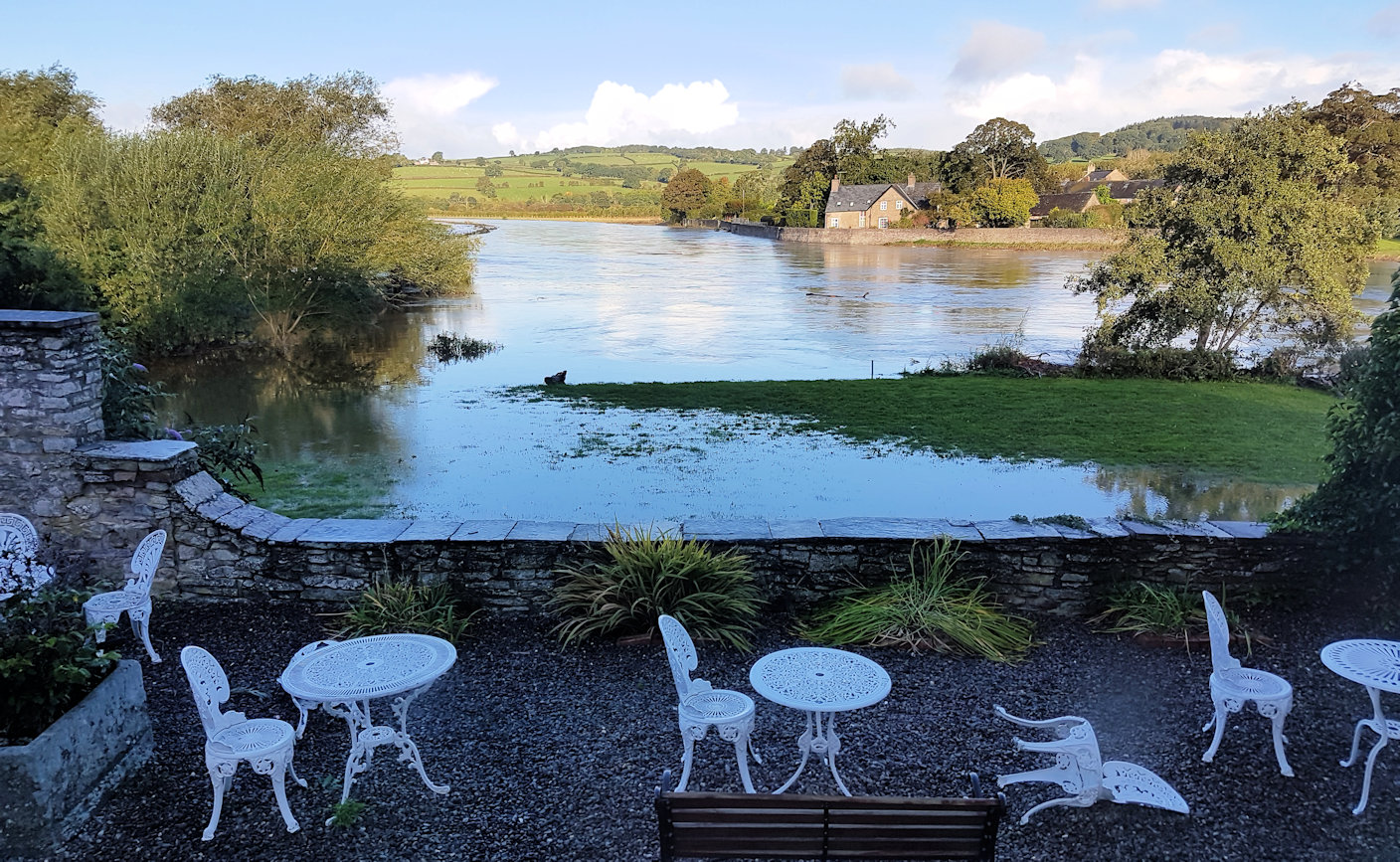
This morning, we saw some of the effect of the storm: the river Wye was somewhat higher than when we arrived, having flooded "the lower field".
The B&B proprietor said the river sometimes flooded that field, in winter, or in spring, but they had never seen it flood in September.
I'm visiting Abertay University for a couple of days, to get a grant proposal with some colleagues here finished off. This evening, taking a break from editing the proposal, here is the view from my hotel window, looking east over the dock by the river Tay:
Today was the Waitomo caves. I booked the “triple cave combo”, and drove along to the first one, the Ruakuri Cave, to join the 9am tour party. The rain was hammering down outside, but inside it was (mostly!) dry, cold, and quiet. We had an excellent guide, who knew the history of the cave system, and also had been involved in digging out mud in order to open it up to tourists.
The tour lasted nearly 2 hours, with many wondrous sights. To get in, we descended a deep shaft using a large spiral ramp.
I didn’t manage a good photo of the entry ramp, so I got a postcard
The sights started almost immediately, with wonderful stalactites (growing down) and stalagmites (growing up). We learned the water deposits new material at about a cubic centimetre a century.
Stalactites, up close
amazing coral-like structure
sheets of rock
atmospheric lighting
so many stalactites
caves within caves
a large cavern (note the handrail at the bottom, for scale)
other people enjoying the caves in their own way
a giant funnel
After walking round in dazed wonder, we re-emerged blinking into daylight. The rain had just about stopped, and it was a short drive up to the next site: the Aranui Cave. This was a shorter tour, just under an hour, but no less spectacular.
small stalactites and stalagmites, some connected
A ceiling full of spikes. Some are broken. This cave has been open longer, and in the early days, before it was known how long the stalactites took to grow, tourists were allowed to break pieces off as souvenirs.
over 6 feet high: like a vast leg
a ceiling like ice cream
a vast cavern; see handrail at bottom for scale
a petrified waterfall
I’m running out of things to say other than “wow!”
so fragile to have survived so long in a geologically active region
more petrified falling water
the huge cavern on the way back: see heads at bottom for scale!
this is what makes the stone features -- slowly
When we left this cave, not only had the rain stopped completely, but the sun had come out, and it was a beautiful day. I had no specific time on my ticket for the third cave trip, so I decided to do the short Ruakuri bush walk, which my host at last night’s B&B had told me was the “best bush walk in New Zealand”. It goes along a river which itself goes through a natural tunnel (the path goes over the top though).
The sign suggested it was a 30 minute tramp. I took an hour. (That sounds better than “it took me an hour”.)
a natural tunnel
the path goes through a twisty tunnel of its own
beautiful mossy trees
a view from inside the river tunnel (view accessed down a dark unlit staircase...)
another tunnel along the path: at least with this one, I could see the other end!
a view down to the river
the other end of the natural tunnel
Although I have no sense of direction, I did get a bit confused along this path as the river seemed to switch direction. Then I saw a map: the river performs a 180° turn in the tunnel.
On the walk I passed two other people, until I got close to the end, when I passed a noisy crowd of about 10 teenagers on a tramp. Like with my Kauri forest visit, the solitude was part of the experience. I don’t know if it is the best bush walk in New Zealand; however, it is an excellent bush walk.
Next, back down the road to the Waitomo glowworm cave. We weren’t allowed to photograph in this one, as there were a lot of parties milling about, and it gets very dark. There was a short walk through a big cavern with lots of stalactites: very impressive, then, once our eyes had adjusted, onto a boat to see the glowworms. Um, wow! There is a big cave system with a lake that the boat moves slowly and silently down, and a relatively low roof, utterly smothered in glowworms. When the boat is still, it looks like an exceptionally starry night (except that the points of light are too evenly spaced for stars). When the boat moves, the shape of the roof becomes apparent. I’m running out of superlatives, but, amazing!
Once I had done with Waitomo, I headed off to the Otorohanga Kiwi House, to see some more kiwis. This site again had a night enclosure, with four kiwis in separate pens. The largest kiwi, a mature female, was very active, strutting around her enclosure, probing the ground for food. Then it was feeding time. The keeper entered her pen with the food, and the kiwi went bonkers, running around, really fast, and kicking the keeper, really hard. The keeper told us after that she had been hospitalised twice over the years, once from a deep peck, and once when a kick hit her knee (rather than her tough boots). So much for fragile sweet little birds!
three stuffed kiwis on display; the live kiwis are in a much darker environment
There was a lot more to see, but I had had my fill for the day, and finished off with a short drive to Tamahere, where the friends I’m staying with over the weekend live.
I enjoyed seeing the big Kauri tree so much yesterday that I changed my plans for today. Instead of heading south of Auckland, I went west, to the Waipoua Kauri forest.
First I drove across to the west coast. As I drove along, I saw a sign outside a shop: LENS PIES (in block caps like that). I spent a few moments wondering what sort of pies these might be; surely not made of lenses? Then, I got it. Len’s Pies. Anti greengrocer’s apostrophe problem.
I stopped at The Landing Cafe and i-SITE information centre, Opononi, for tree-oriented information and a coffee.
I was told that Ara Te Uru cape was also worth a visit, so I stopped off there first.
Google Earth view of Arai Te Uru cape. Car park in bottom right corner.
The signs claimed a 5 minute walk to the view point. I was there over half an hour, walking, standing, photographing, looking.
Arai Te Uru : looking north east along the river
Arai Te Uru : looking west to the Tasman Sea
Then off south to the trees. First stop, Tane Mahuta, the Lord of the Forest, the largest Kauri still standing. It is just a short walk into the forest from the car park.
Still impossible to get a sense of scale. Tane Mahuta’s trunk’s girth is 45.2 feet, so the diameter is over 14 feet – nearly three times that of yesterday’s huge tree!
Then off another kilometer down the road to the next batch.
The path into the forest. Not exactly wilderness, but there were no other people around, which made it wonderfully atmospheric.
First was a short tramp to The Four Sisters, a glade with four enormous Kauris growing close together in a clump,
A confusion of trunks. The Four Sisters, plus some smaller siblings.
The Four Sisters
I stood alone with these mighty trees for a long time. There was silence: no other people, no chatter, no footsteps. Just the fractal drip drippity drip of past rainwater, the occasional chirping of a bird, and the distant susuruss of the wind. The sunlight came and went, dappling the bark. It was utterly peaceful and serene.
Eventually I moved off, a further 15 minute stroll deeper into the forest to Te Matura Ngahere, Father of the Forest, the second largest Kauri tree (by volume).
deeper in the forest the gravel path is replaced with boardwalk
The boardwalk had the occasional railing. This wasn’t to protect walkers from the sometimes precipitous drop to the forest floor, but to protect a large Kauri next to the walk. I learned to look for these, and to stop and stare at the trees so protected. They were each magnificent.
another magnificent Kauri
And beautiful bark – some mossy, some patterned, some almost plain.
Then, a bend in the boardwalk, and suddenly, about 100 yards ahead in a clearing was the big tree.
Whoever designed the walk had an eye for the dramatic
It is absolutely massive! Although smaller (by volume) than Tane Mahuta, it has a trunk diameter of 17 feet, and it felt much bigger to me.
Like all the Kauris, the trunk goes straight up for ever before branching out into a whole separate independent world
I stood and stared. And stared.
One the way back I barely glanced at any more trees. This was partly due to the rain, which started in earnest as I headed back, but mainly due to the fact that all the trees along my route, Four Sisters included, now looked like mere saplings.
After that, I drove down through the forest (a stunningly beautiful drive), then to Dargaville, and dinner.
From Piahai to Dargaville, via Arai Te Uru cape and Wiapoua Kauri Forest, ~170km
The 65th British National Science Fiction Convention, or “Eastercon” as it is usually known, was this year held in Glasgow, at the Crowne Plaza Hotel. It was the usual excellent collection of talks, panel discussions, and other events, focussed on Science Fiction. This year the science talk theme was especially strong, with Dame Jocelyn Bell Burnell as the science Guest of Honour, bringing us up to date on recent advances in astronomy, and a collection of three talks from researchers from the University of Strathclyde, on the science behind some science fiction.
So the con was great fun, as usual. Not so usual was the weather. Here’s the obligatory “photo from hotel window”, showing the anomaly.
seagull and armadillo through glass
We had a good view of the Clyde Auditorium, or “Armadillo”, next to the River Clyde itself. That strange circular flying saucer shaped building just behind it is the Hydro. And that even stranger blue area behind them both is the sky. It was warm, sunny, and clear for the whole time we were there. That was quite a contrast to last year’s Eastercon, in Bradford, where there was snow on the ground!
We had flown up to Glasgow on Thursday evening, so had a little time to kill before the con started on Friday. We had planned to go into the city, but a combination of getting up late and the glorious weather meant we instead opted for a stroll along the Clyde, in shirtsleeves.
looking west along the Clyde
the Crowne Plaza con hotel, and the Armadillo, from across the Clyde