The latest batch:

The latest batch:
The latest batch, including a few belated Christmas presents that were ordered well in advance, but delivered less so.

His'n'hers Christmas presents (including a DVD, for a change)

The latest batch:


This slim book (100 paperback-sized pages) is a transcript of a series of six radio lectures given in 1973, with some additional illustrative sketches.
Stafford Beer was a renowned systems thinker, in the field of operations research and management cybernetics. These lectures outline his view of what the severe problems with management and governmental practices are, and how to solve them by taking Ashby’s Law of Requisite Variety seriously.
His point is that these human systems are dynamic systems of parts and connections, not static fixed monoliths, and they need to be thought of as such to even ask the right questions. In particular, he points out that what we typically observe as the entity, the system, are actually outputs of that system, products of the system organised to produce them. Focussing on the outputs as if they were the system itself then leads to problems when we try to modify or stabilise things. In particular, societal properties like crime, poverty, immorality and the like are outputs of a society organised to produce these (“the cruelty is the point”), not mere unfortunate “blemishes” that can be ironed out by doubling down on our current practices. If we want liberty, say, then we need to design a system of government where liberty is an output.
And how do we interact with, and modify, such tremendously complex and dynamic systems as organisations, governments, and society? Here is where the Law of Requisite Variety comes in. If a system has a lot of variety (a large number of possible states) then we need to match and “absorb” that variety with an equal amount of variety in our interactions and interventions. But we can’t actually do that in practice, since the resources producing system variety greatly outweigh and outnumber our resources to intervene (eg, there are more and various people in the population producing variety than there are government ministers and civil servants responding). So what to do?
If the system has too much variety for regulation, then its variety must be attenuated, or regulatory variety must be increased, to make them match. However, many variety attenuators (low variety models, aggregation, long and set time periods, etc) are not appropriate for faster moving dynamic systems. Beer discusses several approaches from the point of view of operations research, but his main emphasis is on the use of computers as variety matchers. He mentions that common use of computers is counter-productive, attenuating when they should increase, and vice versa, however. He talks about his Chilean experiment in cybernetic government, cut short by the military coup that overthrew the Allende regime, as an example of the kind of computational use he says is needed.
He points out a serious issue: that there is a lot of variety attenuation going on to match the capability of the human brain, but that we have no control over the forms of attenuation. Education is one form, often enforcing the “right” answer, attenuating the student’s creativity. Publishing is another, with the editor providing the attenuation. Beer suggests an alternative to these: personalised education via the computer, and personalised computerised search of recorded information.
These lectures were given 50 years ago. How well have they stood the test of time? Well, civilisation hasn’t collapsed, contrary to Beer’s prediction. Maybe this is because his ideas for personalised education and search have been realised: the Internet and search engines have made vast quantities of information available at the click of a few keys, allowing self-education. Unfortunately, he was too optimistic: these technologies have also enabled the self-publication of, and self-education from, “information” by flat earthers, creationists, anti-vaxxers, science denialists, and full-blown conspiracy theorists. So, things have got a lot better, and also a lot worse, in the intervening half century. I find myself reminded of Ada Palmer’s discussion of the “Ever-So-Much-More-So” powder, which increases the intensity of everything, good and bad alike: “Sprinkle it on the Middle Ages and you get the Renaissance”. The Internet is today’s Ever-So-Much-More-So powder, sprinkled on civilisation.
Despite its age, this book is an excellent introduction to the ideas of management cybernetics, and requisite variety, and how variety may be attenuated and increased beneficially. Well worth the read, even 50 years later.
For all my book reviews, see my main website.
The latest, pre-Christmas, batch:

A third Checquy book! I didn't know there was another one. Yay!
The latest batch:

The Systems Engineering book is a bit weird. On the spine it says "Blanchard et al", implying at least two more authors; on the front cover it says "Blanchard Fabrycky", which sounds like a single author. It's actually by Benjamin S. Blanchard and Wolter J. Fabrycky, who are multiply credited in the table of contents as the authors of every individual chapter (so, 25 times).
His ’n’ hers Christmas presents:

Giving someone a book on infrared astronomy on the very day the James Webb Space Telescope was launched is either prescient, or premature.
The latest batch:

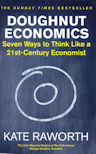
Modern economics is clearly not fit for purpose. It is based on false axioms like unbounded rationality, and individual optimisation. It is too narrow a model, not including many important and linked systems, like the family, the state, and the biosphere. It requires continual exponential growth, which is physically impossible, and is destroying the planet. And its predictions have been repeatedly falsified, from repeated financial crashes to ever-increasing wealth inequalities. So what to do?
Raworth lays out a plan for a better economics, based on the visual image of the doughnut. The outer edge represents an upper level of activity, beyond which activity is unsustainable, due to climate change, biodiversity and habitat loss, pollution, etc. And the inner edge represents a baseline activity, below which people cannot thrive: the need for food, water, shelter, healthcare, education, equality, justice, etc. (I would have liked some acknowledgement that it is necessary to demonstrate that the inner edge is indeed inside the outer edge!)
The doughnut forms a useful image to illustrate the goal of the new economics; Raworth then carefully unpicks the requirements to achieve this, identifying seven facets of the new approach. Each chapter digs into a particular facet, such as the goal of economics, the need for systems thinking, the issue of growth, and more. Starting with a brief review of the historical development of the current theories, Raworth shows how they came about, how that often the originators emphasised they were mere approximations or idealisations, yet that they have subsequently come to be been set in stone. This background serves to demonstrate that changing the models is not somehow going counter to some established truth, but is rather correcting old fundamental errors. So next Raworth outlines how to correct the errors, giving a new model and new requirements. And just when each chapter gets to the point where you are thinking “yes, this is all very well and good, but it would never be possible to make that change”, Raworth gives examples of how that change is already happening in certain (albeit often small and local) cases.
So this is informative, constructive, and hopeful. Everyone should read it, and act on it.
The latest batch:

The latest batch:

The latest batch:

The latest batch:

The latest batch:

The latest batch:


[p40] If one just stops for a moment and says, “The person who is producing this view of the world is you. It isn’t outside, and it isn’t some so-called objective reality that I can relate to,” a very unusual emphasis on the respective personality of the person speaking occurs. All of the general statements that begin as “This is the way it is!” begin turning into statements that start with “I think that…” To return to rather lofty terminology, one uses the self-referential operator “I think” and decides not to use the existential operator “it is”. In so doing, a completely different relationship emerges that permits a dialog that is free and actually quite nice.Although on the one hand this seems reasonable (I started writing “is clearly true”, but decided that was against the spirit of the passage itself), on the other hand, there are some things for which we at least have better evidence than others, even if that evidence is mediated through our senses and potentially unreliable. I have more evidence that I read this book (the notes I made while reading it, for example) than evidence that I understood it (the density of question marks in those notes, for example). We may be mistaken about the quality or provenance of the evidence (maybe somebody else made those notes; maybe I am hallucinating them), but if we treat everything on the same level, we would probably soon be hit by a car, or starve to death.
[p43] No, no. I am Viennese. That is the only label that I have to accept. I come from Vienna; I was born there, that’s an established fact. Of course, you are correct when you say that there are a few people who claim that I am a representative of a certain epistemology. But that just isn’t right. I don’t have any epistemology at all.Umm. How can Foerster claim that the “fact” of him being born in Vienna is “established”, or that Poerksen is “correct”, if he doesn’t “have any epistemology at all”? At first, I assumed this was a going to be a little joke, but it was never picked up on.


