Showing posts with label game. Show all posts
Thursday, 11 September 2025
Saturday, 3 August 2024
Thursday, 23 May 2024
Tuesday, 11 July 2023
Saturday, 27 October 2018
Sunday, 15 July 2018
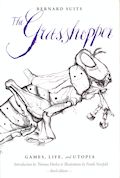
book review: The Grasshopper
Labels:
books,
game,
philosophy,
review,
winter
Bernard Suits.
The Grasshopper: games, life, and utopia: 3rd edn.
Broadview Press. 2014
There are two main components to this book: (i) a definition of what constitutes a game; (ii) an argument that, since in Utopia, playing games is the only thing worth doing, that playing games is the supreme good. Suits spends some of the time building the framework needed for the definition of a game, but most of the time then arguing that the definition is correct, and about the overriding value of games.
First, the definition of a game, both long form, and snappy:
The long form is just a more precise framing of the snappy version, which is short, clear, and to the point:
the voluntary attempt to overcome unnecessary obstacles.
There are no wasted words.
A game must be voluntary, not compulsory (so much for those compulsory “games” in school then);
it is an attempt to overcome, success is not required, trying is sufficient;
there must be an obstacle, so it isn’t some trivial activity, but requires some effort;
and that obstacle must be unnecessary, for it it were necessary,
overcoming it would be a job, or for survival, or some other reason.
This definition seems very reasonable, and gets around Wittgenstein’s claim that there is no sufficient and necessary conditions for something to be a game, by moving up a level of abstraction. Suits spends time picking apart his definition, and showing how various activities do, and do not, fit, and that those activities are, and are not, games, respectively.
So far, so good. Suits’ second argument is about the role of games in Utopia. In Suits’ Utopia there is no need to work; there is abundance of goods, companionship, and sexual partners for all; there is no physical or mental illness. That is, there is no need for involuntary activity, and there are no necessary obstacles to overcome. So the only worthwhile thing left to do in Utopia is play games:
I’m not convinced there is nothing to do in this Utopia other than play games.
What about learning to play a musical instrument?
That doesn’t seem to be a game:
it is (in Utopia, at least) voluntary, but where is the unnecessary obstacle?
One might argue that one could get a machine to play the music:
is requiring the music be produced by oneself an unnecessary requirement?
Listening and performing is qualitatively different, however.
But there is a deeper problem: I am not convinced that this Utopia can exist. Even if we assume perfect mental health, so no-one coerces anyone to do anything against their will (everything is voluntary), this does not imply there will be someone else to engage in any particular activity with you. Suits claims that
This totally misses the point: sexual partners (or even tennis partners)
are not “objects” in anything like the same sense that yachts and diamonds are objects.
They are people, with their own desires, which, even with their posited perfect mental health,
need not overlap with yours.
But let us for the sake of argument agree that if such a Utopia were to exist, then the only worthwhile thing to do there is play games. Suits goes further, and has his narrator (the eponymous Grasshopper) make an extraordinary claim: that because games have this status of being the only worthwhile thing to do in Utopia, that they are the only worthwhile thing for him to do in this world; he will only play games, will do no work, and so will starve to death come winter. He won’t even do a little work in order to live longer and thereby play more games: doing so would be the death of his essence as the Grasshopper (although he seems quite willing to lecture his acolytes rather than play). This seems a little fanatical. However, he does say to his acolytes that:
Oh that all fanatical believers took such a view of their beliefs!
But in a sense, this reinforces my view of Utopia:
what if, instead of dying for his principles, the Grasshopper wanted to play a new game:
I found this a fascinating and thought-provoking book. The definition of a game is excellent: compact enough to be memorable; simple enough to be applicable; abstract enough to show the virtue of abstraction. The consequences of the definition are not so apparent to me, but it is an interesting journey to follow the argument: in my Utopia, reading such books would be more worthwhile that playing games.
For all my book reviews, see my main website.
The Grasshopper: games, life, and utopia: 3rd edn.
Broadview Press. 2014
There are two main components to this book: (i) a definition of what constitutes a game; (ii) an argument that, since in Utopia, playing games is the only thing worth doing, that playing games is the supreme good. Suits spends some of the time building the framework needed for the definition of a game, but most of the time then arguing that the definition is correct, and about the overriding value of games.
First, the definition of a game, both long form, and snappy:
[p43] To play a game is to attempt to achieve a specific state of affairs [prelusory goal], using only means permitted by rules [lusory means], where the rules prohibit use of more efficient in favour of less efficient means [constitutive rules], and where the rules are accepted just because they make possible such activity [lusory attitude]. I also offer the following simpler and so to speak more portable version of the above: playing a game is the voluntary attempt to overcome unnecessary obstacles.
This definition seems very reasonable, and gets around Wittgenstein’s claim that there is no sufficient and necessary conditions for something to be a game, by moving up a level of abstraction. Suits spends time picking apart his definition, and showing how various activities do, and do not, fit, and that those activities are, and are not, games, respectively.
So far, so good. Suits’ second argument is about the role of games in Utopia. In Suits’ Utopia there is no need to work; there is abundance of goods, companionship, and sexual partners for all; there is no physical or mental illness. That is, there is no need for involuntary activity, and there are no necessary obstacles to overcome. So the only worthwhile thing left to do in Utopia is play games:
[p188] I believe that Utopia is intelligible and I believe that game playing is what makes Utopia intelligible. What we have shown thus far is that there does not appear to be any thing to do in Utopia, precisely because in Utopia all instrumental activities have been eliminated. There is nothing to strive for precisely because everything has already been achieved. What we need, therefore, is some activity in which what is instrumental is inseparably combined with what is intrinsically valuable, and where the activity is not itself an instrument for some further end. Games meet this requirement perfectly.
But there is a deeper problem: I am not convinced that this Utopia can exist. Even if we assume perfect mental health, so no-one coerces anyone to do anything against their will (everything is voluntary), this does not imply there will be someone else to engage in any particular activity with you. Suits claims that
[p183] Under present conditions, there is a short supply of willing sexual objects relative to demand. And it may be surmised that the reason for this is the prevalence of inhibitions in the seekers of such objects, in the objects themselves, or in both, so that great expenditures of instrumental effort are required in order to overcome them and thus get at the intrinsic object of desire. But with everyone enjoying superb mental health the necessity for all this hard work is removed and sexual partners are every bit as accessible as yachts and diamonds.
But let us for the sake of argument agree that if such a Utopia were to exist, then the only worthwhile thing to do there is play games. Suits goes further, and has his narrator (the eponymous Grasshopper) make an extraordinary claim: that because games have this status of being the only worthwhile thing to do in Utopia, that they are the only worthwhile thing for him to do in this world; he will only play games, will do no work, and so will starve to death come winter. He won’t even do a little work in order to live longer and thereby play more games: doing so would be the death of his essence as the Grasshopper (although he seems quite willing to lecture his acolytes rather than play). This seems a little fanatical. However, he does say to his acolytes that:
[p9] I agree that the principles in question are worth dying for. But I must remind you that they are the principles of Grasshoppers. I am not here to persuade you to die for my principles, but to persuade you that I must.
I agree that the game in question is worth playing. But I must remind you that this is a game of Grasshoppers. I am not here to persuade you to play my game, but to persuade you that I must.But what if the game requires other players, and there are no other players wishing to play? One cannot require that Utopia be populated with other players for one’s own benefit. Robot players may not be sufficient: playing against another person may be an unnecessary obstacle, but if that’s part of the game…
I found this a fascinating and thought-provoking book. The definition of a game is excellent: compact enough to be memorable; simple enough to be applicable; abstract enough to show the virtue of abstraction. The consequences of the definition are not so apparent to me, but it is an interesting journey to follow the argument: in my Utopia, reading such books would be more worthwhile that playing games.
For all my book reviews, see my main website.
Monday, 28 May 2018
film review: Ready Player One
Labels:
film,
game,
review,
science fiction
Society has all but collapsed, but everyone is happy playing in the OASIS virtual reality.
Wade [Tye Sheridan] has just got a full body suit, not just a headset,
so is fully immersed as his avatar Parzival.
The creator of the OASIS has left various puzzles and challenges:
the first person to solve them and reach the end will inherit the OASIS itself.
When Parzival solves the first puzzle, things stop being a game,
as he suddenly finds that the sinister Corporation
is after him, in VR and in reality.
Wade and his VR friends are in a race against time,
against the Corporation, who want to take control of the OASIS.
This is the film of the book, and is good fast paced imaginative fun. On the technology side that is – provided you have a fair knowledge of 1980s computer games. The “human” plot is the standard boy meets girl, girl shows no interest in boy, girl is hiding a secret she thinks boy won’t like but boy doesn’t care now that he knows her, boy and girl (plus an underwritten team of sidekicks) save the world together.
Unlike some other VR plots, this has answers to some of the “trapped in VR” issues: so here there is a reason why Samantha [Olivia Cooke] can’t escape when trapped by the Corporation. For the most part, there aren’t any eXistenZ-like confusions about reality v. VR, Inception-like scene tricking the Corporation boss. Although people know they are in no real danger in the OASIS, they have a good reason that they don’t want to “die”: they will then lose all the gaming “coin” they have accumulated. Maybe this greater “realism” here is due to the protagonists being teenagers rather than adults; teenagers are presumably more VR-savvy and need such questions addressed.
Despite these pleasing aspects of plausibility, however, I remain to be convinced by people at the end walking around outside in the real world whilst fully immersed in their VR experiences. And I am puzzled by the economics of the real world. Even if everyone escapes to VR most of the time, presumably they still have to eat: where do they get the money for food? They all look fit and well-fed.
Worth watching for the visuals and action and semi-coherent plot. But don’t expect a lot of depth.
For all my film reviews, see my main website.
This is the film of the book, and is good fast paced imaginative fun. On the technology side that is – provided you have a fair knowledge of 1980s computer games. The “human” plot is the standard boy meets girl, girl shows no interest in boy, girl is hiding a secret she thinks boy won’t like but boy doesn’t care now that he knows her, boy and girl (plus an underwritten team of sidekicks) save the world together.
Unlike some other VR plots, this has answers to some of the “trapped in VR” issues: so here there is a reason why Samantha [Olivia Cooke] can’t escape when trapped by the Corporation. For the most part, there aren’t any eXistenZ-like confusions about reality v. VR, Inception-like scene tricking the Corporation boss. Although people know they are in no real danger in the OASIS, they have a good reason that they don’t want to “die”: they will then lose all the gaming “coin” they have accumulated. Maybe this greater “realism” here is due to the protagonists being teenagers rather than adults; teenagers are presumably more VR-savvy and need such questions addressed.
Despite these pleasing aspects of plausibility, however, I remain to be convinced by people at the end walking around outside in the real world whilst fully immersed in their VR experiences. And I am puzzled by the economics of the real world. Even if everyone escapes to VR most of the time, presumably they still have to eat: where do they get the money for food? They all look fit and well-fed.
Worth watching for the visuals and action and semi-coherent plot. But don’t expect a lot of depth.
For all my film reviews, see my main website.
Monday, 4 September 2017
ECAL 2017, Monday
Labels:
chemistry,
conference,
France,
game,
growth,
Lyon,
space flight
Day one of the European Conference of Artificial Life, in Lyon, was dedicated to Workshops and the Summer School.
All the workshops running in parallel meant a tricky choice. In the morning I went to the (half day) Morphogenetic Engineering Workshop. First we had three plant-inspired talks: on simulating complex ecosystems to investigate the evolution of diversity; on guiding the growth of a system by being inspired by plant growth mechanisms; on real-time interactive systems for biological investigations, based on game engines. After the break there were three more talks, on using the NEAT encoding scheme to evolve cellular automata rulesets; an investigation into criticality in gene regulatory networks modelled using Random Boolean Networks; a multi-level model of autopoiesis to investigate self-organisation. So the conference was off to a great start!
After lunch I gave a talk on Open-Endedness in Simulations at the ISAL Summer School. My very brief abstract: Open-ended behaviour in simulated systems is one goal of artificial life, yet the term “open-ended” is rarely defined. Here I discuss a recent definition in terms of models and meta-models, its consequences for discovering multi-scale open-endedness in computer simulations, and some suggested ways forward. The talk was based on findings/rants from four recent-ish papers: Reflecting on Open-Ended Evolution (ECAL 2011), Bio-Reflective Architectures for Evolutionary Innovation (ALife 2016), Defining and Simulating Open-Ended Novelty: Requirements, Guidelines, and Challenges (2016), and Semantic closure demonstrated by the evolution of a universal constructor architecture in an artificial chemistry (2017). Later, a colleague said “I heard you talk on this in Cancun, and thought you were mad. This time, I think I can see what you are getting at. Maybe next time I will believe you!” I suspect this might be partly due to me having had 30 minutes for a highly compressed summary last year, and 90 minutes for a more relaxed approach this time.
I then had the opportunity to drop into the final session of the Living Architectures Workshop. The presentation about the HyperCell project was given via skype, and covered a lot of ground, from a design for the flexible, magnetically connecting “cells” that looked wonderful, to large scale applications for “growing” buildings.
The formal part of the day was completed with a fascinating keynote by André Brack, Honorary Research Director, CNRS, Center for molecular biophysics, Orleans, France. The topic was on the origin of life, from Miller & Urey’s now over 60-year-old experiment, to today’s explorations of the solar system, and the possibility of life on exoplanets. Lots of fascinating chemistry, and delightful anecdotes from a life in science (including, how to get your name on a Science paper by saying “add copper chloride”).
Then it was off to dinner with the other Associate Editors of the Artificial Life journal, for strategy and planning discussions. I’ve been banging on for years about how important good review articles are to any discipline, so I am now responsible for the reviews part of the journal!
All the workshops running in parallel meant a tricky choice. In the morning I went to the (half day) Morphogenetic Engineering Workshop. First we had three plant-inspired talks: on simulating complex ecosystems to investigate the evolution of diversity; on guiding the growth of a system by being inspired by plant growth mechanisms; on real-time interactive systems for biological investigations, based on game engines. After the break there were three more talks, on using the NEAT encoding scheme to evolve cellular automata rulesets; an investigation into criticality in gene regulatory networks modelled using Random Boolean Networks; a multi-level model of autopoiesis to investigate self-organisation. So the conference was off to a great start!
After lunch I gave a talk on Open-Endedness in Simulations at the ISAL Summer School. My very brief abstract: Open-ended behaviour in simulated systems is one goal of artificial life, yet the term “open-ended” is rarely defined. Here I discuss a recent definition in terms of models and meta-models, its consequences for discovering multi-scale open-endedness in computer simulations, and some suggested ways forward. The talk was based on findings/rants from four recent-ish papers: Reflecting on Open-Ended Evolution (ECAL 2011), Bio-Reflective Architectures for Evolutionary Innovation (ALife 2016), Defining and Simulating Open-Ended Novelty: Requirements, Guidelines, and Challenges (2016), and Semantic closure demonstrated by the evolution of a universal constructor architecture in an artificial chemistry (2017). Later, a colleague said “I heard you talk on this in Cancun, and thought you were mad. This time, I think I can see what you are getting at. Maybe next time I will believe you!” I suspect this might be partly due to me having had 30 minutes for a highly compressed summary last year, and 90 minutes for a more relaxed approach this time.
I then had the opportunity to drop into the final session of the Living Architectures Workshop. The presentation about the HyperCell project was given via skype, and covered a lot of ground, from a design for the flexible, magnetically connecting “cells” that looked wonderful, to large scale applications for “growing” buildings.
The formal part of the day was completed with a fascinating keynote by André Brack, Honorary Research Director, CNRS, Center for molecular biophysics, Orleans, France. The topic was on the origin of life, from Miller & Urey’s now over 60-year-old experiment, to today’s explorations of the solar system, and the possibility of life on exoplanets. Lots of fascinating chemistry, and delightful anecdotes from a life in science (including, how to get your name on a Science paper by saying “add copper chloride”).
Then it was off to dinner with the other Associate Editors of the Artificial Life journal, for strategy and planning discussions. I’ve been banging on for years about how important good review articles are to any discipline, so I am now responsible for the reviews part of the journal!
Thursday, 10 August 2017
Worldcon 75: Thursday
Day 2 of the Worldcon had more programming, so the attendees were distributed over several more rooms. This meant I got into more programme items, if not always my first (or even second) choice items.
First up was the panel In Defence of the Unlikeable Heroine. This discussed the double standard: a hero is allowed to have flaws, to be unlikeable, and we forgive him for this. But give the same traits to a heroine, or even less extreme ones, and suddenly she is unforgivably unlikeable. Men can be heroes or antiheroes, but women who cross the line become villains. Characters don’t need to be likeable, though: we want to read about interesting rounded compelling characters doing interesting things; we don’t necessarily want to sit down and have a cup of tea with them. In films, a female protagonist can be strong and assertive, provided she is also sexy, to soften her for male audiences. Think of Katniss from The Hunger Games: her youth and hotness compensates for her unlikeableness, yet her unlikeableness merely stems from the fact that she doesn’t want to die. Moreover, the plot is manipulated so that she only kills in self-defence; a male lead would be allowed to strike first and not be apologetic for saving his own life. Charlize Theron and Helen Mirren can play cold ice queens because they are beautiful. Older female characters can get away with being unlikeable—Granny Weatherwax has no fucks to give—but there is a dearth of such older characters too. Some of the issues might be from the way audiences code “female” as “mother”, and that unmotherly becomes unlikeable. Part of being a mother is putting your children ahead of you, part of being motherly is putting everyone ahead of you.
Next was Nalo Hopkinson’s Guest of Honour interview, and then Walter Jon Williams’ Guest of Honour presentation. I always enjoy hearing about authors’ lives: they are often unusual in some respects.
Next was a panel on Asexuality in SF. Jo Walton was on the panel, and commented that her first novel, The King’s Peace, has an asexual protagonist, which fact got zero attention (except from asexual people recognising themselves), yet when her novel Farthing came out, everyone was saying “there are so many gay people in this book” that she had to come out as straight! Why the difference in attention? Is it because it’s hard to notice the lack of something? A lot of early SF left out sex; it was essentially asexual. Now that it can include sex, there’s no more room for asexual characters. Historically there were a lot of asexual and celibate people, who are being reimagined as gay. Yet people like Leonardo da Vinci wouldn’t have been closeted, because their Renaissance pals were writing about their homosexual relationships all the time. Authors play with pronouns, and the reading of the characters’ relationships as sexual or not can depend on this. Ann Leckie uses “she” for all in the Ancillary series. Ada Palmer uses “they”, except for the narrator who uses “he/she”, but coded for social role, not gender. Delany, in Stars in My Pocket Like Grains of Sand, uses “she” unless you desire them, when it changes to “he”. The experience of reading with this ambiguity is interesting. [I was wondering how it works in non-gendered languages, like Finnish, but that was another panel.]
After a break for lunch, I went to a panel on the Role of Secrets in Speculative Fiction. There are different sorts of secrets: the true identity of a character, something being hidden from the character, something a character knows that they couldn’t possibly know, secret histories, conspiracies, and so on. The reveal shouldn’t be too early, losing tension, but it shouldn’t wait until the last page, turning everything on its head; it is best to reveal large secrets of the world slowly, letting the reader puzzle them out. It shouldn’t be over-signposted, but shouldn’t be a rabbit out of a hat. It should be important to the plot, and should stand up to re-reading.
Next came a panel on Science Fiction and Fantasy in musical theatre. Musicals are inherently not realistic, but how to make them science fictional? There are more fantasy-based musicals, as there often needs to be less world-building: Wicked as a prequel to Oz needs very little context setting, as the audience can be expected to know the story. Musicals allow for breaking the fourth wall and other such devices; the audience is willing to suspend a lot of disbelief. An adaptation needs two female and two male roles, for the range of voice parts: this can be difficult for adapting many SF stories!
Long-form Storytelling in Scifi Videogames was an interesting lecture by Ivaylo “Evil Ivo” Shmilev, about requirements for the interactive story basis for videogames that require a significant time to complete. The requirements boil down to sufficient non-trivial diversity and complexity that the players maintain interest, and a range of ways to achieve this. Even if a game is very linear, the complexity can result in a kind of urgency that keeps the player engaged.
I then went along to a presentation on The Perils Of Book Collecting, by James Bryant, covering what to collect, how to store, and when to dispose of items. People collect different things: incunabula, first editions, all editions or all translations of a particular work, autographed copies, complete works of a single author, works of a small publisher, and even books you want to read. For storage, the main perils are water (falling from above, rising from below, or seeping in from outside), inadequate floor strength, and children. A tip re damp: build shelves with a lip at the back and a gap between them and the wall, so books can’t touch the wall, and air can circulate. Make sure books are insured for replacement price, not cover price. Have your paperbacks in electronic format (not textbooks, illustrated, signed or other special editions, though), well backed up. You can get 5000 paperbacks on an SD card, so you can have your library with you everywhere, without need to access the cloud; it’s great on aeroplanes, for searching for passages, for making the font size bigger. Leave your collection in your will to someone who wants it, and understands what they are getting, otherwise it will get thrown out.
I looked in on Adventure Games, but only stayed for about 20 minutes, as it was mostly a list of games, and once he got past the ones I knew of, it wasn’t that interesting to me. [Yes, I played Colossal Cave on an IBM 370 mainframe in the early 1980s.]
The final panel of the day was Bringing SF into University Courses: Experiences from the Field. There are Masters courses on SF, and more undergraduate literature courses are including SF modules. It’s being pushed by academics interested in the area, and pulled by student interest. There is still some snobbery about it, but after all, mainstream is just another genre: it has its own shelf in the bookstore! It also provides an opportunity for cross-disciplinary teaching, such as: teaching physics by ruining Hollywood movies; an Environmental Studies programme seeing how the Anthropocene is tackled in SF.
Then it was off for supper with a couple of Finnish fan friends I first met at a Narrating Complexity workshop in York. It’s a small world.
First up was the panel In Defence of the Unlikeable Heroine. This discussed the double standard: a hero is allowed to have flaws, to be unlikeable, and we forgive him for this. But give the same traits to a heroine, or even less extreme ones, and suddenly she is unforgivably unlikeable. Men can be heroes or antiheroes, but women who cross the line become villains. Characters don’t need to be likeable, though: we want to read about interesting rounded compelling characters doing interesting things; we don’t necessarily want to sit down and have a cup of tea with them. In films, a female protagonist can be strong and assertive, provided she is also sexy, to soften her for male audiences. Think of Katniss from The Hunger Games: her youth and hotness compensates for her unlikeableness, yet her unlikeableness merely stems from the fact that she doesn’t want to die. Moreover, the plot is manipulated so that she only kills in self-defence; a male lead would be allowed to strike first and not be apologetic for saving his own life. Charlize Theron and Helen Mirren can play cold ice queens because they are beautiful. Older female characters can get away with being unlikeable—Granny Weatherwax has no fucks to give—but there is a dearth of such older characters too. Some of the issues might be from the way audiences code “female” as “mother”, and that unmotherly becomes unlikeable. Part of being a mother is putting your children ahead of you, part of being motherly is putting everyone ahead of you.
Next was Nalo Hopkinson’s Guest of Honour interview, and then Walter Jon Williams’ Guest of Honour presentation. I always enjoy hearing about authors’ lives: they are often unusual in some respects.
Next was a panel on Asexuality in SF. Jo Walton was on the panel, and commented that her first novel, The King’s Peace, has an asexual protagonist, which fact got zero attention (except from asexual people recognising themselves), yet when her novel Farthing came out, everyone was saying “there are so many gay people in this book” that she had to come out as straight! Why the difference in attention? Is it because it’s hard to notice the lack of something? A lot of early SF left out sex; it was essentially asexual. Now that it can include sex, there’s no more room for asexual characters. Historically there were a lot of asexual and celibate people, who are being reimagined as gay. Yet people like Leonardo da Vinci wouldn’t have been closeted, because their Renaissance pals were writing about their homosexual relationships all the time. Authors play with pronouns, and the reading of the characters’ relationships as sexual or not can depend on this. Ann Leckie uses “she” for all in the Ancillary series. Ada Palmer uses “they”, except for the narrator who uses “he/she”, but coded for social role, not gender. Delany, in Stars in My Pocket Like Grains of Sand, uses “she” unless you desire them, when it changes to “he”. The experience of reading with this ambiguity is interesting. [I was wondering how it works in non-gendered languages, like Finnish, but that was another panel.]
After a break for lunch, I went to a panel on the Role of Secrets in Speculative Fiction. There are different sorts of secrets: the true identity of a character, something being hidden from the character, something a character knows that they couldn’t possibly know, secret histories, conspiracies, and so on. The reveal shouldn’t be too early, losing tension, but it shouldn’t wait until the last page, turning everything on its head; it is best to reveal large secrets of the world slowly, letting the reader puzzle them out. It shouldn’t be over-signposted, but shouldn’t be a rabbit out of a hat. It should be important to the plot, and should stand up to re-reading.
Next came a panel on Science Fiction and Fantasy in musical theatre. Musicals are inherently not realistic, but how to make them science fictional? There are more fantasy-based musicals, as there often needs to be less world-building: Wicked as a prequel to Oz needs very little context setting, as the audience can be expected to know the story. Musicals allow for breaking the fourth wall and other such devices; the audience is willing to suspend a lot of disbelief. An adaptation needs two female and two male roles, for the range of voice parts: this can be difficult for adapting many SF stories!
Long-form Storytelling in Scifi Videogames was an interesting lecture by Ivaylo “Evil Ivo” Shmilev, about requirements for the interactive story basis for videogames that require a significant time to complete. The requirements boil down to sufficient non-trivial diversity and complexity that the players maintain interest, and a range of ways to achieve this. Even if a game is very linear, the complexity can result in a kind of urgency that keeps the player engaged.
I then went along to a presentation on The Perils Of Book Collecting, by James Bryant, covering what to collect, how to store, and when to dispose of items. People collect different things: incunabula, first editions, all editions or all translations of a particular work, autographed copies, complete works of a single author, works of a small publisher, and even books you want to read. For storage, the main perils are water (falling from above, rising from below, or seeping in from outside), inadequate floor strength, and children. A tip re damp: build shelves with a lip at the back and a gap between them and the wall, so books can’t touch the wall, and air can circulate. Make sure books are insured for replacement price, not cover price. Have your paperbacks in electronic format (not textbooks, illustrated, signed or other special editions, though), well backed up. You can get 5000 paperbacks on an SD card, so you can have your library with you everywhere, without need to access the cloud; it’s great on aeroplanes, for searching for passages, for making the font size bigger. Leave your collection in your will to someone who wants it, and understands what they are getting, otherwise it will get thrown out.
I looked in on Adventure Games, but only stayed for about 20 minutes, as it was mostly a list of games, and once he got past the ones I knew of, it wasn’t that interesting to me. [Yes, I played Colossal Cave on an IBM 370 mainframe in the early 1980s.]
The final panel of the day was Bringing SF into University Courses: Experiences from the Field. There are Masters courses on SF, and more undergraduate literature courses are including SF modules. It’s being pushed by academics interested in the area, and pulled by student interest. There is still some snobbery about it, but after all, mainstream is just another genre: it has its own shelf in the bookstore! It also provides an opportunity for cross-disciplinary teaching, such as: teaching physics by ruining Hollywood movies; an Environmental Studies programme seeing how the Anthropocene is tackled in SF.
Then it was off for supper with a couple of Finnish fan friends I first met at a Narrating Complexity workshop in York. It’s a small world.
Saturday, 17 September 2016
book review: Constellation Games
Labels:
books,
computer,
game,
Mars,
moon,
review,
science fiction,
space flight
Leonard Richardson.
Constellation Games.
Candlemark and Gleam. 2011
The back-cover blurb:
The aliens are about as useless as the humans, too. They are in several minds (some more so than others) about what to do about earth: they were expecting to find the usual post-self-annihilation scenario, and are a bit bemused about the pre/ongoing-self-annihilation scenario they encounter instead.
Personally, I prefer “competence porn” style tales, rather than “loveable (allegedly) man-child and evil hapless bureaucrats bumble through world-changing events”. I never find the latter as funny as I am supposed to. There’s quite enough incompetence in real life thank-you-very-much; I read for escapism. However, things do pick up as Ariel begins to realise the seriousness of the situation and starts doing stuff. Although how effectively remains a question.
Despite their uselessness, I did nevertheless like the aliens. They are alien in many ways, both physically and psychologically; in fact, some of the physical descriptions had me flashing back to Sector General tales. Their “Constellation” idea for group working is intriguing; the eventual explanation of its genesis adding an unexpected layer. I also liked the fact that Ariel is effortlessly at ease with these aliens, unlike many of his earth-side relationships.
But all in all, I felt there was more interesting stuff going on behind the scenes than in main view. What was up with the Martian sub-plot? What were all the other aliens doing (we only see a handful)? What does the rest of the galaxy look like (these aliens are atypical)? Just what was the code Ariel wrote to reconfigure the habitat? Is the posed solution to uploading workable? And so on.
For the record, this is my one thousandth blog post!
Constellation Games.
Candlemark and Gleam. 2011
The back-cover blurb:
First contact isn’t all fun and games.
Ariel Blum is pushing thirty and doesn’t have much to show for it. His computer programming skills are producing nothing but pony-themed video games for little girls. His love life is a slow-motion train wreck, and whenever he tries to make something of his life, he finds himself back an the couch, replaying the games of his youth.
Out of the sky comes the Constellation: a swarm of anarchist anthropologists, exploring our seas, cataloguing our plants, editing our wikis and eating our Twinkies. No one knows how to respond – except far nerds like Ariel who’ve been reading, role-playing and wargaming first-contact scenarios their entire lives. Ariel sees the aliens’ computers, and knows that wherever there are computers, there are video games. Ariel just wants to start a business translating alien games so they can be played on human computers. But a simple cultural exchange turns up ancient secrets, government conspiracies, and unconventional anthropology techniques that threaten humanity as we know it. If Ariel wants his species to have a future, he’s going to have to take the step that nothing on Earth could make him take: he’ll have to grow up.That back-cover blurb gives a fair overview of the content. What sets this apart from others in the “worst choice of human for alien first contact” sub-genre is the style: a combination of blog posts and alien game reviews. Discovering millennia of alien history through playing their video games provides interesting insights, but trying to do it essentially all this way is maybe a step too far.
The aliens are about as useless as the humans, too. They are in several minds (some more so than others) about what to do about earth: they were expecting to find the usual post-self-annihilation scenario, and are a bit bemused about the pre/ongoing-self-annihilation scenario they encounter instead.
Personally, I prefer “competence porn” style tales, rather than “loveable (allegedly) man-child and evil hapless bureaucrats bumble through world-changing events”. I never find the latter as funny as I am supposed to. There’s quite enough incompetence in real life thank-you-very-much; I read for escapism. However, things do pick up as Ariel begins to realise the seriousness of the situation and starts doing stuff. Although how effectively remains a question.
Despite their uselessness, I did nevertheless like the aliens. They are alien in many ways, both physically and psychologically; in fact, some of the physical descriptions had me flashing back to Sector General tales. Their “Constellation” idea for group working is intriguing; the eventual explanation of its genesis adding an unexpected layer. I also liked the fact that Ariel is effortlessly at ease with these aliens, unlike many of his earth-side relationships.
But all in all, I felt there was more interesting stuff going on behind the scenes than in main view. What was up with the Martian sub-plot? What were all the other aliens doing (we only see a handful)? What does the rest of the galaxy look like (these aliens are atypical)? Just what was the code Ariel wrote to reconfigure the habitat? Is the posed solution to uploading workable? And so on.
For the record, this is my one thousandth blog post!
Sunday, 23 August 2015
sequestering carbon, several books at a time XLX
Labels:
astronomy,
books,
computer,
game,
philosophy,
Pluto,
psychology,
science fiction
The latest batch:
Hmm. Six out of seven of the SF/F are sequels or parts of series. The seventh (Lock In) has a sequel scheduled, so it will be the first in its series.
There are three books on HCI/Interaction Design, as I need to find out about it for something coming up next year. Three books staring at me from a shelf should provide sufficient osmotic pressure, surely?
Update 30 Oct 2015: It’s been pointed out to me that the title should read: “sequestering carbon, several books at a time L”. I've written 50-10+10 instead of 50. Duh! I’ve left it as it is (wrong) for posterity’s amusement.
Hmm. Six out of seven of the SF/F are sequels or parts of series. The seventh (Lock In) has a sequel scheduled, so it will be the first in its series.
There are three books on HCI/Interaction Design, as I need to find out about it for something coming up next year. Three books staring at me from a shelf should provide sufficient osmotic pressure, surely?
Update 30 Oct 2015: It’s been pointed out to me that the title should read: “sequestering carbon, several books at a time L”. I've written 50-10+10 instead of 50. Duh! I’ve left it as it is (wrong) for posterity’s amusement.
Tuesday, 12 May 2015
procedural generation
Labels:
algorithm,
game,
science fiction,
space flight
I came across this article on No Man’s Sky reading BoingBoing, as one does.
It’s a new game in the making, using procedural generation to enable you to explore a galaxy containing 18,446,744,073,709,551,616 unique planets. It has a shout-out to Elite, a BBC micro game that I remember playing way back when (it still has what I think is the best representation of the ships surrounding you in 3D space), with its then mind-bogglingly massive 256 different planets to explore.
As I read more about the game, I got a definite flutter of good old-fashioned sensawunda:
But one thing struck me: a galaxy containing 18,446,744,073,709,551,616 unique planets. A galaxy containing 18 × 10^18 unique planets. We are used to calling large numbers “astronomical”. But this number isn’t astronomical: it’s much bigger than that. Our Milky Way galaxy has about 100 billion stars, or 10^11 stars. Even if each of them had 100 planets, a huge number, then that would be a total of 10^13 planets. This game galaxy is over a million times bigger!
Space is big. Really big. Astronomically big, even. But that’s just peanuts compared to combinatorically big numbers, like Graham’s number, arrived at by multiplying numbers, and raising them to powers, and then to powers again, and again, and again…
Procedural generation uses combinatorics. So we won’t run out of virtual worlds to explore. But will we run out of novelty? I’ll be interested to see if the game can make the worlds feel sufficiently different from each other, rather than just variations on a discernible theme. The details in the article certainly give me hope that they will. I’m now off to explore the Superformula cited as one of the many procedural generation techniques they are using.
It’s a new game in the making, using procedural generation to enable you to explore a galaxy containing 18,446,744,073,709,551,616 unique planets. It has a shout-out to Elite, a BBC micro game that I remember playing way back when (it still has what I think is the best representation of the ships surrounding you in 3D space), with its then mind-bogglingly massive 256 different planets to explore.
As I read more about the game, I got a definite flutter of good old-fashioned sensawunda:
Every player will begin on a randomly chosen planet at the outer perimeter of a galaxy. The goal is to head toward the center, to uncover a fundamental mystery, but how players do that, or even whether they choose to do so, is open to them. People can mine, trade, fight, or merely explore. As planets are discovered, information about them (including the names of their discoverers) is loaded onto a galactic map that is updated through the Internet. But, because of the game’s near-limitless proportions, players will rarely encounter one another by chance. As they move toward the center, the game will get harder, and the worlds—the terrain, the fauna and flora—will become more alien, more surreal.I’ll be looking out for the game if and when it is finally released.
But one thing struck me: a galaxy containing 18,446,744,073,709,551,616 unique planets. A galaxy containing 18 × 10^18 unique planets. We are used to calling large numbers “astronomical”. But this number isn’t astronomical: it’s much bigger than that. Our Milky Way galaxy has about 100 billion stars, or 10^11 stars. Even if each of them had 100 planets, a huge number, then that would be a total of 10^13 planets. This game galaxy is over a million times bigger!
Space is big. Really big. Astronomically big, even. But that’s just peanuts compared to combinatorically big numbers, like Graham’s number, arrived at by multiplying numbers, and raising them to powers, and then to powers again, and again, and again…
Procedural generation uses combinatorics. So we won’t run out of virtual worlds to explore. But will we run out of novelty? I’ll be interested to see if the game can make the worlds feel sufficiently different from each other, rather than just variations on a discernible theme. The details in the article certainly give me hope that they will. I’m now off to explore the Superformula cited as one of the many procedural generation techniques they are using.
Friday, 3 April 2015
EasterCon Friday
Labels:
game,
Heathrow,
holiday,
humour,
science fiction,
space flight
We left home at 10 am to drive to Dysprosium 2015, the 66th British National Science Fiction Convention (‘Eastercon’), in the Park Inn Hotel near Heathrow. After admiring parts of the M25 from our stationary car for a while, we finally arrived at the hotel close to 1pm. The hotel was easy to find; a parking space less so. After driving around the entire car park, we finally squeezed into a space that was right outside the Aviator Suite, where many of the programme events were happening. Fortunately the opening ceremony wasn’t scheduled until 1:45, so we had time to check in and grab something to drink.
Then it was down to serious sitting on chairs, listening to panels and talks. First was a panel on The Things We Learned From Pratchett: An exploration of fantasy, storytelling and ethics. (LonCon was dominated by Iain M. Banks; this Eastercon by Terry Pratchett. I hope this isn’t going to be a new trend.) The panelists talked about his professionalism in his relationship to his fans; how Discworld series is a collection of subseries; how the structure of the books is a “classic screwball comedy” where events domino; and how there are inconsistencies in his world, but that doesn't matter.
In The Hitchhiker’s Guide to Human Spaceflight, SpaceKate gave a quick overview of the history of spaceflight, with several interesting anecdotes.
The panel on Cryptids (a species unknown to science, or believed extinct) covered both the panelists’ own inventions, and “real world cryptids”, from mythical (BigFoot) to real (recent discoveries of new species large mammals, as well as insects, amphibians, and funguses). One panellist didn’t want Bigfoot disproved, as belief in its existence is a valuable conservation tool! Cryptids are urbanising: they used to live in the wilderness, but that’s running out, so they are moving into our towns, just like foxes. Seanan McGuire recommended Warren Fahy’s Fragment, as like Jurassic Park with mantis shrimp: “If you want a fun book about tearing people apart, it’s brilliant!” But as the panel noted, many real species are being driven to extinction: “We people the wilderness with the monsters we want, while we are exterminating the real wonders.”
The Ultimate Urban Fantasy Panel followed on neatly from all this talk of Cryptids. Now the unknown species are wizards, elves, fairies, and whatnot. There was a discussion of how urban fantasy is different from paranormal romance: it was claimed that urban fantasy focuses more on the world-building, paranormal romance focuses on the relationships (although I suspect the real difference is “urban fantasy is stuff I like; paranormal romance is stuff I don’t like”). A jet-lagged Jim Butcher described how he’d come to write the Dresden Files. He had been writing a lot, but his writing professor didn’t like any of it (Roger Zelazny claimed that every writer learns by writing a million words of crap). So he set out to prove her wrong, by writing something that conformed to all the practices she advocated. He wrote a couple of chapters, and she said it was saleable! So he sat down and planned out a 20 book series…
We rounded the evening off with a performance of John Robertson’s The Dark Room, a combination of stand up comedy and text based adventure where all routes (seemingly) end in DEATH. Hilarious!
Then it was down to serious sitting on chairs, listening to panels and talks. First was a panel on The Things We Learned From Pratchett: An exploration of fantasy, storytelling and ethics. (LonCon was dominated by Iain M. Banks; this Eastercon by Terry Pratchett. I hope this isn’t going to be a new trend.) The panelists talked about his professionalism in his relationship to his fans; how Discworld series is a collection of subseries; how the structure of the books is a “classic screwball comedy” where events domino; and how there are inconsistencies in his world, but that doesn't matter.
In The Hitchhiker’s Guide to Human Spaceflight, SpaceKate gave a quick overview of the history of spaceflight, with several interesting anecdotes.
The panel on Cryptids (a species unknown to science, or believed extinct) covered both the panelists’ own inventions, and “real world cryptids”, from mythical (BigFoot) to real (recent discoveries of new species large mammals, as well as insects, amphibians, and funguses). One panellist didn’t want Bigfoot disproved, as belief in its existence is a valuable conservation tool! Cryptids are urbanising: they used to live in the wilderness, but that’s running out, so they are moving into our towns, just like foxes. Seanan McGuire recommended Warren Fahy’s Fragment, as like Jurassic Park with mantis shrimp: “If you want a fun book about tearing people apart, it’s brilliant!” But as the panel noted, many real species are being driven to extinction: “We people the wilderness with the monsters we want, while we are exterminating the real wonders.”
The Ultimate Urban Fantasy Panel followed on neatly from all this talk of Cryptids. Now the unknown species are wizards, elves, fairies, and whatnot. There was a discussion of how urban fantasy is different from paranormal romance: it was claimed that urban fantasy focuses more on the world-building, paranormal romance focuses on the relationships (although I suspect the real difference is “urban fantasy is stuff I like; paranormal romance is stuff I don’t like”). A jet-lagged Jim Butcher described how he’d come to write the Dresden Files. He had been writing a lot, but his writing professor didn’t like any of it (Roger Zelazny claimed that every writer learns by writing a million words of crap). So he set out to prove her wrong, by writing something that conformed to all the practices she advocated. He wrote a couple of chapters, and she said it was saleable! So he sat down and planned out a 20 book series…
We rounded the evening off with a performance of John Robertson’s The Dark Room, a combination of stand up comedy and text based adventure where all routes (seemingly) end in DEATH. Hilarious!
Saturday, 29 November 2014
sequestering carbon, several books at a time XXXVI
Labels:
books,
computer,
game,
graphics,
lego,
London,
processing,
python,
science fiction
This batch we got the hard way: walking in to shops, picking books off the shelves, and physically carrying them home.
After visiting the Lego BRICK event at the ExCel, we popped into central London, first to Foyles, then to Forbidden Planet. The Lego event explains some of the purchases...
Foyles has moved a few yards down Charing Cross Road from when I was there last. The shop that is now in its old location has made excellent reuse of its name:
The new Foyles is rather different in style from the way it used to be. To be fair, it had been changing even in its previous location. But I well remember the eccentric shelving by publisher, and the three separate queues (to get the books wrapped and stored, then to pay, and then to collect the paid-for books). Now there is only one queue, and the shelving is less idiosyncratic. However, I did fail to find the books on Python and Processing in the Programming Languages section: the Python books were mainly under Web (and the Nutshell volumes under O'Reilly, the publisher!), and the Processing books were with Graphics. But that’s more a problem of having to have a single physical hierarchy.
Books are heavy.
After visiting the Lego BRICK event at the ExCel, we popped into central London, first to Foyles, then to Forbidden Planet. The Lego event explains some of the purchases...
Foyles has moved a few yards down Charing Cross Road from when I was there last. The shop that is now in its old location has made excellent reuse of its name:
The new Foyles is rather different in style from the way it used to be. To be fair, it had been changing even in its previous location. But I well remember the eccentric shelving by publisher, and the three separate queues (to get the books wrapped and stored, then to pay, and then to collect the paid-for books). Now there is only one queue, and the shelving is less idiosyncratic. However, I did fail to find the books on Python and Processing in the Programming Languages section: the Python books were mainly under Web (and the Nutshell volumes under O'Reilly, the publisher!), and the Processing books were with Graphics. But that’s more a problem of having to have a single physical hierarchy.
Books are heavy.
Friday, 28 November 2014
bricks galore
Today was a holiday in London, at the Lego BRICK 2014 festival, in the ExCel. (That’s the same huge building as the SF WorldCon this summer, but in a different huge hall.)
There were some tremendous pieces, like Westminster Abbey.
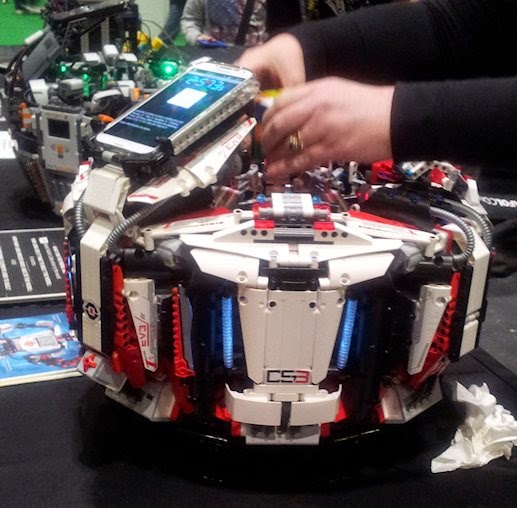
There was a good display of the latest generation of Lego Mindstorms, EV3, including a robot scorpion
and the Cubestormer, the record-breaking Rubik’s cube solver:
Not everything was a massive construction. Some smaller pieces helped demonstrate the versitility.
Small bricks are just large pixels, so there were many pictures on display. My favourite was this transition of millennia:
There were some tremendous pieces, like Westminster Abbey.
![]() |
| Westminster Abbey |
![]() |
| beware! |
![]() |
| watch it in action on YouTube – don’t blink! |
![]() |
| the Platonic solids |
![]() |
| Lego Lascaux, complete with Lego prehistoric artists |
![]() |
| the original, for comparison |
It’s easier to do things like this with the large palette of colours available today.
![]() |
| a far cry from the old black, white, red, blue, yellow and green... |
Trains were much in evidence, combining two standard passions. Possibly my favourite was the nested train systems:
![]() |
| nested train systems |
The upper small oval track system was itself mounted on two trains, one running on the lower large oval track, the other on the central narrow blue oval. That itself was fun and clever, but then we spotted that lower train had a wagon hosting a tiny train running on its own little track, too!
It wasn’t just the Lego itself that was a blast from the past.
It all started getting a bit self-referential with the merchandising, though:
We had a great time looking at all the displays, and also bought about £10 worth of bits (given the price of the entrance tickets, and the train fares, it was quite an expensive £10 purchase). Being a Friday, it wasn’t too crowded; I expect the Saturday will be packed.
Also, I can highly recommend the ExCel’s Orange and Chocolate muffins: they are delicious, and go brilliantly with the coffee.
It wasn’t just the Lego itself that was a blast from the past.
![]() |
| Thunderbirds Are Go! |
![]() |
| the videogame based on the movie based on the toy |
![]() |
| full circle: the toy based on the movie based on the toy |
We had a great time looking at all the displays, and also bought about £10 worth of bits (given the price of the entrance tickets, and the train fares, it was quite an expensive £10 purchase). Being a Friday, it wasn’t too crowded; I expect the Saturday will be packed.
Also, I can highly recommend the ExCel’s Orange and Chocolate muffins: they are delicious, and go brilliantly with the coffee.
Sunday, 26 October 2014
testing, testing
Jack Witham shows how to use Tetris to demonstrate how hard it is to test software.
For all my social networking posts, see my Google+ page
Saturday, 28 June 2014
Euclidean geometry
Labels:
algorithm,
game,
geometry,
mathematics
I saw this interactive geometry game on BoingBoing recently. I’ve just completed the final level 20. It’s great fun. The final couple of levels did have me scribbling on pieces of paper and muttering for a bit. (Well, it has been a while since I left school!)
For all my social networking posts, see my Google+ page
Monday, 5 May 2014
book review: From Elvish to Klingon
Labels:
books,
game,
language,
review,
science fiction
Michael Adams, ed.
From Elvish to Klingon: exploring invented languages.
OUP. 2011
Arika Okrent wrote the excellent and very readable In the Land of Invented Languages, referenced many times here. This book covers some of the same languages, but branches out into a more diverse range that could potentially be considered to be “invented”, with a much wider scope than implied by the examples chosen for the title. The various chapters (discussed below) are contributed by individual experts in the specific areas, and, as with most collections, this results in a somewhat choppy, uneven style, but it does mean that is can be read piecemeal, chapter by chapter. Adams provides his own short appendix (unfortunately printed in a microscopic font size) to accompany each chapter, expanding on some of the issues raised.
An interesting addition to the invented language literature.
For all my book reviews, see my main website.
From Elvish to Klingon: exploring invented languages.
OUP. 2011
Arika Okrent wrote the excellent and very readable In the Land of Invented Languages, referenced many times here. This book covers some of the same languages, but branches out into a more diverse range that could potentially be considered to be “invented”, with a much wider scope than implied by the examples chosen for the title. The various chapters (discussed below) are contributed by individual experts in the specific areas, and, as with most collections, this results in a somewhat choppy, uneven style, but it does mean that is can be read piecemeal, chapter by chapter. Adams provides his own short appendix (unfortunately printed in a microscopic font size) to accompany each chapter, expanding on some of the issues raised.
An interesting addition to the invented language literature.
- Michael Adams. The spectrum of invention.
- This chapter provides an introduction to and scoping of the overall book,
discussing how and why languages are invented, and what might be included as an invented language.
The appendix “Owning language” discusses how different language inventors attempt to control their languages, with greater or lesser success. - Arden R. Smith. Confounding Babel: international auxiliary languages.
- Smith provides a fascinating historical and biographical overview of
the more obvious candidates for invented languages,
including Volapük and Esperanto, and of simplified natural languages,
including regularised Latin, Basic English, Weltdeutsch, and Saxon English
(shades of Poul Anderson’s “Uncleftish Beholding” here).
Adams’ appendix “Esperanto’s zentih” provides some contemporary historical insight into Esperanto, with many acerbic news clippings. - Howard Jackson. Invented vocabularies: the cases of Newspeak and Nadsat.
- Newspeak (from Orwell’s 1984)
and the Russian-derived Nadsat (from Burgess’ A Clockwork Orange)
are not entire languages,
but this chapter unpicks their underlying logic to show that
they are more than just a few random invented words.
Adams’ appendix “Nadsat and the critics” quotes some contemporary reviews. - Edmund S. C. Weiner, Jeremy Marshall. Tolkien's invented languages.
- A look at the development of Sindarin, Quenya, and Orkish, both at how they developed over real
time as Tolkien adjusted his mythology, and at their derivation from a common fictional root.
Adams’ appendix “Tolkien’s languages: a brief anthology of commentary” references some contemporary critiques. - Mark Okrand, Michael Adams, Judith Hendriks-Hermans, Sjaak Kroon. 'Wild and whirling words': the invention and use of Klingon.
- The inventor of Klingon provides an account of its genesis, structure, rationale, and subsequent uses.
Adams’ appendix “Advanced Klingon” gives examples of classics translated into Klingon, particularly Hamlet. - James Portnow. Gaming languages and language games.
- Not all imagined worlds are in books: some are in sophisticated computer games,
and this chapter discusses a few languages that have been invented for interactive games,
and the extra constraints there are on such languages, in particular,
that it be rewarding (games should be fun),
easy to learn (the aim is to play the game, not learn a new language),
and inessential for playing the game (to cater for those players who are not linguistic enthusiasts).
The chapter covers Gargish,
D'ni,
Simlish,
Al-Bhed,
Logos, and
l337 (leet).
In some the languages very few actual example phrases are given, which makes it
a little hard at times to understand the points being made.
Adams’ appendix “L4ngu4ge g4m35 in g4ming l4ngu4g35” gives a leet lexicon. - Stephen Watt. 'Oirish' inventions: James Joyce, Samuel Beckett, Paul Muldoon.
- This chapter is a discussion of the inventive language games played by certain Irish writers who found
English (or any other existing language) to be less than sufficient for their needs.
I found this the least helpful chapter, as it assumes significant familiarity with the material
in question, unlike the other chapters.
Adams’ appendix “The case for synthetic Scots” is an interesting account of Lallans. - Suzanne Romaine. Revitalized languages as invented languages.
- Some languages have dies out, either completely or nearly,
then been revitalised, usually for nationalistic reasons.
This chapter covers Modern Hebrew, Māori, Hawai‘ian, Cornish,
and Breton, among others, as examples of revitalised languages.
There are several issues.
There are difficulties in bringing the languages up-to-date with modern vocabulary
that is somehow faithful to the original language,
and even more difficulties on agreeing how to spell both the new and the original the words,
particularly when the original language had several dialects.
And there are tensions between the few remaining native speakers (often poor)
and the school-taught middle-class who speak a reconstructed variant language
for political reasons as a second language:
each find the other inauthentic.
Adams’ appendix “A reconstructed universal language” closes the circle, and discusses neo-Latin.
For all my book reviews, see my main website.
Thursday, 21 November 2013
this is what happens when you give Computer Scientists access to piped chocolate
We had a Children in Need quiz night at work yesterday. One round was to decorate a cake. Our team (The Flying Robots) felt that a fractal, with its infinite chocolate complexity, should be a sure winner.
The judges, for some unfathomable reason, preferred another:
Okay, maybe we weren’t taking it that seriously…
Thanks to Richard Hawkins, Gary Plumbridge, Simon Poulding, Ian Gray, Ed Powely and Sarah Christmas for some fiendish questions, as well as lovely cake!
![]() |
| Sierpinski cake |
![]() |
| double decker artistry |
Thanks to Richard Hawkins, Gary Plumbridge, Simon Poulding, Ian Gray, Ed Powely and Sarah Christmas for some fiendish questions, as well as lovely cake!
Monday, 12 August 2013
Elite next gen
Amazing! I remember when Elite was state of the art.
For all my social networking posts, see my Google+ page
Subscribe to:
Comments (Atom)


![Before the full body suit [Wade in VR headset]](https://www-users.cs.york.ac.uk/susan/sf/films/ready_player_one/wade.jpg)
![The gang’s all here [Aech, Parzival, Art3mis in the OASIS]](https://www-users.cs.york.ac.uk/susan/sf/films/ready_player_one/gang.jpg)
![This is clearly VR, guys [Aech, Parzival in VR]](https://www-users.cs.york.ac.uk/susan/sf/films/ready_player_one/vr.jpg)