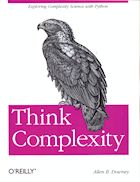
Allen B. Downey.
Think Complexity.
O'Reilly. 2012
The problem with being an autodidact is the unknown unknowns: if you are teaching yourself something, how can you fill the gaps in your knowledge that you don’t even know are there? I am teaching myself Python. Not from scratch, because I can already program in other languages. But that’s part of the problem: because I know how to program, I am learning Python from the on-line documentation (which could be better) and Stack Overflow (which in invaluable). This means I can find the constructs I look for; but what about the ones I don’t know exist?
So I’ve been thinking about getting a book, to help fill the gaps. I came across
Think Complexity, a slim book (130pp) that claims to be targeted at an intermediate level, with the bonus of using examples from Complexity Science, a subject I also study.
It starts off well, with a mention of Python generators (which I had come across as a concept) and their “yield” statement (which was new to me). Yet the discussion is very brief: less than a page. I wanted to know more, as it sounded interesting, and made me wonder if the approach would allow coroutines (am I showing my age?). So I googled, and found David Beazley’s excellent tutorials, one on Python
generators, using them in a functional manner to implement processing pipelines, and one, indeed, on
coroutines. There is a lot more than even hinted at in
Think Python.
Next comes a chapter on algorithmic complexity and “big
O” notation that introduces Python list comprehensions. Now, it’s virtually impossible to have visited Stack Overflow more than a few times without having come across list comprehensions: they are marvellous beasts. However, their introduction here crystallised my apprehension with the book: they are explained with just a few examples only. Examples can be great for showing what is possible, and the examples here are good in that they start trivial and get more complicated. But you also need a description of the underlying syntax, so that you know that you have inferred the structure correctly from the examples, and to cover usages not illustrated by the examples.
The chapter on Cellular Automata uses NumPy arrays, but doesn’t talk about them much. NumPy is excellent for doing anything with arrays, and if you have come to Python via Matlab, like I have, you will feel right at home with them. One interesting snippet made here is an efficient way to implement Conway’s Game of Life using convolution from SciPy (although Bill Gosper’s
HashLife, underlying Golly, is faster, and more interesting algorithmically).
Then there are brief chapters on fractals, self-organised criticality, and agent-based models. But not a lot more Python. The book finishes up with several case studies prepared by students following up some of the concepts in the book; these are probably the most interesting parts. However, they are interesting mainly from a complexity viewpoint, not really from a Python viewpoint.
In summary, although this is advertised as “intermediate level” Python, it doesn’t go very far beyond what you can pick up readily from Stack Overflow. However, the idea of teaching a programming course using fun examples from Complexity Science is a good one: so many texts use relatively boring examples with little motivation. It is clear here from the chapters contributed by the students that they really engaged with the material.
For all my book reviews, see
my main website.