The latest batch, before the Christmas batch arrives.

The latest batch, before the Christmas batch arrives.
The latest batch

The latest batch:

These are some books we bought in York on the way home from our Scottish holiday in August, some undatabased books I discovered when I packed up my office in October, plus a few maths books related to a potential retirement project I'm thinking about.

The latest batch:


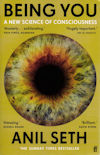
I confess that I have a problem with the problem of consciousness: most descriptions implicitly assume that consciousness itself is a well-defined concept. But I’ve never really come across a precise definition that could be a satisfactory starting point for examining it. Wikipedia starts off with “awareness of internal and external existence”; okay, but what is “awareness” in this context? Many definitions assume it is a human property, which begs the question of possible animal consciousness. And so on.
In this book on state of the art studies of consciousness, Seth also doesn’t give a precise definition. He is tackling the issue from a somewhat different direct, and describes consciousness as “something that it is like to be you”. Then we can allow for the possibility of animal consciousness: there might be something it is like to be a dog, or a bat, or a mouse, or an octopus, but presumably there is nothing it is like to be a rock, or a river, or a car. Is there something it is like to be a tree, or a carrot, or a bacterium? Could there be something it is like to be a robot?
I’m still struggling, though: I’m not really sure what it specifically is like to be me, because I’ve never been anything else, so have nothing to compare it with. Maybe I should just go with “something that it is like to be”?
Lack or precise definitions aside, this is an excellent and thought-provoking book. Seth links consciousness to sensing and acting in the world, at many different levels. Essentially, the brain “hallucinates” different possibilities of what is happening, and uses what we sense to choose the best possibility, which can change as we get more sensory input (such as from the world changing, or from us changing things in the world, including our own position in it). This is accompanied by descriptions of a variety of interesting experiments, and leads to possible criteria for detecting consciousness in patients in comas.
There is lots of great detail here to back up the various claims, and the model explains senses, actions, emotions, and more. Seth uses this model to argue that machines (robots, computers) can never be conscious, that only “wet” organisms have the essential grounded linkages between their hallucinations, senses, and bodily processes, to be fully conscious. I’m not sure I agree with this conclusion, but it is certainly food for thought.
For all my book reviews, see my main website.
Latest batch:

It's been a while since the last update, so there are rather more in the pile than usual:

I came across a new term recently: parasocial relationship. These are “one-sided” relationships, where person A invests some degree of time, energy and emotion in following the life of person B, yet person B is unaware of even the existence of person A.
In these relationships, person B is typically some celebrity enough in the news that person A can easily follow them. But person B may even be fictional: people can look forward to book sequels or new TV seasons so that they can “spend more time” with their favourite characters. More dedicated fans may even write “fan fiction” to this end.
Parasocial relationships have been categorised into three levels: (1) entertainment-social, with normal fan-like following of news; (2) intense-personal, with feelings to the point of obsession; (3) borderline-pathological, with addiction-like fantasies and behaviours.
I would say there is also a level 0, more a form of acquaintanceship, due to existing in a culture where news of the other cannot be avoided, so they necessarily become familiar over time.
An aspect of relationships is that we humans build mental models of our world that include models of these other people (and models of ourselves, and models of their models of us, and…). Most of the people in our own mental model are our specific friends, relatives, colleagues, and acquaintances, plus a sea of famous people, and a sort of background of undifferentiated extras. We each use our own model to predict and anticipate events and behaviours, and so need to keep it up to date and as correct as is needed for us to function in the world. Differences between our model and the real world may be due to a faulty model (eg, I completely misunderstood X’s motivations), or may be due to a change in the world (eg, Y has died). Then our model needs to be updated. But this takes time, and it can be jarring or upsetting for us when our model keeps making incorrect predictions, for example because it is assuming that a person who has recently died is still alive.
A combination of a parasocial acquaintanceship and an uncorrected mental model can possibly explain why one feels upset, or discomforted, or just plain off balance, when a famous person dies. A famous person such as Queen Elizabeth II, for example.
So, I will be watching the funeral. Partly to help update my mental model through forced correctional input (when will it stop being totally weird to hear people saying “the King”?) And partly to grieve the end of a parasocial relationship (level 0+) that I have been engaged in for over 60 years.

The latest batch:

The latest batch:

The final batch before Christmas:

The latest batch:

The latest batch:

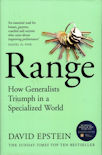
We have all heard about the 10,000 hour rule: that to become an expert, it takes this much repetition and practice. So it seems to make sense that the best way to achieve that expertise is to get a good head start: start young, and to focus. Epstein picks apart that advice here. He has two main arguments, illustrated with copious anecdotes, about why range, or breadth of practice, is just as necessary as depth.
First: 10,000 hours is a long time, requiring a lot of dedicated work. So, you need to be engaged with the topic: if you have not instantly picked your specific area (chess, golf, piano, whatever), you should spend some time surveying the field to discover what you want to do. Epstein give examples of world class sports people who engaged in several different sports initially, and world class musicians who played several instruments at first, before they focussed on one. These people at least had a field, and were just deciding which particular subgenre was for them. He also gives examples of people who tried a much broader range of occupations before discovering their vocation: flitting from job to job, never succeeding, giving up and moving on, until finally they found their life’s work; van Gogh is the best known example given here.
Second: the fields where 10,000 hours of focussed practice works are relatively simple: the practitioner gets immediate feedback on how successful they are, and the topic is constrained, so it is clear where to focus the effort and expertise. However, many disciplines today involve wicked problems: there are no immediate or clear markers of success, the boundary of the problem is ill-defined, and expertise can become constraining, limiting the solution approaches considered. In these circumstances, breadth of experience is an advantage.
Some depth is also needed, of course: too much breadth, and you end up knowing nothing about everything, as opposed to too much depth, where you know everything about nothing. So what are needed are T-shaped people: depth in some area, but breadth across areas, too. I am interesting in interdisciplinary working, and also use this metaphor of T-shaped expertise: in successful interdisciplinary teams, the ‘arms’ of the T join up to bridge between the different areas of expertise.
The book is engagingly written, with many fascinating examples, and covers a broad range of ideas, from the Flynn effect of increasing IQ, to where outsiders have provided insight, to why too much grit may not be a good idea. This latter example discusses a problem with many suggested techniques for success: survivor bias. ‘All CEOs do X’, trumpet these works, implying that if you simply also do X, you too can become a CEO. But to evaluate this claim, you also need to know how many unsuccessful people also do X. After all, presumably all CEOs brush their teeth, eat food, and wear clothes, yet these are not the (sole) reasons for their success. In the case of grit, the successful people studied have indeed grittily persevered, yet Epstein provides examples of others who instead gave up, yet also succeeded, just in something different that fits them better.
And, of course, this book itself also suffers somewhat from survivor bias: showing successful people who nevertheless flitted from job to job before their final success again does not imply that flitting from job to job will result in success. However, there is much interesting material here, and certainly it paints an interestingly different picture from the more mainstream view of the need for specialisation.
The latest batch:

The latest batch:

The latest batch:

The latest batch:


