Showing posts with label solar power. Show all posts

Tuesday, 30 June 2026

three months later

Late March, we decided to experiment with a new solar PV usage strategy due to the relative rates of chear rate grid power overnight (costing us 6.4p/kWh) and the amount we are paid for exporting during the day (15p/kWh).  Rather than use the battery to power the house during the cheap rate, we would used grid power and charge the battery overnight, then export more during the day.  We assumed, from the relative rates, the power company preferred this, maybe to even out demand.

Late June, we get a letter from our power company.  They are changing the export payment rate to 6p/kWh.  On asking why, they told us that some customers are charging their batteries overnight, then exporting that charge during the day.  So the power company is paying those customers 8.6p/kWh (not accounting for losses) to store and resupply its own power.

Anyhow, the power company obviously thought that paying customers to time-shift its own power was a step too far in power demand management, hence the reduction in export payments for all electricity, including actual generation.

Oh well.  Back to manually setting the battery charging pattern (and a severly reduced income from export payment).  Since it's currently summer, that mostly means using the battery to power the house overnight, as there will be enough sunshine to recharge it during the day.  Things will start getting more complicated again come autumn.


Thursday, 2 April 2026

new solar PV and battery charging strategy

We have solar PV and a battery.  If sunny, we can use the PV during the day and export any excess.  We can charge the battery overnight on cheap rate (6.4p/kWh) for use during cloudy days and in the evenings, when power is more expensive (24.2p/kWh).  We can also charge the battery off any excess production during the day.  And we have an electric car, which we can charge off excess production, or off the grid.

Up until now, we have been trying to balance things so that we minimise our import from the grid.  This means charging the battery as much as possible off excess generation during the day, only topping it up overnight if needed, and even using it all through the night if it has enough charge.  In the winter, this means we have been charging it overnight, but in the summer we have been using it all through the night, and charging it off excess during the day, therby having essentially no grid import at all.

This is all well and good, but there are two issues.  First, and most complicated, is that we need to know how much sunshine there will be tomorrow in order to know whether to charge overnight or not.  We have been making this decision manually, because the automatic system is not very good at predicting the weather. This is better than the automatic system, but it doesn't always work, and in early March this year we didn't charge one night when the weather forecast promised sun the next day, but the sun never appeared.  This meant the battery went flat mid evening and we had to import from the grid at the expensive rate.  This cost us about £1, so, more irritating than anything else.  

The second, and more economic point, is that overnight grid power on our current tarrif costs 6.4p/kWh, whereas we are paid 15p/kWh for export.  This means that it makes financial sense to charge the battery (and the car) on cheap overnight electricity, and export all the excess during the day.  That feels wrong, somehow, because we are using more grid electricity than we need to.  But, presumably, the electricity company prefers to provide us electricity at night, and use ours during the day.  We can timeshift, at a profit.

So we have started a new PV/EV strategy.  From late March we have started charging the battery and car, and using grid power, overnight, then exporting all surplus generation during the day now that we are no longer charging the battery off the PV.  We'll try that for the rest of the year, and have a look at the various bills to see if it makes any significant financial difference.  It is certainly easier to "program": we just set and forget.


Monday, 5 January 2026

on a technicality...

Today is Twelfth Night, or the twelfth day of Christmas, so it's still (just) Christmas season.  So does this mean it's technically a white Christmas?

8:08 GMT, looking north

9:29 GMT, looking west

Despite it now being clear sky and full (if low) sun, we have very little solar PV generation.  It has to get through an inch of snow covering the panels first!


Wednesday, 5 November 2025

daylight savings costing coding

We have four sources of data we combine to get our various solar power usage charts.  We have data from the production of the solar panels on the house (PV1&2) and separate data from the new solar panels on the garage roof (PV3).  We have data from a Wattson meter on how much power we consume in the house, and data from the Zappi on how much we use to charge the car (either overnight off the grid, or during the day from excess solar).  Combining these is tricky, because they all have different granularities (from every 30s to every hour).

The combination is even trickier when the clocks change.  None of the data sources tell us whether the timestamps are in GMT, BST, or something else, but we have guessed, probably correctly.  When the clocks went back last week, the Wattson and PV3 systems simply repeated the times for the relevant hour, with the different data.  But the PV1&2 and Zappi systems overwrote the first hour of data.  Aaargh.

Thankfully for my sanity at least, it's my other half who combines the data.  I use the combined data to plot the charts.  So he was tearing his hair out, rather than me doing so.  He has now completed the task.

But still.  Honestly, it's not as if daylight savings is a new thing!  It reminds me of the very first item on the list of Falsehoods programmers believe about time.  At least it gives me an excuse to re-read the list, anyway.)


Monday, 15 September 2025

100 MWh

We've had solar panels on the house roof since early 2014.  Earlier this month, while reading the meter, we realised we had generated over 100 MWh in that time.


And actually, it's a bit more than that, since we have had more solar panels on the garage roof since April last year (to offset charging the electric car), which has increased our capacity by ~50%.

So, we can have a smug green glow of satisfaction.  As long as we don't count my air miles!


Tuesday, 15 April 2025

breaking the trend

We had a lovely start to March: nine sunny days before the weather turned.  

April has been even more amazing.  Fourteen sunny days:


before the weather turned today:


Well, we needed the rain!


Saturday, 29 March 2025

Eight ways to observe the eclipse

We watched the partial solar eclipse quite closely this morning, with eight different instruments.


Going counterclockwise, we have:

  1. A pair of solar viewing glasses from the 1999 total eclipse.
  2. The SeeStar telescope with a solar filter.
  3. The new solar binoculars.
  4. The digital SLR with zoom lens, and, of course, solar filter.
  5. The cardboard solar projector telescope, bought for the 1999 eclipse
  6. The 5" Meade telescope with, you guessed it, a solar filter.
We used all the instruments, but the 5" gave the best view, and the SeeStar got the best pictures, overall.

Just starting: see the big sunspot near the limb. 
There are some smaller, fainter spots towards the top-middle of the disc.

Near maximum, and the smaller sunspots are close to the edge of the moon.

Nearly over

I snapped the sky with my phone to show that it was getting somewhat cloudy. 


The sun is completely overexposed, of course.  But wait. What's that spot on the dome?  (In case you are wondering, we couldn't use the 8" telescope in the dome for this event, as we don't have a solar filter for it.)
Look at that reflection!

So that's the seventh way we could see the eclipse (although we didn't notice it at the time, only when looking at this photo).  

What about the eighth?  Well, that's the same as the way we "observed" a partial eclipse 10 years ago, with our solar PV:

The big dip: that's no cloud, that's the (partial) eclipse)


The device to attach a phone camera to the 5" telescope arrived in the post later in the afternoon.  Oh well.  In any case, a well observed eclipse.


Monday, 10 March 2025

what a difference a day makes

Yesterday, we had had nine sunny days since the beginning of the month, and the solar PV plot looked amazing.

Today broke the streak.  It was not sunny: it was full cloud cover all day, with a bit of brightness around noon.  The solar PV plot now looks very different, with a lot of (pale) orange filling in the minimum to lower quartile range:


Sunday, 9 March 2025

Nine sunny days in March

I make a variety of plots of data from our solar PV system.  One set is of the power generation over the day, plotted on a background of the month (so far) averages.  February looked like this:

The horizontal time axis runs from 3:00am to 9:00pm GMT. The vertical axis runs from zero to 8kW. The orange regions indicate the minimum, lower quartile, median, upper quartile, and maximum generation at that time, over the month. The line indicates the actual generation at that time.  Several days have very little generation, with the black generation line hugging the x-axis (February this year seemed a particularly dark month), so the orange fills the shape.

March so far has been somewhat different:

Nearly full sun every day; hardly any orange in sight on the plots.  Even on the 7th, originally forecast to be dull, there were only a few dips in an otherwise bright day.  It has been very mild, even warm.

The weather is due to break tomorrow.  Ah well, it was glorious while it lasted!


Wednesday, 5 June 2024

solar system model

Before I can develop new charts of the new solar PV + battery system, I need a system model to help me spec up what I should do.  After a few more complicated attempts, I came up with the following:


The horizontal line represents the house mains through which all the power flows.

PV1&2 are the two banks of PV panels on the house; PV3 is the new bank on the garage: they supply power to the mains.  As does the battery when needed (overnight, and daytime when very cloudy or high demand), and the grid (as a last resort).

The main sinks are the house usage, and charging the car via the 7kW Zappi charger.  The car can be powered off surplus PV during the day, or off the cheap rate grid power at night.  Any surplus power goes to the battery (before the car) until it is charged.  After the house, car and battery are satisfied, and further surplus is exported to the grid.

I'll use this model to design some new generation and consumption charts next.


Saturday, 1 June 2024

Westward Ho!

I've finally got around to processing some of the data from our new garage roof mounted solar PV.

Because the house PV is facing south, and the garage is facing west, we expected the garage PV to start later, and finish later.  On the nice sunny 12th of May, that's exactly what we see:

blue = half the south facing house PV; orange = west facing garage PV; x-axis times in BST; y-axis production in Watts

We're getting nearly half as much again solar production from the new panels (the blue line is showing only one of the two banks of panels for house PV production, to make comparisons easier).  The new system peaks later, so we are extending the day to some degree.  But, the two systems actually start and stop generating at about the same times.  On 12th May where we are, sunrise was 5:07 BST, sunset was 20:44 BST.  So they both start generating just after sunrise (despite the garage panels facing west, directly away from the rising sun), and both stop just before sunset, albeit one generating much more than the other around these times.  

This is due to the panels generating a small amount from diffuse sunlight reflecting from the rest of the sky, in addition to generating the bulk from direct sunlight.

The effect of diffuse sunlight generation is even clearer on 16th May:

blue = half the south facing house PV; orange = west facing garage PV; x-axis times in BST; y-axis production in Watts

This was a cloudy day: note the different y-axis scale, here maximum production per bank of panels was around 1.4kW, as opposed to the 3.5kW on the sunny day.  On this day, sunrise was 5:01 BST, sunset was 20:55 BST, essentially the same as on the 12th.  There was no direct sunlight: it was cloudy all day.

Now the two curves are essentially identical, just tracking the thinning and thickening clouds: the different orientations of the panels has practically no effect.

More charts coming later!


Wednesday, 3 April 2024

battery power

We recently got an electric car.  In order to be even greener, we also got some more solar PV panels, to augment the ones for the house.  These are now installed, mounted on the west facing garage roof, whilst the original ones are on the south facing house roof.  So we are also extending our generation time to later in the day.

9 new PV panels, plus a Zappi car charger (between the open garage door and the water butt)

These panels should generate approximately the amount of electricity in a year for 10,000 miles of car travel, hence making us effectively carbon-neutral on mileage (even if some of the generation will be exported, and I will need to charge the car in other places sometimes).

And to be economical with all the electricity we generate, we have also invested in 20 kWh of battery to store our PV generation for use over night:
20 kWh of storage capacity


So we have three rough use cases:
  • summer, best case: we generate enough during the day to run the house (and also charge the car off the PV), and charge these batteries, which we use to run the house overnight -- so using zero mains electricity
  • winter, worst case: we charge the batteries overnight on cheap rate electricity (and also charge the car overnight off the cheap rate), and use the batteries to run the house during the day -- so use only cheap rate overnight electricity 
  • spring/autumn: we generate some during the day, enough to run the house during all the expensive rate electricity, but still need to charge the battery (and car) overnight -- so use only cheap rate electricity, and not that much of it
We also have an app that allows us to obsessively track generation, usage, and battery level.

Let's see what our electricity bills start to look like!  (But even so, it will take over 10 years to break even, we think: batteries are expensive!)


Saturday, 10 February 2024

electric car

We changed car in January, and now have an electric one.  The idea is to use our solar power during the day to charge it, and cheap rate electricity at night as needed.  We don't have our 7kW Zappi charger installed yet (watch this space!), so are charging off the mains more slowly, at just over 2kW.  Even so, we get about 20% added to the battery overnight (exact amount seems to depend a bit on temperature and starting charge in an as yet ill-understood way; I am gathering data), and about 10% on a sunny February day (we anticipate more during longer summer days).

Here's our electricity usage for the beginning of February (more details on my solar stats page).   The vertical axis runs from -8kW to 8kW. The region above the axis represents our usage: orange is generated usage, red is imported from the grid. The green region below the line is surplus generation exported to the grid.  The numbers are total kWh for each day.


On 1st Feb, a nice sunny day, we charged the car on solar power (the orange block around midday), adding a reported 9% to the battery, with an estimated range increase of 25mi, for "free" (as we broke even on the cost of the PV installation several years ago).

Then on 4th Feb we charged overnight (the red block, midnight to 7am), adding 18% charge, with an estimated range increase of 37mi, for  £1.42 on our low cost overnight tariff.  That's 3.8p/mi.

The fuel consumption stats are a bit more fiddly to calculate than with petrol, going from filled tank to filled tank, as not every charging session "fills" the battery.  And the cost of charging varies wildly, from free off PV, to low off overnight tariff (9p/kWh), to eye-watering in service stations (79p/kWh).  So, no "filling up" at service stations; rather, adding just enough to get home.

I do like the fact that during charging, you can measure how fast the estimated range is increasing, in units of miles per hour.


Saturday, 26 October 2019

20 years later

It is 20 years to the day since we moved into our newly-built and actually still-in-the-process-of-being-finished house:
Our house in November 1999; still not actually finished!
We were eager to move in asap, as we had sold our previous house, and had been living in B&Bs for a couple of weeks.  Never believe builders’ schedules, even after adding a couple of months to their estimate, as contingency!

Over the last two decades, we’ve had one major repair: the underfloor heating needed to be replaced due to faulty pipework. (No, of course none of the installer’s insurance, the NHBC construction insurance, or our buildings insurance covered it: when do they ever?)

We’ve made one major upgrade: in January 2014 we installed solar panels on the back roof, which conveniently faces south.  Inside, there has been continual shelf-building over the years, as we had 9000 books when we moved in, and have 14000 now.

But the main noticable change from outside is in the maturity of the garden:

our house today; less of a building site, more of a home
Looking forward to many more years here.


Sunday, 27 August 2017

an infrequent power loss

It’s not just night and clouds that reduce solar power:


For all my social networking posts, see my Google+ page

Saturday, 22 April 2017

free from coal

No coal was burnt to make electricity in the UK yesterday:
First coal-free day in Britain since Industrial Revolution 
Friday is thought to be the first time the nation has not used coal to generate electricity since the world’s first centralised public coal-fired generator opened in 1882, at Holborn Viaduct in London. 
Cordi O’Hara of the National Grid said: "To have the first working day without coal since the start of the industrial revolution is a watershed moment in how our energy system is changing.
I think you’ll find that the industrial revolution started somewhat earlier than 1882, however.
half of British energy on Friday came from natural gas, with about a quarter coming from nuclear plants
Burning natural gas isn’t exactly carbon neutral, either.

Given Friday was cloudy where we were, we actually used a small amount of grid electricity.  It was much sunnier earlier in the week.  On Friday, our solar panels generated a mere 12.7 kWh, while on Wednesday they generated 51.4 kWh.  I assume overall demand is lower on a Friday.


Update 6 May 2017: I see the BBC page has removed its reference to the Industrial Revolution.


For all my social networking posts, see my Google+ page

Tuesday, 2 August 2016

solar beats coal, but gas beats both

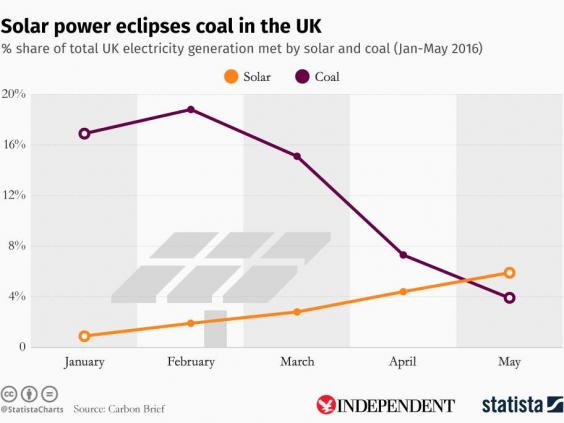
More solar power that coal powered electricity in the UK this May, but each is only a small fraction of the total.
Solar just made more power than coal in the UK for the first month ever


For all my social networking posts, see my Google+ page

Thursday, 7 January 2016

Underestimating renewables

John Baez asks why autonomous intergovernmental organisation The International Energy Agency (IEA) consistently underestimate the future production of renewables in their annual World Energy Outlook (WEO).


Maybe they’re not as independent as they look?  


For all my social networking posts, see my Google+ page

Wednesday, 6 January 2016

don't throw stones!

Build your house inside a glass shell, save on heating, and have lovely interior gardens. Probably only useful in cold northern climes, though, otherwise I suspect summer would be a problem! But I like the point about needing no roof (instead, using the space for a terrace), and less maintenance on the house itself, because it is fully protected from the wind and rain.

This is a relatively old system (10 years) and they have no solar PV – I wonder how that could be integrated into the system?


For all my social networking posts, see my Google+ page

Sunday, 1 November 2015

summer, what summer?

Here’s the record of how much our solar PV system has been generating over the summer:
summer 2015

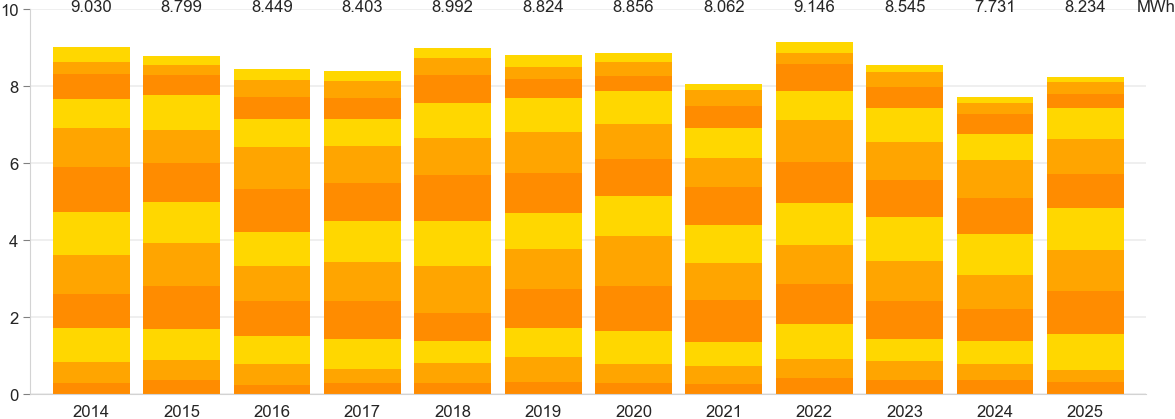
So, a monotonic decrease in the average energy from April all the way through to August; then September with a higher average than August; then plummeting in October.

Last year had a much more sensible shape:

summer 2014