Showing posts with label TV. Show all posts

Friday, 7 April 2023

Conversation 2023: Eastercon Day 1

We drove to the Birmingham Metropole for this year's Eastercon, arriving around lunchtime, and dove straight in to going to panels.  (Hotel checkin wasn't open until later.)

First was Where does history end and fantasy begin?  The discussion was mainly about history, and how things happen, then history is a narrative we use to explain what happened.  We get to pick and choose events to narrate, and different people at different times pick different things, while still telling a valid history.  Although things can get exaggerated or omitted for political reasons.  A few snippets: Wolf Hall is interesting, because it flips who was originally the good guy (More) and the bad guy (Cromwell).  Early accounts of Dick Turpin had him as a thug, but the stories gradually softened over time.  There are three separate iterations of the story of St Patrick, told at different times for different political purposes.

Next up, The Adaptable Gaiman, on how Neil Gaiman stories adapt to film or TV.  Apparently American Gods season 1 is great, then goes downhill.  Season one of the Sandman is also great, and the panellists are waiting to see if this continues.

We went to a couple of panels on Beyond Human Intelligence and Conlangs and You (constructed languages), and finished the day with Fearlessly Spineless: Invertebrates in SFFH, where we learned that Western cultures are more afraid of insects and invertebrates than other cultures despite having the fewest poisonous ones, and that there is a type of chordate where members can combine into a group organism (I didn't catch the name of it, unfortunately).

And so to bed.


Saturday, 10 September 2022

On parasocial relationships, and updating mental models

I came across a new term recently: parasocial relationship.  These are “one-sided” relationships,  where person A invests some degree of time, energy and emotion in following the life of person B, yet person B is unaware of even the existence of person A.

In these relationships, person B is typically some celebrity enough in the news that person A can easily follow them.  But person B may even be fictional: people can look forward to book sequels or new TV seasons so that they can “spend more time” with their favourite characters.  More dedicated fans may even write “fan fiction” to this end.

Parasocial relationships have been categorised into three levels: (1) entertainment-social, with normal fan-like following of news; (2) intense-personal, with feelings to the point of obsession; (3) borderline-pathological, with addiction-like fantasies and behaviours.  

I would say there is also a level 0, more a form of acquaintanceship, due to existing in a culture where news of the other cannot be avoided, so they necessarily become familiar over time.  

An aspect of relationships is that we humans build mental models of our world that include models of these other people (and models of ourselves, and models of their models of us, and…).  Most of the people in our own mental model are our specific friends, relatives, colleagues, and acquaintances, plus a sea of famous people, and a sort of background of undifferentiated extras.  We each use our own model to predict and anticipate events and behaviours, and so need to keep it up to date and as correct as is needed for us to function in the world.  Differences between our model and the real world may be due to a faulty model (eg, I completely misunderstood X’s motivations), or may be due to a change in the world (eg, Y has died).  Then our model needs to be updated.  But this takes time, and it can be jarring or upsetting for us when our model keeps making incorrect predictions, for example because it is assuming that a person who has recently died is still alive.

A combination of a parasocial acquaintanceship and an uncorrected mental model can possibly explain why one feels upset, or discomforted, or just plain off balance, when a famous person dies.  A famous person such as Queen Elizabeth II, for example.

So, I will be watching the funeral.  Partly to help update my mental model through forced correctional input (when will it stop being totally weird to hear people saying “the King”?)  And partly to grieve the end of a parasocial relationship (level 0+) that I have been engaged in for over 60 years.


Saturday, 25 December 2021

sequestering carbon, one Christmas at a time IX

 His ’n’ hers Christmas presents:


Giving someone a book on infrared astronomy on the very day the James Webb Space Telescope was launched is either prescient, or premature.

Friday, 2 July 2021

TV review: Timeless season 1

Historian Lucy Preston is brought in to a strange case: terrorist Garcia Flynn has kidnapped a scientist, stolen a time machine, and taken him back in time to change the timeline. Lucy, along with soldier Wyatt Logan (the brawn) and time machine pilot Rufus Carlin (the engineering brains) need to take the backup time machine and stop him before he wipes out the future.

One the one hand, this is great, with an exploration of multiple historical vignettes as the team bounce through time trying to stop Flynn, and as the reason for Flynn’s actions is gradually revealed. Also, the racism and sexism in the past are highlighted: Rufus notes that there is nowhere in history where it was a good time to be a black man; Lucy doesn’t fare that well sexism-wise either, but does manage to get away with several snappy comebacks. (There is an implicit assumption that racism and sexism are no longer a problem in the present, but where else did Lucy get those comebacks?)

On the other hand, it is totally bonkers, with the results of changes in the past having essentially only single effects on the future. For example, the first episode has the conflicting efforts of Flynn and the team meaning that the Hindenburg passengers didn’t die. The only visible effect once they get home is that Lucy’s beloved sister Amy disappears from the timeline and her mother is no longer dying of lung cancer; Amy’s father (who turns out not to be Lucy’s father, to her great surprise, and of subsequent plot importance) married a descendent of a Hindenburg survivor in the changed timeline. So Lucy’s mother never married, and never started smoking. But she still lives in the same house, with the same furnishings, as before… In fact, there’s a bit of a running joke of finding out what change to history resulted from their actions each time, like an extra James Bond film, or a different person being the recognised hero of the event. Also, Lucy, apparently involved because of her encyclopaedic knowledge of history, should become steadily more useless as the past moves away from her knowledge of it.

So, don’t think too carefully about the logic of the timelines. Instead, sit back and enjoy the interesting views of historical events.


For all my SF TV reviews, see my main website.

Sunday, 24 January 2021

Netflix spam

I’ve started receiving email ads from Netflix.  

They claim I’m getting them because I have an account: I don’t.  

These emails are being sent to an old email address I haven’t used in over a decade…


Monday, 14 December 2020

the eyes of the tiger

Back several decades ago, Esso had a TV ad with the most breathtaking pictures of tigers, including a fantastic final shot.

I was desperate for a copy of that pic, so actually wrote to Esso.  They were kind enough to send me a poster (I think they had many requests!), but it was the wrong picture.  It was a poster titled “The Cat’s Whiskers”, and was a lovely picture of a tiger, but wasn’t that picture.

The Cat’s Whiskers

Then yesterday we were watching an episode of Neil Brand’s short TV series on the music of TV; the episode was about adverts.  AND THERE IT WAS...

screen shot

That expression!  Those eyes!  “Look on my Face, ye Puny, and despair.”

I did a Google image search, which matched a few eBay sites that only led through to “The Cat’s Whiskers”.  So this fuzzy screenshot is the best I’ve got for now.  But still better than I had. 


Sunday, 2 August 2020

TV review: Devs

Beautiful nonsense

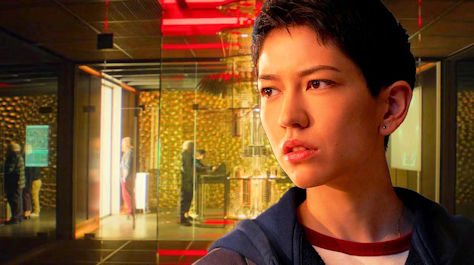
Lily Chan and her boyfriend Sergei Pavlov are software developers at the high tech Amaya company in San Francisco. Sergei is reassigned to the secretive Devs project, disappears, and then security video of his suicide turns up. Lily is initially distraught, but then suspicious. She starts to investigate, and discovers the Sergei was murdered when he tried to steal Devs code. Her own life is at risk as she works to discover what the Devs project is actually trying to do.

The whole premise is bonkers. SPOILER: the Devs team are developing quantum computer code that can retrodict the past from the current state of the world. (It can also predict the future, but the team are forbidden to use it to do that. Yeah, right.) My first snort of derision was when Sergei asks how big the quantum computer is, and Forest answers “a number that it is meaningless to state”, while they are looking at a machine that has about 50 qubits in the real world.

At one point we see a crystal clear rendition of an episode from tens of thousands of years in the past. This is, of course, all impossible, for so many technical reasons. At another point one of the team asks Lily to name something that in not determined by something earlier: everything she says is refuted. The one thing she doesn’t suggest is Schrödinger’s cat, or some other quantum process. (And even if we ignore quantum mechanics, the very technology central to the plot, we know that chaos means that even a deterministic system can’t necessarily be predicted, or retrodicted, because of sensitive dependence on initial conditions. Okay, I’ll stop the dynamical systems lecture now…)

Also, everyone works on the assumption that the computer’s predictions of the future (because, yes, of course they do use it for that) are inevitable. There’s a scene where the predictions are running a couple of seconds ahead of a group of people watching the prediction; no-one even tries to do something different. Lily, apparently, is the only person who can do something different from the prediction. It all ends nonsensically in a computer simulation.

So why do I say it is “worth watching”? Because the slow calm pace (even of a couple of murders!), the beautifully shot soft, rich, misty San Francisco, the amazing soundtrack, all add up (even with occasional shouting at the screen) to a dreamily beautiful experience.

Even if the premise is bonkers.


For all my SF TV reviews, see my main website.

Wednesday, 8 July 2020

TV review: Star Trek Discovery season 1


I recall when this first came out hearing a lot of fannish criticism, from the uniforms to the plot. I hadn’t heard whether that died down during the season or not. But we thought we’d give it a try anyway.

So, we are in the Star Trek universe, about 100 years after Enterprise, and 10 years before the Original Series. I’m not sure if it joins up with the original TV timeline, or the new movie series timeline (which I personally consider to be non-canon); maybe that never becomes clear. Michael Burnham, adopted daughter of Sarek and Amanda, is cashiered for mutiny at the start of the Klingon war with the Federation. Despite this, she ends up on board the starship Discovery, with its experimental spore drive, a key weapon against the Klingons.

This is not your typical light optimistic Star Trek. It unfolds into a dark season arc; it has a (deliberately) non-funny Harry Mudd episode, a “Groundhog Day” episode, a Mirror Universe episode, a lot of very nasty Klingons, a lot of very nasty Terrans, a captain acting dubiously, Starfleet acting dubiously, and more. It plays like grimdark non-canon Star Trek fanfic (what happened to the spore drive? why had we not seen Kelpiens before, or since?), yet also weaves in bits of early Original Series background.

It starts off slowly, but as the existence of the arc becomes established, the tension mounts. Characters die. Other characters are not what they seem. There are several jaw-droppingly unexpected moments. It’s really rather good.

Now for season 2…


For all my SF TV reviews, see my main website.

Sunday, 5 July 2020

TV review: Good Omens


Armageddon is coming. Still, it’s not the end of the world…

The angel Aziraphale [Michael Sheen] and the demon Crowley (originally the snake Crawly) [David Tennant clearly having immense fun] have been on earth since the beginning of time (that is, about 6000 years), slowly become unacknowledged friends, and the only immortals around. But now time is up. The Antichrist has been born, and it’s Crowley’s job to make sure he’s placed with the American Ambassador, ready for Armageddon in a few years time. But Crowley messes up, and the boy is placed with a surburban British couple. Apocalyptic hijinks ensue.

This is Neil Gaiman’s adaptation of the book by him and Terry Pratchett (I haven’t read the book). Some might not feel it’s a good idea to watch an end of the world tale during a global pandemic lockdown, but it felt appropriate. There may be a few places where Gaiman is simply having too much fun, but on the whole this is a great series. It is clever, funny, scary, weird, sarcastic, touching, inventive, and wonderfully irreligious.


For all my SF TV reviews, see my main website.

Tuesday, 5 May 2020

Covid-19 diary : snooker

The 2020 World Snooker Championship should have been on TV last week, but unsurprisingly it has been postponed.  So BBC2 have been showing highlights of old matches.  Ask anyone who has been around a few years which match they would definitely show, and you will get the answer “the 1985 final”.  That final, between Steve Davies and Dennis Taylor, is the stuff of legend.

It was the best of 35 frames.  It looked as if it was going to be over quickly, as Steve Davies took the first 8 frames.  But then Taylor started coming back, and the match went into its second day.  We decided to watch the end game, thinking Davies would probably clean up quite quickly.  But then it reached 17 all.

The final frame was agonising, but riveting.  It took over an hour, and went on past midnight.  It was eventually decided on the black ball, which didn’t go down without a fight.  Truly memorable, and there were a lot of bleary-eyed people at work the next day!

BBC2 showed it again at the end of last week.  I watched the final frame.  Again.  I had forgotten the details of the agonising safety play, the foul strokes, the snookers, the missed pots, the green that ended up in a different pocket from where it was aimed.  I held my breath during several shots.  And then there was that final black, hanging on, with another succession of safety shots and missed pots.  Eventually, Steve Davis missed a pot, and the white hit the black on the rebound, leaving a clear shot for Taylor; the look Davies gave the table when he saw what had happened.

In the interview afterward the repeat, we learned that nearly 19m people, nearly one third of the UK population, watched that final frame, after midnight, on BBC2.  And we learned how snooker had grown; only 13 years earlier, in 1972, Hurricane Higgins won the championship playing in a cramped workingman’s club.  David Attenborough was responsible for this growth, wanting a relatively cheap programme to show off the new colour television service.

One intersting little fact I got from Wikipedia: Taylor had not been in the lead at any point during the game, until he potted that final black to win the championship.

And I suppose that, if not for Covid-19, we might not have seen it again.  It’s a funny old world.


Saturday, 13 April 2019

TV review: The Good Place season 1

We’d heard good things about this, and it came up on E4, so we thought we’d give it a try. We were rapidly hooked.

Eleanor Shellstrop wakes to find herself dead, and in The Good Place. The boss, Michael, explains that she is one of only a very few who gets to be there, because of all her marvellous humanitarian works during her lifetime. The problem is, she’s actually a selfish unpleasant person, who has been mixed up with a different Eleanor Shellstrop, and isn’t supposed to be there at all. How to ensure she isn’t found out, and sent to The Bad Place? Well, her soulmate just happens to be a moral philosophy professor...

Every episode is interesting, funny, and ends with a twist we never saw coming. There are real ethical dilemmas, real philosophy lectures, people who aren’t nice but you care about, utterly absurd situations, and it’s all just beautifully performed. And the massive twist at the end of season one – well, how are they going to handle season 2?

Witty, funny, clever, and unexpected. E4 don’t seem to be showing season 2, so we went off and got the DVD.


For all my SF TV reviews, see my main website.

Sunday, 7 October 2018

It's About Time

O brave new world, That has such people in ’t!


Saturday, 14 July 2018

TV review: Grimm season 6

!!! SPOILERS FOR SEASON 5 !!!
.
.
.
.
.

This sixth and final (half) season starts where season 5 ended: Black Claw leader Bonaparte dead by Reynard’s Diana-controlled hand. This leads into a frantic set of episodes, where monster-of-the-week vies with a scramble to tie up all the loose ends in only 13 episodes. Black Claw conveniently disappears in a puff of smoke, while the arc focusses on the Magic Stick and what it means, leading up to a potential catastrophe that could destroy the entire human world. (Well, if you are going to potentially save the world, best to leave it to the end, otherwise it’s hard to top.)

There were possibilities for “happy” endings that would have been annoying resets: these possibilities were not taken. However, there were hanging guns that never went off (Black Claw conveniently vanishing; Diana conveniently not destroying the world in a fit of pique; re-hexenbiested-Adelinde conveniently not reverting to a monster). Also note: if you kill one major character, viewers might think they are really dead even in a fantasy series. When you kill them all, viewers are more suspicious. Despite these issues, the season did tie up most loose ends, without giving the impression that the characters’ adventures over.


For all my SF TV reviews, see my main website.

Tuesday, 29 May 2018

TV review: Grimm season 5

!!! SPOILERS FOR SEASON 4 !!!
.
.
.
.
.

This fifth season starts off with the fallout from season 4: new-Hexenbeast Juliette having killed Nick’s mother, tried to kill Nick, then herself been killed by Trubel. Only, in the best way of fantasy tales, Juliette isn’t as dead as she once was, having been taken by Hadrian’s Wall, the covert anti-Wessen organisation Trubel now works for. They have turned Juliette into Eve, a super-powerful emotionless Wessen killer with a strange taste in wigs. Meanwhile, Adelind and her new baby, Nick’s son (from when Adelind was disguised as Juliette), has become part of the good guy team, and Nick seems quite happy to change the target of his affections. And Black Claw, a powerful covert Wessen organisation, is out to take over the world, starting with Portland.

Yes, it’s getting complicated. And a bit of a mess. The overall season arc is the fight against Black Claw, but still with the monster-of-the-week detecting to do. When the stakes are low, fighting monsters one at a time seems fine; when the stakes have risen to world domination by Wessen, I would have thought a more joined-up response would be better. That’s what Hadrian’s Wall is for (although rather sparsely staffed), but Nick can’t just join them, for some reason. In fact, the monster-of-the-week is often the light relief from the darker background tone. And this time it’s Wu’s turn to misguidedly keep secrets from the others. Also, Hank now appears to be about the only normal human on the planet.

Two characters have massive plot-driven changes. Adelind becomes one of the good guys. Even when the humanising potion wears off and she’s got her hexenbiest powers again, despite dire warnings and fears of her turning bad, she stays the same. And Reynard’s change seems rather under-signalled: his flip to the Dark Side needed more motivation, which it would have been easy to provide, given his background. Then the Magic Stick is found, and forgotten for a few episodes, before becoming potentially, but not actually, decisive. Maybe next season?


For all my SF TV reviews, see my main website.

Thursday, 22 February 2018

TV review: Arrow, season 4

My name is Oliver Queen. After five years in hell, I returned home with only one goal: to save my city. But my old approach wasn’t enough. I had to become someone else. I had to become something else. I had to become … the Green Arrow.
At the end of last season, Oliver and Felicity drove off into the sunset, leaving the Scooby Gang to keep Star City free of bad guys, while they tried to get over the way Oliver had deceived them all.

At the beginning of this season, Oliver and Felicity return, to help out with a new Big Bad. There’s lots of confusion and deception, as we discover who Damien Darhk is, where he gets his power from (including a nice parallel Island of Hell story), what Felicity’s codename is, whether Oliver will win the race for Mayor, who is going to get killed (not a spoiler, as we see Oliver crouching by a gravestone early on), and whether Oliver can go for a season without deceiving his friends about Important Facts in order to Protect Them (hint: he can’t).

The stakes are higher than ever: Darhk is after much more than the destruction of Star City. And with a cross-over episode with the Flash, and some weird time travel changing the past/future, Oliver manages to screw up his relationship with Felicity twice.

By the end of season, everyone has been put through the wringer. And many arrows have been shot.


For all my SF TV reviews, see my main website.

Saturday, 13 January 2018

TV review: The Librarians, season 1

Flynn Carsen [Noah Wylie] is The Librarian, charged with care of The Library and all its magical artefacts – sort of a more book-oriented Warehouse 13. (Apparently this follows on from where the Librarian films leave off, but I haven’t seen them.) While tracking down a magical artefact, Flynn runs across Colonel Eve Baird [Rebecca Romijn] on a counter-terrorism operation. She later receives a mysterious invitation to become The Guardian. They discover previous Librarian candidates are being killed off, so go to rescue the last remaining three: Jacob Stone (an Art History geek pretending to be a redneck), Cassandra Cillian (a maths genius with a brain tumour), and Ezekiel Jones (a thief). The villain Dulaque [Matt Frewer, channelling Christopher Lloyd as Judge Doom] is behind the deaths, and at the end of the pilot, the Library is lost, Flynn goes off the find it, and Eve and the three Librarians-now-in-Training are left holding the fort (or rather, the Annex) with grumpy factotum Jenkins [John Larroquette], pursuing the Artefact-of-the-Week.

This is mild fun, and definitely improves after Flynn goes off on his own quest: Wylie galumphingly overacts, and the way he frantically pulls books off shelves … shudder.

The episodes strengthen as the various characters bed in, and stop being simply stereotypes. There is actually a season arc, and some of the seemingly-disparate episodic adventures come together in the season finale. But it doesn’t quite gel: it can’t make up its mind if it is slapstick humour or mystical thriller, and falls rather uncomfortably between the two. So I’m not sure if I’ll be venturing into season 2.


For all my SF TV reviews, see my main website.

Saturday, 28 October 2017

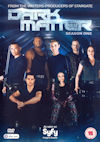
TV review: Dark Matter, season 1

Six people wake up from stasis on an interstellar spaceship: all have lost their memories. Which one of them wiped all their minds? And why? They must work as a team to survive, but how can they do so when any one of them may be a traitor?

As the season progresses we learn more about the crew. Initially, it seems they are a gang of criminal mercenaries, ready to hire out to various Corporations to destroy inconvenient colonies, steal dangerous research, and more. But as we learn along with them more about their backgrounds, it becomes clear that this simplistic picture is far from the truth. Each of them has deeper secrets, and no-one is who they seem.

It’s a pity that the three “women” each have to be atypical in some particular way: the kid, the android, the [spoiler], whereas the men are all simply men with their own agendas. But, hey ho, at least there are women here.

I don’t know if it’s just me, but I’m sure after all this time I would have given the android a name. Mind you, the crew are still calling each other by their waking-order numbers, which makes it complicated to remember who’s who. (Which one is “Four” again?) In fact, their strangely spacious spaceship, the Raza, is the only main character with a name!

Each episode has some good action, moves the arc along, and reveals more background. Sit back and enjoy some fun hijinks with mercenaries who are actually the only good guys around! And be prepared for a massive end-of-season cliffhanger.


For all my SF TV reviews, see my main website.

Sunday, 22 October 2017

Christmas teaser

I see that the cover of last week’s Radio Times shows Clara Oswald impersonating Queen Victoria.

Is this a teaser for the BBC Christmas special?  Maybe hinting at a cybermen-kidnapping-royalty plot, or even a prequel to Rose’s role in the Royal werewolf plot?

Or am I just overthinking this?


Friday, 14 April 2017

Innominate Eastercon - Friday

This year’s 68th Easter Science Fiction convention saw us driving to the Birmingham Hilton Metropole, next to the NEC, the same hotel as used for Illustrious in 2011.  We left plenty of time for the drive, as the travel-pundits were predicting road chaos.  There was no road chaos. That left us plenty of time for lunch before starting to go to the sessions.

The first session I attended was a two-person panel on Biotechnology and the Law.  Dr Helen Pennington and Dr Colin Gavaghan talked on a variety of aspects of how the law is maybe failing to keep up with scientific advances.  CRISPR/Cas9, a technique to edit out genes from the genome, was mentioned a lot, including the fact that it can be used to produce GM organisms that are indistinguishable at the DNA level from organisms “naturally” bred to have the gene removed.  The consensus was that items should be labelled so consumers could exercise choice: some don’t want to eat GM food, some prefer GM food, as it doesn’t tend to have the trace amounts of natural fungal microtoxins that organic food does. Nevertheless, Scotland and New Zealand have banned the growing of all GM crops, not just food crops, in order to present a clean “green” image; this is ironic, given that Scotland does not exactly have a healthy food reputation!  The current “over the counter” availability, cheapness and ease-of-use of CRISPR led on to discussion of potential dangers; the panellists weren’t too worried, given the difficulty of keeping the GM organism alive: “any back-garden bio-terrorist is likely just to kill themselves, and a couple of neighbours”.  Given the potential untraceability of GM organisms, the suggestion was the most important legislation change is to require registering trials and publishing results, as is now beginning to happen for medical trials, to stop the covering up of “mistakes”.
Victorian times: Dinner in the Iguanodon Model, 1854

Next I went to a talk on Dinosaurs in fact and fiction by Dr Will Tattersdill. Dinosaurs are complicated: there are the “real” dinosaurs that existed in Deep Time, and there is our changing knowledge of dinosaurs since their discovery in Victorian times, to our better but still imperfect knowledge today.  They form a perfect link between the “two cultures” of arts and sciences: you can’t have a dinosaur without scientific activity and physical evidence, but you need imagination and art to “flesh out” a whole animal from a few bones or partial skeleton.  As science advances, our knowledge increases, but our dead images, our wrong images, stay with us, too, in books, in toys.  Arguing that these “old” dinosaurs are wrong is robbing us of our pasts, of our childhoods, in much the same way that arguing Pluto is not a planet does.  We have a nostalgia for outmoded science. In his essay “Dinomania” Stephen Jay Gould writes “When I was a child, ornithopods laid their eggs and then walked away forever.  Today these same creatures are the very models of maternal, caring, politically correct dinosaurs.”  Just look at the tenses and model of time in that quote!  Will speculates that dinosaurs are perfect for SF readers: we have the “cognitive agility” to hold multiple worlds, each with their own rules, and complex models of time, in our heads; this skill is needed to hold all the different “human pasts” of dinosaurs, too.  The talk covered more: history, cultural imperialism, phylogenetic trees, gender, SF stories, … you name it.  Brilliant stuff; I’m looking forward to his book due out end of 2019.

Next came David Allan’s quiz, loosely based on Pointless.  The team of 4 did well, hampered as they were on occasion by one of the options not appearing on their sheets, only on the screen visible to the audience.  Picture round: Name the alien.  Alternate letter round: Fictional planets: _A_I_O_R (Majipoor), _A_L_F_E_ (Gallifrey), A_R_K_S (Arrakis), M_D_E_I_ (Midkemia),  Title of First Novel in Trilogy on Being Given the Second, … When the surprisingly low scores for some of the more obvious options were revealed, the audience demanded to know who on earth the consulted panel were.

Then it was time for the opening ceremony.  As traditional, the Guests of Honour were invited up onto the stage, as were the con committee, for applause.  Afterwards, Dr Emma King from the Royal Institution gave an excellent presentation that involved lots of things going bang.

For the final item of my day, I went along to a panel on Making Money from Art and Craft in the SFF Community.  I am not myself an artist, by any stretch of the imagination, but I have a friend who is, who sells a few fantasy-related items on eBay.  I went to find out if there is more they could do.  In summary, and unsurprisingly, if you want to make more than just your costs back, you are going to have to move from a hobby to a profession, which many crafters don’t want to do.  But I did discover the existence of something called silver clay.  I won’t do anything with this knowledge, other than enjoy the fact that I now know about this.