Showing posts with label film. Show all posts

Monday, 1 December 2025

ooo?

We went to see Wake Up Dead Man (Knives Out #3) in the cinema today.  It's only on for a week, because it is a Netflix film.  They need a cinematic release for it to be considered for awards, but want to minimise the time, so people will pay for it on Netflix.  We missed Glass Onion for this reason, and didn't want to miss out again.  (We don't do Netflix.)

It was excellent.  If you enjoyed the complexity, clues, and red herrings in Knives Out, this is just more so.

In the cinema foyer, there was an advert for Zootropolis 2 (the UK name for Zootopia 2).  The name caught my eye.  It seems to be a back formation from "metropolis".  But that is a combination of "metro" and "polis".  So really it should be Zoopolis 2?  But for a moment I thought the suffix was actually "opolis", in which case it would be Zooopolis 2.  I'm willing to believe this is the case, just to have a word with three consecutive "o"s.


Wednesday, 15 April 2020

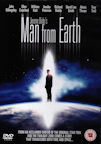
film review: The Man from Earth (2007)

John Oldman is a respected university professor, who resigns just as his career seems to be in the ascendant. He tries to sneak away, but his friends drop round to his cabin to throw him a farewell party. They can’t understand why he is leaving, and pester him for a reason. Eventually he agrees to tell them: he’s an immortal Cro Magnon who has to keep moving on since he doesn’t age. Initially his friends assume he is joking, but as the story lengthens, they start to think him mad, or maybe even start to believe him…

This is almost entirely dialog taking place in a single room, and is utterly gripping. Is he joking? As he and his friends point out, there is no way to prove what he is saying. But the story keeps building. One thing that makes John sound so believable is the serene way he both tells his story, and reacts to the jibes and questions of his friends. Could only someone who has lived as long as he claims, and been taught by the teachers he mentions, be so mellow?

Although filmed in 2007, this was conceived and written by Jerome Bixby somewhat earlier. I think that, with today’s technology, some of Oldman’s claims could indeed be substantiated: a DNA test might help demonstrate his stated age; some antibody tests might help demonstrate he had suffered the various ancient diseases he mentions. So he is even more right to keep hidden!


For all my film reviews, see my main website.

Sunday, 22 December 2019

sequestering carbon, several books at a time CII

The latest, pre-Christmas, batch:


There are several books accompanying “Great Courses” lecture series – there was a sale on; the individual lectures make a nice half-hour session to eat lunch to.

Saturday, 12 October 2019

film review: Predestination (2014)

A young man relates his incredible history as an unmarried mother to a sympathetic bartender, who then recruits him into a secret organisation that explains, and causes, all his troubles.

The underlying plot logic is based on Robert Heinlein’s 1959 short story “—All You Zombies—”. I can’t say how comprehensible the movie is without knowing the background; it may need to be viewed twice to pick up earlier clues. To extend it from a short story, certain elements have been added, like more details on the secret organisation, the violin case, the Fizzle Bomber, and the loop’s closure. These additions are all fine, as they tighten the loop. (I do think it would have been interesting to try to include the organisation’s head in the loop, too, but that would have been quite a big deviation from the original story.)

The beginning is a little slow, being mostly narration with flashbacks, but once the narration has caught up to “the present day” (whatever that means in such a time loop) the action carries along on nicely. It follows the original short story’s plot very closely, including the time it is set – the opening bar scene is set in 1970 – which gives it a retro alternate history vibe, 50 years on from then. The main deviation is the added ending, which, amazingly, improves what is already an almost perfect time loop plot.

On the whole, this is a great realisation of a terse and densely plotted short story.


For all my film reviews, see my main website.

Sunday, 13 January 2019

film review: Spider-Man: Into the Spider-Verse

Miles Morales is a nerdy kid, sent off to a high powered school, but who prefers producing graffiti art with his shady uncle. One time, he gets bitten by a spider, and starts manifesting strange abilities. On returning to the place, he finds Spider-Man (Peter Parker) fighting KingPin over a huge accelerator; Parker hands Morales a data stick that can close down the accelerator. The accelerator has opened a rift in the space-time continuum, and several alternate parallel universe versions of Spider-Man fall through. Morales must gain control of his spider powers, and work with the other spiders to close down the accelerator before the universe is destroyed.
Peni Parker, Spider-Gwen, Spider-Ham, Spider-Miles, Spider-Peter-B, Spider-Man Noir
the gang’s all here
I confess when I started watching this, I didn’t know it is an origin story, and that there is a new Spider-Kid on the block. That means I probably missed some in-references. But even coming to this relatively cold, I still found it hugely enjoyable. It takes a while to get going, as Morales’ pre-bitten character is established. But the film is clever, and knowing, and funny, and moving, and self-referential: every Spider-character gets an increasingly funny origin-narration; Peni Parker and her robot are drawn subtly differently in anime style; there’s a Stan Lee cameo; Spider-Noir’s monochrome character is drawn using different sized black dots to make shades of grey; the tingling spider-sense seems to be of use only to detect the various other Spider-characters; Aunt May’s response to the various alternate Spider-beings is priceless.

I’m not sure about the message on studying: Morales has to work hard at his new school, where all the kids are bright, but to learn how to use his new powers, he seems to only need to want hard enough, and spung, he gets perfect control. No 10,000 hours of practice needed for super-hero skillz, it seems.
Spider-Ham, Spider-Man Noir, Spider-Peter-B, Spider-Miles, Spider-Gwen, Peni Parker

I did some surfing after watching the film, and discovered all these Spider-characters pre-exist in the literature. So I hope there are more films in this multi-verse: having a larger cast of the “same” super-hero riffing off each other gives very rich possibilities.

Highly recommended.


For all my film reviews, see my main website.

Saturday, 28 July 2018

film review: Solo: A Star Wars Story

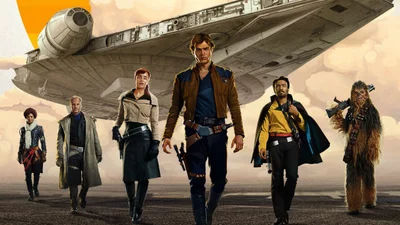
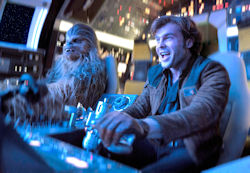
Where Rogue One was a prequel, showing how the situation at the start of the events of Star Wars – A New Hope arose, Solo is an origin story, showing how the character of Han Solo became who he was. We see how Han got the name “Solo”, how he met Chewbacca, how he won the Millennium Falcon from Lando Calrissian in a dodgy card game, how he made the Kessel Run in less than 12 parsecs (with a bit of hasty ret-conning why that even makes sense), and some things we didn’t know from previous films, such as how he joined the Imperial Army, the world and people he left behind, and how he was in at the genesis of the Rebellion.
no longer Solo
cocky kid

There is sufficient plot that this is an exciting stand-alone adventure of trust and betrayal, and also sufficient hooks to what comes later to make it a significant addition to the canon. My main gripe is that this is supposed to introduce us to the cynical Han Solo we know as an adult, by introducing him as a sort of "lovable rogue with a heart of gold"; but he’s just a bratty kid, really.

There is clearly meant to be a sequel, the “Jabba the Hut years”, maybe, since this ends well before episode IV kicks off, with a major part of the plot arc with his childhood sweetheart unresolved. We have to hope that the film does well enough not to end up with a prophetic title.


For all my film reviews, see my main website.

Monday, 28 May 2018

film review: Ready Player One

[Wade in VR headset]
Society has all but collapsed, but everyone is happy playing in the OASIS virtual reality. Wade [Tye Sheridan] has just got a full body suit, not just a headset, so is fully immersed as his avatar Parzival. The creator of the OASIS has left various puzzles and challenges: the first person to solve them and reach the end will inherit the OASIS itself. When Parzival solves the first puzzle, things stop being a game, as he suddenly finds that the sinister Corporation is after him, in VR and in reality. Wade and his VR friends are in a race against time, against the Corporation, who want to take control of the OASIS.

[Aech, Parzival, Art3mis in the OASIS]
This is the film of the book, and is good fast paced imaginative fun. On the technology side that is – provided you have a fair knowledge of 1980s computer games. The “human” plot is the standard boy meets girl, girl shows no interest in boy, girl is hiding a secret she thinks boy won’t like but boy doesn’t care now that he knows her, boy and girl (plus an underwritten team of sidekicks) save the world together.

Unlike some other VR plots, this has answers to some of the “trapped in VR” issues: so here there is a reason why Samantha [Olivia Cooke] can’t escape when trapped by the Corporation. For the most part, there aren’t any eXistenZ-like confusions about reality v. VR, Inception-like scene tricking the Corporation boss. Although people know they are in no real danger in the OASIS, they have a good reason that they don’t want to “die”: they will then lose all the gaming “coin” they have accumulated. Maybe this greater “realism” here is due to the protagonists being teenagers rather than adults; teenagers are presumably more VR-savvy and need such questions addressed.

[Aech, Parzival in VR]
Despite these pleasing aspects of plausibility, however, I remain to be convinced by people at the end walking around outside in the real world whilst fully immersed in their VR experiences. And I am puzzled by the economics of the real world. Even if everyone escapes to VR most of the time, presumably they still have to eat: where do they get the money for food? They all look fit and well-fed.

Worth watching for the visuals and action and semi-coherent plot. But don’t expect a lot of depth.


For all my film reviews, see my main website.

Sunday, 28 January 2018

film review: The LEGO Batman Movie

DVD cover
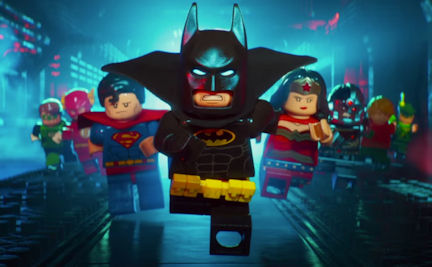
Batman might have had a bit part in the LEGO movie; here he is the protagonist. An isolated Batman feels nothing, not even hatred for the Joker. When Commissioner Barbara Gordon notes that Gotham City is full of crime, despite Batman's best efforts, she decides working together and actual policing, without the help of a certain vigilante, might be a more effective approach. Existential crisis time, for Batman, and for the Joker. But the Joker has a cunning plan to get sent to the Phantom Zone. And Bruce Wayne accidentally adopts an orphan. Mayhem ensues.
Superman, Batman, Wonder Woman minifigs running

The Joker
This is great fun. The gags come thick and fast, with all the clever verbal and visual wit of its predecessor, and much much more, with ridiculous knowing and self-referential comments, and snark, and meta-jokes. It helps to know all the Batman incarnations, even back to the Adam West era, and your DC Comics universe, and your LEGO, and the entirety of the film and TV world to get all the pop culture references (King Kong! the Eye of Sauron! the Daleks!), but even if you miss half the gags (which I'm sure I did), this is still by far funnier and cleverer than anything else out there.

Highly recommended.


For all my film reviews, see my main website.

Sunday, 31 December 2017

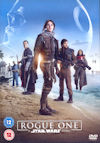
film review: Rogue One

Now, that’s what a prequel should be like!

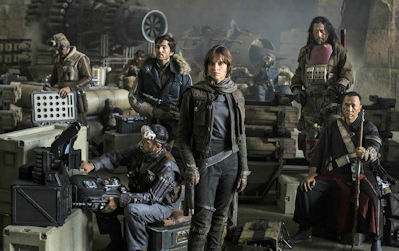
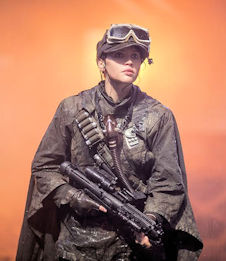
As a young girl, Jyn Erso sees her mother shot and her engineer father taken by Imperial troopers. A decade later she is an embittered young criminal, on the run from everyone. The Empire wants her to put pressure on her father. The Rebellion wants her to stop the Empire getting her. Then a pilot defects from the Empire with news that could mean a new hope for the Rebellion. Jyn Erso, along with a motley crew of rebels, finds herself engaged in a desperate race against time.

This is written for, and by, Star Wars original trilogy fans. There are lots of little call outs to events in those films, and a couple of space battles in the original style. The plot explains two big questions from the original: How did Leia get hold of the Death Star plans? Why did the Death Star have such a ridiculous weakness? And it manages this without introducing too many new questions, although it does introduce a new series of gloomy muddy planets. Nowadays it is a bit harder to fully engage with an armed insurrection quite as whole-heartedly as in the more innocent days of 1977, though.


One great piece of continuity is Peter Cushing reprising his role as Grand Moff Tarkin from the 40-year old original. Not a bad trick given that Peter Cushing died in 1994. That’s what CGI can do nowadays: take one actor, and plaster the face of another over the top. The face worked brilliantly, but the eyes seemed a bit glassy. They played the same trick at the end with Leia, but that was more uncanny valley territory: a grizzled old face in the gloom is easier to fake that a young unlined face in full light, it seems. Mom Mothma also recurs, recast with a good look-alike. Darth Vader was a bit easier to recast behind that black mask, but still has his great James Earl Jones voice.

Speaking of Leia and Mom Mothma, does this film, with its female lead, pass the Bechdel test? Opinion is divided: the young Jyn does briefly talk with her mother at the beginning, but they are talking about her hiding from the men coming for them. Later, Jyn addresses the Rebellion council headed by Mom Mothma. Are they talking to each other, or is Jyn just addressing the assembled, overwhelmingly male, crowd? Even if it can be argued a technical pass, it does needs to be argued. The crew Jyn flies with is all male. About the only other women are another council member, and a couple of fighter pilots, who get a few lines. Would it have killed them to have had another woman in the crew? Or even to have had Jyn’s mother be the abducted engineer? Ah well. Baby steps.

Technically, and plot-wise, the film is great. Not as good as the original (but what is?), but much superior to the prequel trilogy. (We probably should have watched it in the cinema to better appreciate the space battles and mushroom clouds, though.) The plot of Rogue One finishes just before that of Star Wars starts. It’s a very satisfying prequel that adds to the canon.


For all my film reviews, see my main website.

Sunday, 12 November 2017

film review: Blade Runner 2049

The IMDB plot summary for the original 1982 Blade Runner starts: “In the futuristic year of 2019, Los Angeles has become a dark and depressing metropolis, filled with urban decay.” It is now thirty years later: the the entire planet has undergone ecological collapse, and is a wasteland populated with Wallace’s synthetic protein farms to feed the millions living in the cities. (Are there also carb, fibre, and vitamin farms?) The urban decay has also worsened, post the mysterious Blackout that wiped or corrupted most digital data, and is filled with those who cannot afford to migrate to a better life off-world. Despite the bankruptcy of the Tyrell corporation after the previous trouble with replicants, Wallace [Jared Leto] has started up a new line of more obedient replicants. Police agent KD6-3.7 [Ryan Gosling] is one of these new replicants, a Blade Runner hunting down the earlier, dangerous models. His latest mission finds an old replicant living on a protein farm, but what he discovers there leads to an explosive revelation that could destroy humanity. He needs to find Deckard [Harrison Ford] to solve the mystery.

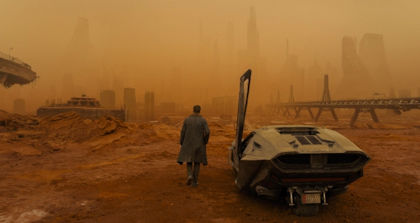
K walks away from shot The new film is long (2hr 44mins) and has a rather dream-like quality. There are a few action scenes, but this is mostly K uncovering dark secrets, moving slowly through huge bleak strangely-lit exteriors, or densely-detailed strangely-lit interiors. This is surprisingly effective at generating a mood of quiet desperation. Gosling plays the part of a seemingly unemotional and obedient replicant very well: without cracking a facial expression, he nevertheless manages to convey the loneliness and misery of being a despised un-person. And Wallace, as both original saviour and now potential destroyer of humanity, is an interesting villain.

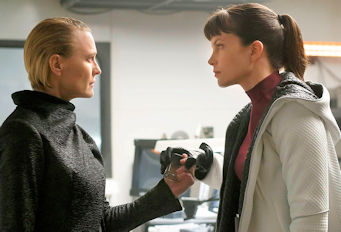
Joshi and Luv Does it pass the Bechdel test? Well, K’s boss police Lieutenant Joshi [Robin Wright] and Wallace’s spooky replicant enforcer Luv [Sylvia Hoeks] do talk about recent events at the forensics lab, but that’s the only brief scene I can recall; the short conversation between prostitute Mariette [Mackenzie Davis] and sex hologram Joi [Ana de Armas] is about K. And, of course, a major female character is “refrigerated” before the film even starts.

While watching, the film is very engaging, pulling you along with the plot, despite its slow unfolding. It also manages a great plot twist that subverts a lot of the initial setup. It is only afterwards that some of the more ridiculous elements become clear. Why is Wallace blind? He owns replicant technology; surely he can make himself some eyes? The Blackout doesn’t seem to have been a very drastic event integrated into the past history, but only there to make tracking down details of earlier replicants more difficult. The deeper systemic effect of a digital purge is handled more effectively in Dark Angel. Given replicants are so dangerous and difficult to spot, why have their only identifying mark a serial number in one eye? Why not just give them, say, a bright blue skin, and tattoo their serial number across their foreheads? The one scene that did jar at the time was the comment that “no two humans have the same DNA”; I guess they’ve never hear of identical twins? Yet we were supposed to think twins, despite them being a boy and a girl.

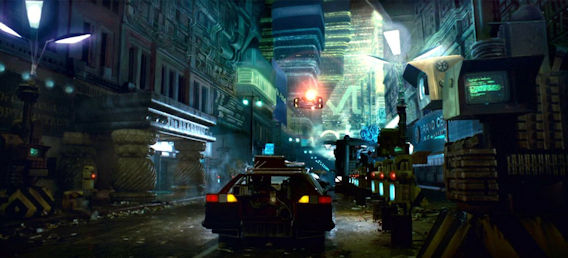
car in dark city
However, for all these niggles (which occur in essentially any SF), the good more than outweighs the bad, and I enjoyed the film. With the evocation of a decaying future, and the underlying questions about what makes someone human, this makes a good sequel to the original masterpiece.


For all my film reviews, see my main website.

Sunday, 26 February 2017

film review: Ghostbusters (2016)

There’s been a lot said about this gender-flipped remake of the 1984 original, ranging from it’s the best thing ever made!, to this desecration has ruined my entire childhood! So, what is the fuss about? Well, the truth, of course, is somewhere in between. But where in between, precisely?

First, I have a confession to make. I was never a big fan of the original. Its style of slap-stick and frat-boy humour grates a little with me. Yet it has its inspired moments. And in this way, I can say that the remake, which follows a similar plot, in a similar style, pretty much hits the same mark for me. The best bits are from Jillian the mad engineer, and the ever more outlandish devices she designs and builds.

There are some nice hat-tips to the earlier version, such as the genesis of the logo, or when the team is looking for a base, and pass up a certain fire station, because of its exorbitant rent. And there are a couple of lovely cameos, one from Bill Murray as a sceptical critic of the team, and one from Sigourney Weaver, as an engineering mentor. These scenes show a degree of engagement with the original.

And what about the gender-flipping? Well, frankly, if this hadn’t been a remake, I don’t think anyone would have thought anything strange about these roles. Except possibly for the pathetic way Erin lusts after the himbo secretary. Of course, a man drooling this way over a bimbo secretary wouldn’t raise an eyebrow (except that this was some of the humour that grated the first time round). Which maybe would be the point, if this version weren’t supposed to be funny, too.

So, neither wonderful, nor a desecration. Just some (for the most part) fun mind candy.


For all my film reviews, see my main website.

Thursday, 9 February 2017

film review: Frozen

poster
Elsa and her younger sister Anna are princesses who love to play together. Elsa has a special power: she can control and shape ice. She uses this power to make ice slides for Anna. But one day there is an accident, and she injures Anna. Fortunately the trolls can cure Anna, but Elsa and her parents are devastated. She is kept in solitude, so that her powers can never hurt anyone again. But when her parents die, she becomes queen. Anna falls in love with handsome Prince Hans visiting for the coronation, and asks Elsa’s permission to marry. Elsa refuses, and there is an argument, which leads to her accidentally freezing her whole country. She runs away in despair, but Anna follows, determined to rescue her sister.

This re-imagining of the Ice Queen changes the fairy tale considerably, and for the better. It subverts two key fairy tale tropes. First, don’t trust love at first sight: get to know your prospective partner first. What you find out about them may make you realise you made a mistake. Second, an act of true love need not be performed by the hero to save the heroine. Since fairy tales, today served up as Disney animations, form an important part of how we parse the world, these are important and useful messages.

an act of true love

Given these good and overt messages, though, it’s worthwhile digging a bit deeper, to see if there are other, less obvious, messages being reinforced.

Firstly, Prince Hans claims to be the youngest of 13 brothers. Does his father have a harem, a poor wife who has borne at least 13 children, or a maybe a series of wives? In any case, I felt his kingdom to be in dire need of knowledge about birth control. An heir and a spare should be fine. This would have two advantages: the queen would have some time to do more than pop out princes, and 13th sons with no role at home wouldn’t get into mischief.

ignorance ending badly

Secondly, it’s clear that Elsa’s parents have never read any fairy tales. Hiding Elsa away, and forcing her to deny her powers – that always ends badly. And Anna’s memories of her own injury are removed by the trolls, to protect her, and this is taken to be a good thing. But instead, it causes her great pain, and eventually puts her in grave danger. Unable to remember the accident, she can’t understand why her adored big sister will no longer play with her. And unaware of Elsa’s powers, she is taken by surprise by events at the coronation, and is put in danger during the attempted rescue. Ignorance is not bliss, yet keeping someone in the dark to protect them is a recurring trope in many stories. It doesn’t protect them, it infantilises them.

Despite these caveats, the film was an enjoyable way to spend the post Christmas lunch turkey food coma.

Oh, and there is also a comic moose, a patronising lunk, and an hilarious snowman. And some songs.


For all my film reviews, see my main website.

Saturday, 21 January 2017

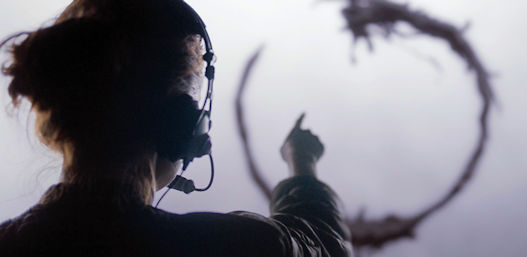
film review: Arrival

The aliens have arrived, in 12 giant mysterious ships dotted around the planet. They are enigmatic, but seem to want to communicate. The Americans enlist the help of academic linguist Louise Banks [Amy Adams] and physicist Ian Donnelly [Jeremy Renner]. They gradually manage to establish communication, but does that important ambiguous word mean “weapon” or “tool”? Louise keeps having flashes of her life with her daughter Hannah, who dies tragically young: these images may hold the key to deciphering the aliens’ intent.

This is a very cerebral film, with a lot of talking about alien language and arguing about alien motives, with a small amount of misguided military action: the CGI goes into making the aliens nicely alien, not into swooping spacecraft and big explosions. The gradual increase in the protagonists’ language knowledge and confidence, and the sheer intellectual slog that involves getting that competence, are conveyed well. This description might make the film sound dull and slow, but the plot moves forward briskly and engrossingly. There’s the obligatory twist, which I am pleased to say I spotted before the reveal, but in truth it wasn’t that much before. It’s one of those interesting twists that might make you want to see the film again, to re-evaluate some of the events.

deciphering alien language

Despite the leading character being a woman, the film only barely passes the Bechdel test: her child is female, and they sometimes talk about things other than the father.

For a film about language and communication, there are a couple of places where that communication is a little opaque. Early on, the military is trying to enlist Louise, and threatening to go to another linguist if she doesn’t agree to their terms. She challenges them to ask the other linguist for the translation of the Sanskrit word for war. When they come back with the answer, it is given inaudibly against an overwhelming background of helicopter blades. I looked it up afterwards; it doesn’t seem to be germane to why they chose her over the other guy. The other communication incident, which is deliberate, is that a turning point in the film has Louise persuade a Chinese general to break off hostilities, by speaking a key sentence to him in Mandarin, and we get no subtitles. It works, even though we don’t know what was said. Again, I looked it up afterwards; the sentence is meaningful, but its content doesn’t actually matter, only that it works. In a sense, these two events seem more profound precisely because I didn’t know exactly what is said.

Overall, I really enjoyed this. It is nice to see people solving problems with their brains rather than with their fists and guns, for a change.


For all my film reviews, see my main website.

Saturday, 6 August 2016

film review: Pride and Prejudice and Zombies

Remember the days when there was only one in-flight movie, which you didn’t want to watch? Well, nowadays there’s a whole raft to choose from, mostly ones you don’t want to watch, and some you feel a little curiosity about. This was how I ended up watching Pride and Prejudice and Zombies on a tiny screen with scratchy sound, several miles up in the sky on a nine hour flight.

I’ve not read the book, Pride and Prejudice and Zombies, that is. I have, of course, read the original zombie-free Pride and Prejudice, and watched the BBC dramatisation. But I’m not a zombie horror fan in general (despite rather enjoying Rowland’s White Trash Zombie series), so I was a little dubious.

However, this is fun. It is played completely straight (for the most part) as a historical romance, just in a context where there are zombies roaming the land, and everyone is trained in martial arts to protect themselves. It has the ‘same’ underlying plot as the original: Elizabeth Bennett is prejudiced against the proud Darcy, but they each learn the error of their ways.

The zombie context changes the flavour of the romance, however. (You don’t say?) Despite the standard trope of Mrs Bennett trying to get good marriages for her daughters, all five of the Bennett sisters are experts in Chinese-style martial arts (rather than the more aristocratic Japanese-style). Darcy’s eye-patch wearing aunt Lady Catherine de Bourgh is a renowned zombie hunter, and the dastardly Wickham is up to something more sinister than elopement. Matt Smith as the oily Parson Collins hits all the right notes. There is some of the original dialogue, marginally altered for context, although delivered in different circumstances: Elizabeth’s rejection of Darcy’s first proposal contrasts dialogue and action brilliantly. The zombie apocalypse finale and heroic rescue does deviate somewhat from the original.

This is pure nonsense, but the straight way it is delivered, and the clever interweaving of the original and the zombie plot makes for fun viewing. It readily passes the Bechdel test, as various of the female characters talk about martial arts and zombie killing (in addition to prospective husbands). I was somewhat distracted by the economic viability of the scenario: how did the peasants grow the food given they had no protection from the roaming zombies? But nevermind; I enjoyed this, and it was definitely engrossing enough to while away nearly two of those nine hours in flight.


For all my film reviews, see my main website.

Sunday, 10 July 2016

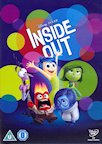
film review: Inside Out

11-year-old Riley and her family move from their home in Minnesota to San Francisco. Riley leaves behind all her friends, and her beloved ice hockey. It is an emotional time for her.

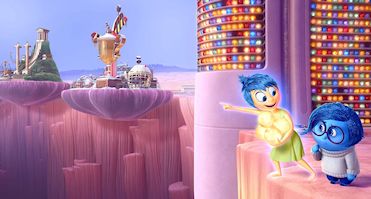
Like everyone else, Riley is guided/controlled by her five emotion homunculi: Joy, Sadness, Disgust, Anger, and Fear. The young Riley is mostly governed by Joy, and is a cheerful child. But Joy has a hard time keeping her human happy after the move. Then disaster strikes: an accident sucks Joy and Sadness out of headquarters, and they become lost in long term memory. Now Fear, Anger and Disgust are left in charge, and Riley turns into a surly brat. Then it gets worse: in their attempt to help Riley, the remaining emotions get locked out of their control panel, and now Riley can’t feel anything at all.

After a slow start with a lot of info-dumping about how the interior world works (as a sort of cross between a child’s fairy tale and a cognitive neuroscience text), things ramp up once Joy and Sadness are lost, and trying to get home. The adventure is wildly imaginative, with memory stores, dream sequences, imaginary friends, forgetting, the subconscious, abstraction, and trying to catch the train of thought. In the end, Joy learns an important lesson about Sadness, becoming a more mature emotion, and Riley grows up, as her homunculi’s control console is upgraded to parallel working.


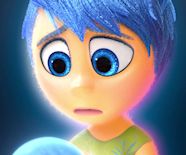
At several points in the internal journey, Joy feels some Sadness of her own, and also Fear (or at least Alarm). Embodied emotions having emotions! Does this mean that Joy has five even smaller emotion homunculi in her own head? My brain kept trying to infinitely regress at several points.

This passes the Bechdel test: Joy and Sadness are female, and spend nearly all the time talking about Riley. In the external world, Riley’s teacher is female (although I don’t believe she is named?), and speaks to Riley, asking her to introduce herself; also Riley video chats with her friend Meg back in Minnesota about their hockey team.


Yet there is a curious asymmetry here. During the film we see inside three other human heads: Riley’s mother and father, with more mature homunculi, and briefly a boy of Riley’s age, whose juvenile homunculi are freaked by being close to a girl. The end credits give us views into a few more people, a dog, and, hysterically, a cat. All these other homunculi are the same sort as their “owners”: five mature females guiding the mother, five arguably less mature and somewhat stereotypical males for the father, five young males for the boy, five very cat-like cats in the cat, and so on. Yet in Riley, although Joy, Sadness and Disgust are female, both Fear and Anger are portrayed as male. If the film had a boy main character, would any of his emotions have been portrayed as female, I wonder?

Overall, after that slow start, this is a marvellously imaginative romp through a brain, and it is interesting that the obligatory happy ending is one of growing up and the realisation that Sadness is important.


For all my film reviews, see my main website.

Sunday, 26 June 2016

film review: Mad Max Fury Road

Max [Tom Hardy] is mad, roaming the desert all hairy and wild. He is captured and taken to the Citadel for use as a universal blood donor. But when truck driver Furiosa [Charlize Theron] helps five slave-wives escape, all hell breaks loose. The War Boys, taking a bound and muzzled Max along as donor/mascot, chase after Furiosa and the oil truck she is driving away with the wives. Max escapes, and joins a suspicious Furiosa. They team up to outrace the War Boys to find the Green Place. But they find something rather different.

This is fast and furious. The first half of the film is a chase across the desert, gun blazing, cars and trucks crashing, and the second half is a chase back across the desert, gun blazing, cars and trucks crashing. There is very little let up, very little dialogue, and much very well done CGI and SFX.

Given how little dialogue there is, it might seem surprising that this film easily passes the Bechdel Test. Yet what little dialogue there is, includes several scenes of Furiosa and the wives (who do have names) talking about freedom, the past, and what they might find at the Green Place. Max himself doesn't even speak until well into the film, once he has managed to remove his muzzle.


One might even call this a feminist film. Furiosa is an excellent character: tough enough to drive the oil truck under fire, a better shot than Max (I love the scene where he shoulders the gun), compassionate enough to help the slave-wives to freedom, and definitely in charge. Of course, this is all set in a world that is a non-feminist post-apocalyptic hell-hole. There is a small gynocracy at the Green Place, which allows several older women to have strong parts, until Furiosa and Max bring the War Boys down on them, that is! In fact, there are more women characters with speaking roles than there are men.

This film also has an interesting take on disability. Furiosa is missing her left arm below the elbow, and has a mechanical prosthesis. This is never commented on by any of the characters; we just see her using her prosthetic arm and hand casually and competently, and it is woven naturally into the plot.

These features help pack a solid amount of plot in the film, which, given the continual adrenaline-packed wild chase scenes, and that lack of dialogue, is a remarkable achievement. A surprising amount gets communicated with just a grunt or a glance, to an audience who knows the context. This is an excellent addition to the series, if you like wild chases with lots of cartoon violence.


For all my film reviews, see my main website.

Saturday, 28 May 2016

film review: The Martian

This is the film of the book, and is a sufficiently faithful version that I’m going to quote my book review where appropriate.

The third Mars mission has had to evacuate and return home because of a dangerously strong storm. Due to a freak accident, Mark Watney [Matt Damon] is left for dead. But he’s not dead. And now he’s alone on Mars, without enough food, air, or energy to last the several years it would take rescue to arrive. Not that he can call for help. So, as he says, he’s "gonna have to science the shit out of this".

Actually, I disapprove of that phrase. In reality, he’s gonna have to engineer the shit out of this. Which he proceeds to do.

Watney is competent and resourceful, and he does have resources to be resourceful with: all the equipment the crew left behind when they abandoned Mars. Mars keeps throwing problems at him, and he keeps figuring out solutions, knowing that the first problem he can’t solve will kill him for sure.

The film is great. It departs from the book in necessary ways: many subplots are removed, reducing the complexity, but keeping the overall story. They also cut my favourite joke, about Mexican food, but there’s loads of snappy repartee. The cuts make Watney’s task seem easier and more linear, and the sheer duration seems compressed, but he still has to struggle, growing his food, making his water, making his air, transporting himself, coping with being alone. And he’s not the only one who is competent: everyone is competent. Even the earth-bound NASA bureaucrats are competent. Even when they make seemingly poor decisions, it’s for what they think are the right reasons, to protect the overall vision, or the returning crew, or something larger than themselves. Okay, this is a massive helping of competence porn, but, hey, it makes such a refreshing change from the standard “let’s have the character make yet another silly decision just to move the plot along”.


Inner dialogue from the book has to get translated into video diary entries and visuals, and works well, for the most part. Mars is indeed The Red Planet, bleak and inhospitable, but beautiful. My main technical gripe is the gravity. Mars has one third Earth gravity (or just twice the moon’s gravity), which would affect Watney’s movements. This could be used to advantage, explaining how he can do all that heavy manual labour on a reduced calorie potato diet, but this Mars has earth gravity. But there’s one point which really jarred for me. There are some parallel scenes, where the engineers back on earth are mocking up solutions, and Watney is performing these on Mars. These actually work really well, as the slick Earth-bound solutions are contrasted with Watney’s duct-taped improvised versions. But at one point, Watney has to cut a hole in the roof of the rover. We see the two versions: earth engineer drills a load of holes; Watney drills a load of holes; earth engineer attempts to break through and fails; Watney attempts to break through and fails; earth engineer bashes on the panel and falls through; Watney bashes on the panel and falls through. But gravity is only one third as strong on Mars; Watney’s bashing would not have had the same effect. Also, the point of doing things on earth first (rather than actually in parallel) is to check the procedures will work and will be safe: that fall would not be safe when performed in a pressure suit in the near-vacuum of Mars’ atmosphere. So there was an opportunity to do something clever here, but it was missed for the laugh of the parallel falls.

However, that’s a really geeky complaint, given the rest of the film. There are several changes from the book, and of course there are further technical mistakes, but overall, it's one of the most faithful adaptations from a novel to screen that I’ve seen. If you enjoyed the book, you will enjoy the film. Read the book first, then watch the film for the visuals and great translation; or watch the film first, then read the book for the subplots.

Monday, 4 January 2016

film review: Guardians of the Galaxy

A bunch of minor criminals and bounty hunters all after the same MacGuffin reluctantly join forces against the Really Bad Guys who want to Destroy the World with said MacGuffin.

We have a motley ensemble cast: human space pirate Peter Quill [Chris Pratt], green humanoid assassin Gamora [Zoe Saldana], uplifted raccoon bounty hunter Rocket [Bradley Cooper, voice] and his sidekick the tree-like Groot [Vin Diesel, voice], and paisley-tattooed humanoid assassin-hunter Drax [Dave Bautista].

After a rather slow start (a dying mother foreshadowing trope) the action gets going, accompanied by a 1980s pop soundtrack (for reasons that make sense at least in the story). There’s lots of running around, lots of wisecracking, lots of fights, lots of CGI things being blown up.

The team of good guys has one woman (Gamora); the team of bad guys has one woman (Nebula, an unrecognisable blue bald Karen Gillan); and the team on the planet has one woman (Nova Prime, Glenn Close). Oh, and Peter’s mother [Laura Haddock], in her death scene. It arguably just passes the Bechdel test: sisters Gamora and Nebula have a few conversations, not necessarily about a man. But that’s not exactly a high bar.

It doesn’t take itself seriously, but isn’t as funny as it thinks it is. Nevertheless, it’s sufficiently entertaining piffle for a dark winter’s evening viewing. And at least the raccoon isn’t cute.


For all my film reviews, see my main website.

Tuesday, 26 May 2015

film review: Looper (2012)

Time travel has not yet been invented. But thirty years from now, it will have been. It will be instantly outlawed, used only in secret by only the largest criminal organisations. It’s nearly impossible to dispose of a body in the future, I’m told. Tagging techniques, what not. So when these criminal organisations in the future need someone gone, they use specialised assassins in our present called Loopers. And so, my employers in the future nab the target, they zap them back to me, their Looper. He appears, hands tied and head sacked, and I do the necessaries. Collect my silver. So the target has vanished from the future, and I’ve just disposed of a body that technically does not exist. Clean.
Although well made, in a grimy dystopian noir sort of way, and fun to watch, in a mindless sort of way, the plot of Looper doesn’t hold up to even the smallest scrutiny. Let’s start with that lazy introductory voice-over: only criminal organisations use this outlawed tech? There’s no Time Police hunting them down? Given the way they can change the timeline? And the only use these master criminals can think of for time travel, instantly outlawed presumably for the amazing power it has, is to dispose of some bodies? Oh, and “tagging techniques” that could seemingly survive incineration or other 2074 disposal technology, somehow don’t raise suspicions when people keep going poof from time-machine-containing warehouses? Nope.

There’s more voice-over (why should I bother summarising this stuff when they couldn’t bother to work out how to film it?):
There’s a reason we’re called Loopers. When we sign up for this job, taking out the future’s garbage, we also agree to a very specific proviso. Time travel in the future is so illegal, that when our employers want to close our contracts, they’ll also want to erase any trace of their relationship with us ever existing. So if we’re still alive thirty years from now, they’ll find our older self, zap him back to us, and we’ll kill him like any other job. This is called closing your loop. You get a golden payday, a handshake, and you get released from your contract. Enjoy the next thirty years. This job doesn’t tend to attract the most forward-thinking people.
Anyway, that voice-over is spoken by Young Joe [Joseph-Gordon Levitt], a Looper who’s about to encounter his future self, Old Joe [Bruce Willis], sent back to close his loop. Things do not go well. We know he has to kill his older self, as we’ve seen what happens to a Looper who messes up.

First time round the loop, he does as he should: Young Joe’s contract is closed, and he gets to enjoy the next 30 years. But when now-Old Joe, a somewhat reformed character, is captured by The Rainmaker’s mob to be sent back, he manages to change things, so that when he arrives in the present, this time round Young Joe fails to kill him. The chase is on: Young Joe must find and kill Old Joe, to avoid the grisly fate of failed Loopers. But Old Joe has a mission: to kill the future crime boss The Rainmaker while he is still a young child, Cid (maybe not that reformed, then), to stop his rise to power in the future. Time lines are fracturing and the future is unsure: eventually Young Joe makes a desperate sacrifice to avoid catastrophe.

The main timelines are nicely shown in this graphic:

This graphic illustrates my first peeve with the plot. Old Joe is trying to kill Cid to make sure he doesn’t grow up to become The Rainmaker, but it becomes clear it is Old Joe’s efforts that make him the Rainmaker, so Old Joe must be stopped. But actually it’s not clear that’s what makes Cid into The Raimaker, as he existed in the initial timeline, which started all this process. (Old Joe killed Sara in timeline B, setting off the Rainmaker transformation, but we don’t know what happened to her in timeline A.)

But my main peeve is with the whole underlying premiss. We see what happens to a Looper who fails to kill his returned older self. The organisation starts chopping bits off the young version; the older version then has these bits chopped off too, but there is no other change to the timeline. Young guy looses a finger: old guy in the present suddenly notices he has a finger missing, all nicely healed up. Then another finger goes. Then his nose. Then a foot. Then a leg. By the end, there’s hardly anything left of him. Given all his wounds are healed, presumably because the younger one lives (lived? will live?) long enough to heal, how one earth does this not have any other effect on the timeline? How does the chopped up guy get to come back? Okay, let’s say for the sake of plot it somehow doesn’t change the timeline. But then Young Joe uses this technique to make his sacrifice in order to change the timeline: not just to stop Old Joe now, but to make Old Joe never have happened. WTF?

And that sacrifice is just stupid. Young Joe has no real reason to believe it will heal the timeline. He could just carry on, become Old Joe, and do something different the next time round, make things better. And if that doesn’t work, do things differently again. He’s so right: “This job doesn’t tend to attract the most forward-thinking people.”

Oh, and the reason Cid can become The Rainmaker is that he’s powerfully telekinetic. Hint: don’t add two impossible things to your SF: either time travel or telekinesis, but not both. Especially without thinking through the consequences of either.


For all my film reviews, see my main website.