Showing posts with label Doctor Who. Show all posts

Sunday, 14 June 2026

This is what GenAI is for

I'm an AI skeptic, gleefully saving stories of AI deleting a company's entire database, or diagnosing faked diseases, or just frankly turning evil.  Although it is more than happy to apologise for its poor behaviour, like after that time it set dinosaurs loose in Central Park.  

I'm waiting for the day it does something so extreme, the problem can no longer be ignored, the lack of any "intelligence" can no longer be overlooked.  Its use, including hallucinating a footall match that never took place, has already resulted in the "retirement" of a Chief Constable.  Check your citations, guys!

However, there are extremely skilled artists generating amazing material with GenAI that enriches culture. 

This LoTR disco movie is amazing:

And I soooo wish this Dr Who trailer was real:


I'm not sure how many gigajoules of electricity, or gigalitres of water, were involved in generating these.  But it is certainly energy and coolant well spent, compared to the standard AI slop inundating us.


Thursday, 5 December 2024

Doctor Who meets Rocky Horror

I am in awe of the effort that must go into this.  It's brilliant -- especially the two different "jump to the left" scenes.


Saturday, 30 March 2024

view from a hotel window

We're at Levitation, the 2024 Eastercon, being held this year at the Telford International Centre (TIC). It's a new venue for Eastercon, and is nice and spacious (great for social distancing) and well laid out.  There are also nice gaps between items, so no need to teleport around the TIC.  So far, we've been to:

  • a panel on SF and the Industrial Revolution -- a theme of the convention, given that Ironbridge is just down the road
  • a talk by Kari on the history of the Welsh border -- also close by, and surprisingly ill-defined
  • a talk about bones and forensics -- not all found bones are human: "the last time this bone was above ground, it was surrounded by cow"
  • a panel on narrative point of view and tense -- which has moved from traditional 3rd person past tense to more 1st person present tense, especially in Young Adult fiction
  • an enraging talk by Clute on the British Library's destruction of 100 years of dust jackets
  • a panel on libraries, in the real world and in SF -- "getting my adult card which allowed 4 books a fortnight meant you were supposed to read 4 a fortnight!"
  • a panel on Dr Who and the Industrial Revolution, including the 1985 story of The Mark of the Rani
  • a panel on Educational Safeguarding in SF/F -- fictional schools seem very dangerous!
  • a talk by Emma King on her unsuccessful applications to be an ESA astronaut, and the other successes that led from that 
  • a panel on (fictional) Invertebrates in Space -- including interesting discussions of real invertebrates (on Earth), too
We're looking forward to more great stuff tomorrow and Monday.

We're staying at the hotel next door to the TIC, with the customary view over the car park:

at least we can keep an eye on our car...

We drove up to Telford yesterday, in our new electric car.  I still have a little range anxiety, so when we stopped for lunch, I did give it some juice, despite the prediction we'd have enough left when we arrived.  Note to self: when travelling on a Bank Holiday, charging points tend to be well-occupied.  The hotel has four of its own fast (22kW) charging points for guest use, that are not quite as eye-wateringly expensive (70p/kWh) as service station chargers (~79p/kWh), so I will fill up tonight, ready for the trip home.  A bit different from the 9p/kWh I can get at home on the overnight rate, though.


Later: for more notes on the convention, see my website


Wednesday, 14 February 2024

dis-mantle-ate!!

 One of the blue roundels came loose on our dalek, and we had to dismantle it to repair it.

not so tough now, are you?

Once all the spider webs had been cleaned out, the roundel could be reattached, and the dalek re-mantled.


Monday, 10 April 2023

Conversation 2023: Eastercon day 4

Final (short) day of the convention.

We started the day with a fascinating discussion of Joanna Russ' The Female Man by Farah Mendlesohn.  As ever, Farah pulled out many links and observations that had passed me by when I read the book.

Next, a panel on Forbidden Hues: Sumptuary Law in History and Fiction.  That is, on controlling people through laws governing what they can and can't wear.

Then we went to the panel Where Did You Get That Potato?, on anachronisms.  Potatoes are a classic opportunity for anachronism: they weren't introduced into Europe until the late 16th century, so no having Arthur eating chips, please!

And last, but not least, a panel on Dr Who at 60.  This year is the 60th anniversary; it only feels like yesterday we were celebrating the 50th!

And so to drive home.

Saturday, 25 December 2021

sequestering carbon, one Christmas at a time IX

 His ’n’ hers Christmas presents:


Giving someone a book on infrared astronomy on the very day the James Webb Space Telescope was launched is either prescient, or premature.

Thursday, 6 May 2021

two total eclipses

I’ve posted before about the Dr Who resonances the song Total Eclipse of the Heart has for me.  It seems to be a favourite for mashups in many genres.  Today I come across two new examples -- each excellent in their own very different ways.

First, The Marsh family do their own Covid-inspired rendition of “Totally Fixed Where We Are”: brilliant lyrics, smashing singing, and inspired interpretive dance.  Clearly a very talented family:


Then there’s this Star Trek inspired one, which is ... different.  Now, I know that the term “slash” as in “slash fiction” comes from “Kirk/Spock” fanfic (say it out loud).  But I didn’t know “Spirk” was a synonym for the latter.  Until I saw the hysterically funny “Total Eclipse of Spirk”, complete with musical accompiament by The Squire of Gothos.


As well as the Squire scenes, I also recognised a clip from Amok Time.  The others are a bit more generic, but, frankly, I don’t remember Spock emoting quite that much! 


Tuesday, 26 November 2019

the Master’s Tardis?

Seen at King’s Cross on my way home from Swindon.

So who uses a black phone box?


Sunday, 7 October 2018

It's About Time

O brave new world, That has such people in ’t!


Friday, 28 September 2018

Friday, 9 March 2018

Inferno

I'm at "A beautiful Accident", the opening conference of Meta.Morf 2018 in Trondheim.  Part of the experience is the "Inferno" performance art project.

colleagues in demi-exo-skeletons
I felt as if I was in a Disco episode of Dr Who and the Cybermen.  And I mean that in a good way.

Sunday, 28 January 2018

film review: The LEGO Batman Movie

DVD cover
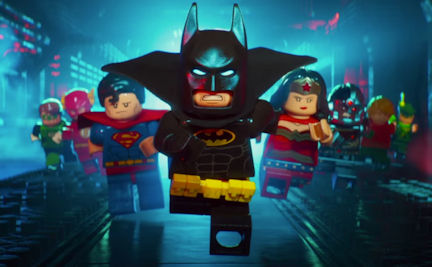
Batman might have had a bit part in the LEGO movie; here he is the protagonist. An isolated Batman feels nothing, not even hatred for the Joker. When Commissioner Barbara Gordon notes that Gotham City is full of crime, despite Batman's best efforts, she decides working together and actual policing, without the help of a certain vigilante, might be a more effective approach. Existential crisis time, for Batman, and for the Joker. But the Joker has a cunning plan to get sent to the Phantom Zone. And Bruce Wayne accidentally adopts an orphan. Mayhem ensues.
Superman, Batman, Wonder Woman minifigs running

The Joker
This is great fun. The gags come thick and fast, with all the clever verbal and visual wit of its predecessor, and much much more, with ridiculous knowing and self-referential comments, and snark, and meta-jokes. It helps to know all the Batman incarnations, even back to the Adam West era, and your DC Comics universe, and your LEGO, and the entirety of the film and TV world to get all the pop culture references (King Kong! the Eye of Sauron! the Daleks!), but even if you miss half the gags (which I'm sure I did), this is still by far funnier and cleverer than anything else out there.

Highly recommended.


For all my film reviews, see my main website.

Monday, 25 December 2017

Christmas done

So that’s all the Christmas Day traditions done for another year:
  1. exchanging presents
  2. eating turkey
  3. watching The Queen
  4. watching the Doctor Who Christmas special (with two regenerations for the price of one! excellent!)


Thursday, 21 December 2017

Cel-ee-brAAAAte!

Even the House Dalek is getting into the spirit of the season!


Tuesday, 7 November 2017

predictive biography

Apparently, typing “I was born” into a predictive text system, and then letting it write the rest of your life is a thing.  So I tried it in Gmail on my phone:
I was born in the future of Dr Who changed so much more like a football match and the fist to three months in a bubble of people needed to maintain knowledge ...
It starts off very plausibly, and the Dr Who bit I can understand.  The football match, less so.


For all my social networking posts, see my Google+ page

Sunday, 22 October 2017

Christmas teaser

I see that the cover of last week’s Radio Times shows Clara Oswald impersonating Queen Victoria.

Is this a teaser for the BBC Christmas special?  Maybe hinting at a cybermen-kidnapping-royalty plot, or even a prequel to Rose’s role in the Royal werewolf plot?

Or am I just overthinking this?


Friday, 11 August 2017

Worldcon 75: Friday

The third day of the Worldcon saw several programme items moved to larger rooms, increasing the probability of getting into items of choice.  Also, the innovation of keeping each session to 45 minutes, allowing 15 minutes of travel/queuing time, worked well.

To start the day, I went to the panel on The Times That Shaped the Science, addressing the question: How do literature/politics/art shape the way people did (or do) science?  Galileo had a strong background in literature and the arts, which meant that when he looked at the moon through a telescope, he could recognise it as a round ball, and paint it as a round ball. He loved the epic poem Orlando furioso (it was the LotR of its generation, or the Alice in Wonderland, with enormous popular impact, and even fanfic).  From this and other literature of the time, to Galileo a hero was someone who fights against all odds.  To him, being attacked and persecuted showed he was the hero, so he would go out of his way to be attacked. Nowadays we have this history of tension between science and the organised church – narratives of Galileo and Bruno – but actually these types of encounter were incredibly rare: other less confrontational people weren’t getting into trouble, despite believing similar things. The church wasn’t interested in things that were “obviously stupid”, only in things that were “nearly true”, plausible heresies that might convince the learnèd. We tend to locate agency in individual heroes and villains – historical heroes with modern opinions – and assume that the advancement of rationalism was by firebrands, and people who look like us intellectually. There were a few like that, but major changes often came from mainstream workers, confident that their results would confirm the orthodoxy, because they believed that both religion and science were true, so couldn’t be in disagreement.  We only realise in retrospect that there’s a conflict between these views.  Many advances were made by quiet people we’ve never heard of, by individual boring people who are nevertheless incredibly important.  The interesting questions depend on society of day, and what is a satisfying answer changes over time, too; when Newton said: I do not feign hypotheses, he was reframing what was an acceptable answer.  One major change occurred as the printing press  made books common: it started earlier and grew exponentially, so initially there were only a few books.  But by 1700 an author could live on book sales, rather than needing a patron: reputation became dependent on the masses, rather than the elites. [Well, that was all jolly interesting: much more engaging and intelligent than history lessons at school.]

Next was a talk from Ian Stewart, the Science Guest at the con, on How to Tell the Ducks from the Rabbits, or a simple mathematical model of optical illusions.  Many illusions of ambiguity (like the rabbit-duck, the spinning dancer, and the Necker cube), and illusions of binocular rivalry where different images are shown to different eyes, can be modelled with simple inhibitory/excitory networks.  This was a beautiful explanation of a lot of weird perceptual processes.  There’s a YouTube video of a slightly longer version of the lecture given earlier in the year: well worth watching.

Then on to a panel on The Pleasures and Pitfalls of Writing Space Opera.  This is possibly the most nostalgic form of SF, and closest to fantasy without getting caught: epic tales of alien megastructures, galactic empires, space pirates…  There are similarities to historical tales, now set in the oceans of space.  They have a sense of wonder and romance: the oldest is the Odyssey: travels through a bunch of islands with beautiful women, updated as Star Trek.  Of course, empires are fundamentally unstable forms of governance, so what makes such societies work in space?  These grander schemes may form the backdrop universe, whilst the central story is focused on a single planet or ship.  Hard SF and space opera can overlap, but they not the same thing.  Yet hard SF can make for good space opera, because it puts limitations on the tech, and those limitations can drive the story.  Series can fall into the Lensman trap: save the world, the solar system, the galaxy, the universe…!

From one extreme to the other: next was the panel on High Fantasy: Is it Still Relevant?  As often, start with some definitions.  High fantasy is set in a complete secondary world; low fantasy can happen in our world with added magic.  High fantasy has elaborate sorcery; low can have obscure, mysterious, and intermittent supernatural events.  High fantasy has consequences on the world level; low is more personal, on the city level (urban fantasy) at most.  High fantasy is about the destination of the human soul en masse, a clash of powers, a vastness of magic and wonder; low is more the individual soul or life impact.  Teresa Neilson Hayden defined genre fantasy as “numinous landscapes and significant personal actions”. There are exceptions to these definitions, particularly where ordinary humans travel from our world to the other, as in Narnia or Oz.  [I was amazed no-one said "portal fantasy".]  Some fantasy is “just” historical fiction in a secondary world context; all historical fiction involves worldbuilding, with different mindsets and worldviews.  Fantasy can use the trope of the little shepherd boy/kitchen maid/apprentice who makes good: how an individual becomes great, or at least a rite of passage to adulthood.  This allows the reader to discover the world along with the character.  But it can also feature noble protagonists, although more usually in fairy tales.  French salon fairy tales are about women in trouble in French courts, using fairy tales to explain their own upper class problems.  The Grimm fairy tales are peasant folk tales about how they have survived the Napoleonic wars, and are going to rebuild German values.

Having enjoyed the previous interview with GoH Nalo Hopkinson, I went along to Nalo Hopkinson and Farah Mendlesohn: a Conversation, framed as a late night Skype call.  More interesting snippets: Farah always asks interesting questions I would never think of.

How Science REALLY Happens was a panel about, well, how science really happens.  There are no single lone hero (or even mad) scientists.  It’s simultaneously cooperative teamwork and competitive, it’s long tedious applications for funding, it’s negotiating ethics panels, it’s slogging through field work, it’s writing papers and responding to referees, and it’s all about uncertainty.

The final panel of the day was on the Future of Doctor Who.  I got into this despite a huge queue; the room seemed bigger on the inside.  The hope was for more writers bringing more variety, and no jokes about the Doctor’s new gender.  During the hiatus (1989-2005, ignoring the Paul McGann film) there was a lot of fan fiction, with female doctors, black doctors, and more: it was an age of endless possibilities.  Dr Who changes yet remains the same, much like a football team.  All the previous Doctor incarnations are still with us: will there be joint episodes as before?  Recall how the last thing Bill said to the Doctor was “you know how I’m usually all about women and, and kind of people my own age”? Ooooh!

The last event of the day was the Hugo Awards Ceremonies.  A lot of applause.  Three of the acceptance speeches were anti-puppy: one managed to be so without even mentioning them!


Monday, 24 July 2017

cyber-loaf

yummy Tesco Mediterranean loaf
loaf prepared for the freezer
why do I always flash back to these at this point?