My car was upset that I had changed my phone, and insisted on an introduction protocol to recognise the new one. It led me through the process, but then asked for my car keys. I waved the electronic fob around for a while, but no dice. I pushed a few buttons at random (the time-honoured way to get a machine to do what you want) and eventually I spotted some text that said it wanted both keys. Hmm. I wonder where the other fob is? Hunting around, I found it in a cupboard drawer. Back out to the car, which was now willing to admit that I was probably its owner. Eventually, after more button pressing, car would speak unto phone, and connection was established.
Given how difficult it is for the registered owner to convince their car of this fact, I am surprised how easily criminals seem to manage...
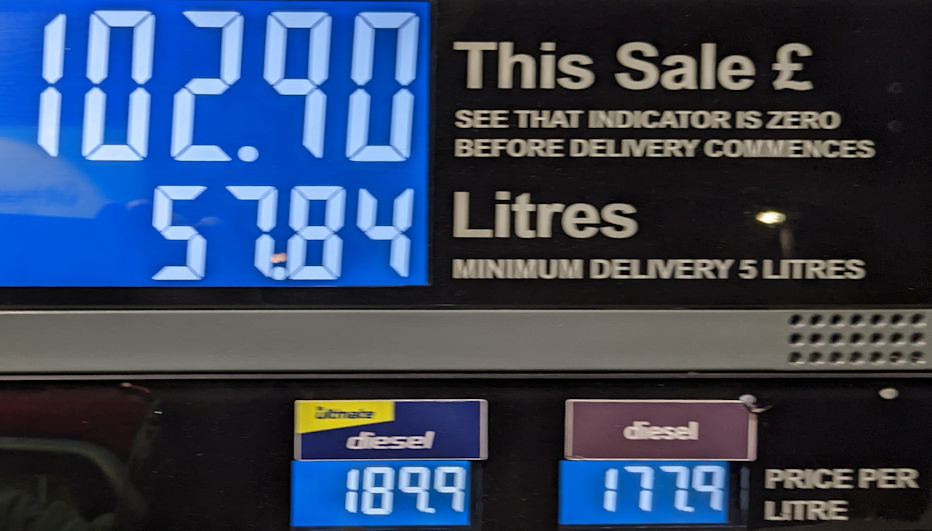
On my way down the A1 today, I stopped at a service station for a break. I hooked up the car to get a bit of charge from the Gridserve system, then went off into the service area for a while. When I returned, I was surprised to be seeing double.
that's mine on the right, somewhat better parked...
We're at Levitation, the 2024 Eastercon, being held this year at the Telford International Centre (TIC). It's a new venue for Eastercon, and is nice and spacious (great for social distancing) and well laid out. There are also nice gaps between items, so no need to teleport around the TIC. So far, we've been to:
a panel on SF and the Industrial Revolution -- a theme of the convention, given that Ironbridge is just down the road
a talk by Kari on the history of the Welsh border -- also close by, and surprisingly ill-defined
a talk about bones and forensics -- not all found bones are human: "the last time this bone was above ground, it was surrounded by cow"
a panel on narrative point of view and tense -- which has moved from traditional 3rd person past tense to more 1st person present tense, especially in Young Adult fiction
an enraging talk by Clute on the British Library's destruction of 100 years of dust jackets
a panel on libraries, in the real world and in SF -- "getting my adult card which allowed 4 books a fortnight meant you were supposed to read 4 a fortnight!"
a panel on Dr Who and the Industrial Revolution, including the 1985 story of The Mark of the Rani
a panel on Educational Safeguarding in SF/F -- fictional schools seem very dangerous!
a talk by Emma King on her unsuccessful applications to be an ESA astronaut, and the other successes that led from that
a panel on (fictional) Invertebrates in Space -- including interesting discussions of real invertebrates (on Earth), too
We're looking forward to more great stuff tomorrow and Monday.
We're staying at the hotel next door to the TIC, with the customary view over the car park:
at least we can keep an eye on our car...
We drove up to Telford yesterday, in our new electric car. I still have a little range anxiety, so when we stopped for lunch, I did give it some juice, despite the prediction we'd have enough left when we arrived. Note to self: when travelling on a Bank Holiday, charging points tend to be well-occupied. The hotel has four of its own fast (22kW) charging points for guest use, that are not quite as eye-wateringly expensive (70p/kWh) as service station chargers (~79p/kWh), so I will fill up tonight, ready for the trip home. A bit different from the 9p/kWh I can get at home on the overnight rate, though.
We changed car in January, and now have an electric one. The idea is to use our solar power during the day to charge it, and cheap rate electricity at night as needed. We don't have our 7kW Zappi charger installed yet (watch this space!), so are charging off the mains more slowly, at just over 2kW. Even so, we get about 20% added to the battery overnight (exact amount seems to depend a bit on temperature and starting charge in an as yet ill-understood way; I am gathering data), and about 10% on a sunny February day (we anticipate more during longer summer days).
Here's our electricity usage for the beginning of February (more details on my solar stats page). The vertical axis runs from -8kW to 8kW. The region above the axis represents our usage: orange is generated usage, red is imported from the grid. The green region below the line is surplus generation exported to the grid. The numbers are total kWh for each day.
On 1st Feb, a nice sunny day, we charged the car on solar power (the orange block around midday), adding a reported 9% to the battery, with an estimated range increase of 25mi, for "free" (as we broke even on the cost of the PV installation several years ago).
Then on 4th Feb we charged overnight (the red block, midnight to 7am), adding 18% charge, with an estimated range increase of 37mi, for £1.42 on our low cost overnight tariff. That's 3.8p/mi.
The fuel consumption stats are a bit more fiddly to calculate than with petrol, going from filled tank to filled tank, as not every charging session "fills" the battery. And the cost of charging varies wildly, from free off PV, to low off overnight tariff (9p/kWh), to eye-watering in service stations (79p/kWh). So, no "filling up" at service stations; rather, adding just enough to get home.
I do like the fact that during charging, you can measure how fast the estimated range is increasing, in units of miles per hour.
100,000 miles isn't bad. However, it's put to shame by some friends of mine who only got rid of their car with over 250,000 miles on the clock because someone ran into it, making it an insurance write-off.
I took my car in for its annual MOT and service today. It has been just the year since the last test and service, but what a year!
I normally drive about 10,000 miles annually. Over the last year, service to service, it was 827 miles. (Also, no bus or train travel, and no flying, in that time, either.)
I have saved quite a bit on fuel. I normally fill up fortnightly. But I filled up just after last year’s service in March, then again in September, and still have half a tank left…
Dominic Cummings has said that he drove to Barnard Castle with his wife and child at the end of his lockdown-busting trip to County Durham in order to test his eyesight before making the long drive home to London.
If the Indepedent’s report is accurate (and I have no reason to believe otherwise; there is plenty of other evidence), then here are only two possibilities:
Cummings is lying about his reason for his actions
Cummings is telling the truth about his reasons for his actions
If he is lying, then he should be sacked for this lie.
If he is telling the truth, then he should be sacked for being too stupid to be a government advisor.
Additionally, if he is telling the truth, and he is happy to risk his wife and child’s life in such a manner, then it rather calls into question his original excuse for travelling north: worry for his child’s well being.
While I was driving home down the A1 yesterday evening, a pheasant walked right out in front of me, and so I hit it. I know enough not to swerve in these circumstances (there were other cars around me, so swerving could have caused a nasty accident), but it wasn’t a fun thing to happen at 70mph, for me, or for the pheasant.
There was no big cloud of feathers visible in my rear view mirror, unlike the last time this happened. I continued for about a mile to the next service station, and pulled into their car park, to assess the damage. I looked at the radiator grille, and saw a pheasant’s head behind it, and a large tail feather sticking out. Great.
I tried to open the bonnet, but failed. It seemed stuck. I couldn’t tell if the car was safe to drive, or if the rest of the pheasant was doing something nasty in there. So I phoned RAC Accident (mobile phones make life so much easier), and said I’d hit a pheasant, and didn’t know if the car was safe to drive. They put me through to RAC Breakdown. I explained again. They said I needed to speak to RAC Accident. I said I’d come from there. They checked: yes, it counted as an accident, not a breakdown. I was told that my “RAC accident and breakdown” cover only covers breakdowns; although the cover says “We’ll rescue you if you’re involved in an accident”, I was told this rescue would cost me a £165 callout charge. Hmm. I said I’d try another option first.
So I phoned Volvo Assistance, which I get as a complimentary deal because I pay a lot for the car to be serviced at an official Volvo dealer, which helps maintain its resale value. They were much more helpful. Although the assistance usually only covers a maximum 50 mile trip to home or a dealership (I was 75 miles from home at the time), because it was a Friday evening, they said they would take me home if necessary. A breakdown truck would be with me within the hour.
The breakdown truck arrived within 15 minutes, actually; he’d been nearby on the road when the call came in. He got out of his truck and looked at the head-and-feather combo in my radiator grille. He tried to open the bonnet, struggled a while (somewhat to my relief, as I didn’t feel so stupid at not managing it myself), but eventually managed. My sort of Volvo has a large gap between the radiator grille and the radiator itself; this was currently full of very dead pheasant.
The pheasant had smashed straight through the grille, breaking it and the surrounding fascia (which had buckled up, making it harder to open the bonnet), but was stopped by the rather more substantial radiator itself. The breakdown guy removed the pheasant, in a cloud of feathers, to the amazement/amusement of a couple of other people in the car park. He inspected the radiator, and said it was a bit dented (and covered in feathers), but still whole. He had me start up the car, and poked around to check there were no problems: the radiator didn’t start leaking or anything, and there appeared to be no other damage to working parts. He declared the car safe to drive.
I offered him the pheasant, but he declined. He completed some paperwork, I signed a form, and off he went. I continued on my way too (also declining to take the pheasant), and arrive home safely, although somewhat later than planned.
After I had been on the road again for about ten minutes, I realised that I am definitely not a digital native. I took no photos of the pheasant, either inside the engine, or after it had been removed; it never occurred to me, despite me having my phone in my pocket. I did take a photo of the grille this morning, though:
broken fascia, smashed grille, and internal feathers: there goes my no claims bonus.
I’m now back home in the UK, after a lot of sitting in planes.
Here is almost, but not quite, a map of the travelling I did while in New Zealand.
Google maps gives me a “route cannot be modified further”, so I cannot put in the precise route from Dargaville to Whangarei.
Now I didn’t actually drive all of that myself: the trip to Cape Reinga was in a coach. But hey, I travelled about a thousand miles. Well, plus the 20 thousand plus miles to get there and back!
I saw so many stunningly beautiful and amazing things. And yet the map shows how little of the country I actually covered: less than half of North Island, and none at all of the larger (and I am told, even more beautiful) South Island. Next time…
Google Earth’s view of Wai-O-Tapu. North is to the left
And here is the brochure’s similar view, showing the various paths, and numbered features along the way:
brochure image, showing red, orange and yellow walks
I arrived about 9am. One feature is the nearby Lady Knox Geyser, which erupts at 10:15 each day. So I had about an hour to kill, and killed it by doing the “red” walk.
the Weather Pool
a panoramic view of Rainbow Crater; feature (2) on the map
the ground is steaming everywhere!
Thunder Crater (3)
the Devil’s Ink Pots (4)
the vegetation seems affected by the heat
a panorama of the Artist’s Palette (5)
While crossing the Boardwalk (7) and looking over the Champagne Pool (21), the mist in the wind fluctuated in density. At some times, the view was clear. At others, only a second later, the mist was so dense I could see nothing at all. And the denser the mist, the stronger the smell, and the stronger the feeling of choking, so watch out if you are claustrophobic!
Since I was doing only the red walk, in order to see the Lady Knox geyser erruption, once across the boardwalk I started back along the return route.
minerals being deposited along the edge of the Champagne Pool (21)
Inferno Crater (22)
a Sulphur Cave (24)
Devil’s Bath (25): see the plan view map above to get a feel of the sheer scale of this large lake
Now back at the beginning of the walk, and closer to the time of the geyser eruption, I popped in the car and drove a kilometer up the road to next car park. There a small terraced theatre had been constructed to view the geyser, and about 100 people gathered to watch. (Where they then all went I’m not sure, as I saw very few people on the main walk.) I had been wondering how the geyser could be timed. I had decided it couldn’t be natural – I could think of no mechanism that would give the exact 24 hour period – so I was wondering how it was triggered.
The answer, we all discovered, is: soap. The interior of the geyser has hot water trapped below cold water: dropping soap down it changes the surface tension, allowing the hot water to escape. The presenter dropped a bag of surfactant down the hole, and retreated. It took a couple of minutes, and then there was a bubbling, an overflow, then a gush.
Yes, I know it’s in dreaded portrait mode, but frankly, there’s nothing to see on either side!
It was still going strong 25 minutes after it first blew, when I left to return to the main site, to do the full walk.
Having already done the red walk earlier didn’t matter to me (apart from to my feet): it was well worth seeing again. But when I got to the Champagne Pool (21) again, this time I turned off to new sights along the orange and yellow tracks.
up at the Panoramic View point (11) looking down over Frying Pan Flat
now down on that bridge previously visible from above; a panorama of Flying Pan Flat (15)
the Oyster Pool (16), a natural sulphurous pool
another Sulphur Cave (17)
view over Lake Ngakoro (18)
Sulphur Mounds (20)
At this point, it started raining in earnest (sufficient to make me put on my waterproof), so I walked somewhat briskly back to the starting point, stopping a few times to admire the the Primrose Terrace (8) as I walked along its edge. Fortunately, since I had already done the red walk, I didn’t miss too much by only stopping to stare a few times.
I had lunch in the Visitor Centre, and dried off. Then I drove to the last sight of the Thermal Wonderland: the hot Mud Pools.
Since the rain looked like it would stay for a while, I decided this was now the right time to drive on to Waitomo, ready for the caves tomorrow. However, since it was only 2pm, I decided to take an indirect route, so drove round Lake Taupo on the way. Some of the bends there were marked 25, and they meant it!
from Rotorua, via Wai-O-Tapu, to Waitomo, the long way round, ~ 290km
First thing in the morning, I drove down from Thames to Matamata. There I went to the tourist information centre, to pick up my Hobbiton Tour Ticket that my B&B host had kindly pre-booked for me over the phone.
The Matamata Tourist Information Centre seems different from typical New Zealand architecture somehow...
While waiting for the tour bus, I availed myself of the local facilities. I have found the public conveniences in New Zealand to be excellent: clean, airy, and free. This one, beautifully tiled, sported a sign that bemused me:
Is fruit washing in public convenience hand basins a particular problem in Matamata? Where should fruit be washed? Is it okay to wash vegetables here? Why do I now have a powerful urge to wash fruit? Wut?
Anyway, the bus arrived, and we piled on for the short trip to Hobbiton, and thoughts of fruit cleansing opportunities vanished from my mind.
We learned that the original contract for The Lord of the Rings filming insisted that the sets be removed, and the land put back the way it was. Hence much polystyrene was used. For some unfathomable reason, the contract for The Hobbit was different: the sets had to be made permanent, and left intact.
a view over Hobbiton, with hobbit houses and a vegetable garden
There were two sizes of Hobbit houses, to allow the use of forced perspective to make Gandalf look bigger than the hobbits and dwarves.
a small hobbit house, which makes Gandalf look big
There are no interiors to the houses: interior shots were filmed elsewhere. However, the doors open on some, with a little space behind, which allows photographs of people peering out. At the top of the hill was Bag End, underneath an oak tree.
Bag End exterior
I had been eyeing the tree as we neared the spot, because it looked ... strange. The leaves were a very light bright green, and rather sparse, and I was wondering what kind of tree it was. We were told: an oak tree, a fake oak tree. We were told that for the LoTR set, an oak tree was procured, cut up, transported, and reassembled on site. For The Hobbit, set many years earlier, the tree had to be younger and smaller. So a reduced size model was made. The leaves are individually wired on, and, when Peter Jackson saw them, repainted to get exactly the right colour.
After a tour round the set, we trooped down to the Green Dragon pub, for a complimentary mug of ale or ginger beer. Then back onto the bus, down to the shop, where we were left to buy souvenirs (including the locally brewed ale and ginger beer), then back to Matamata.
In the afternoon, I drove down to Waimangu Volcanic Valley, with a nature walk, by lakes and hot springs, that came highly recommended by a friend. This walk has three sections, followed by an optional boat tour at the end. It was getting late, so there was no time for the boat tour, and I was advised to walk only the first two sections, and get the last bus back. I started off.
The panoramic view down the valley hints at the pleasures to come.
A view down into the southernmost crater and its Emerald Pool, a shallow cold lake.
Echo crater and its gently steaming Frying Pan Lake
5 seconds of boiling water from the hot springs: rather smelly!
Inferno Crater lake
7 seconds of a small geyser on Bird’s Nest Terrace
Amazing colours, and sounds ... and smells
the whole valley is just stunningly beautiful
So, just over an hour after leaving the visitor centre, I arrived at bus stop 2, earlier than planned: the leaflet suggests this walk takes 95 minutes. Clearly I hadn’t taken enough photos! Since I had not heard the bus going towards down to the lake, I kept my fingers crossed. And yes, the bus was running a little late, so instead of catching it on its return to the visitor centre, I caught it going the other way, and went to the lake.
a placid lake, with many black swans
Full of this mind-blowingly beautiful – and a bit stinky – scenery, I drove back to my hotel in Rotorua.
What is it with hotels and wifi? I’ve been staying in motels and B&Bs, all with free wifi as standard. As soon as I stop in a hotel, however, I’m down in the lobby using my "complimentary" 30 mins free wifi…
driving down to Matamata, then Waimangu, spending the night at Rotorua, ~ 200km (the side trip to Hobbiton was on a tour bus)
Today was mainly a driving day, to get back south of Auckland.
Many of the bends on NZ roads have a suggested speed, giving warning of their sharpness. That’s not peculiar, but it is quite exciting when driving along a road with a 100 kph speed limit, and seeing a “35” bend ahead…
At dinner yesterday I learned about Kiwi North near Whangarei (pronounced “Fonga-rie”; the Wh now follows the Maori pronunciation as an F). Kiwis are nocturnal, and essentially impossible to see in the wild. Here, in the Kiwi House, there are a couple of juvenile kiwis living on UK time! The lights are kept dim during the local day (approximating a full moon) and then brightened at night. So the nocturnal birds can be viewed (dimly) during daytime, and especially at feeding time.
It took a while for my eyes to adjust to the gloom, but I did get to see both kiwis; the larger older female was more active. They are being kept in the same enclosure, with burrows at opposite corners, so that they can get accustomed to each other, and hopefully breed.
No photos possible, but here's a shot from the Kiwi North website (it was much darker than this in the Kiwi House)
I also had a look round the museum, at the Moa bones. Then off south. I stopped for a late lunch in Orewa, where I finally got a photo of a Norfolk Island Pine. I've been seeing these all over the place, and with their sparse branches and upright needles, they just look fake, like bad camouflage for a phone mast, or a cheap plastic Christmas tree. But they are real.
A Norfolk Island Pine. Smaller ones look even more fake.
Then on to Thames, where I had decided to spend the night before pressing further south tomorrow.
From Dargaville to Thames, via the Kiwi house in Whangarai, ~ 350km