Showing posts with label London. Show all posts

Friday, 6 February 2026

view from a London hotel window

I had a very productive and enjoyable time at the ALICE workshop in Copenhagen, working with a great team, modifying and using a system that modifies its own programming language.  We hope to get a paper out of it.  Watch this space!

Unfortunately, the last day of the Workshop clashed with a prior engagement in London: Astrofest 2026.  So I left Copenhagen on the last flight out on Thursday evening.  I knew this was a risky decision at the best of times, and then it started snowing...

The flight was delayed by two hours.

In the queue to board.  Brrr.

That meant I missed the last train from Stansted to London.  Saved by National Express!  I got a coach to Paddington.  I felt very 21st Century as I sat on the coach and used my Greater Anglia app on my phone to cancel my rail ticket and request a refund, for which I was charged £5.

I got to Paddington after 2am: the tube was shut, and there were no taxis.  I downloaded a taxi app (not Uber), and summoned a black cab.  That took me to my hotel off Kensington High Street (and cost more than my coach fare from Stansted).  

I arrived at 3am (4am Copenhagen time), but I arrived.  Five hours sleep, then breakfast (and a photo out of the window) ready for a day of astronomy talks.  

no snow!

The talks were very good, covering the JUICE mission, the Herschel telescope, the Square Kilometre Array (and its relationship to K-Pop; yes, really!), landscape astrophotography (marvellous photos), the history of Guillaume Le Gentil's tragi-comic failure to witness two transits of Venus, and galaxies in 3D (I thought the Hubble Deep field photos were mind-blowing enough; seeing them in 3D takes that experience to another level).

Well worth the travel hassle.  And more tomorrow!


Sunday, 9 February 2025

new toy

AstroFest has a lot of exhibitors.  Last year we bought a small SeeStar telescope, and a dome for the big telescope we bought back in 2020.  This year we were a little more restrained.  

We had recently been looking at Jupiter with the big telescope; we had also tried for Mars.  But Mars is high in the sky at the moment, which means the telescope is almost vertical.  We have a 90 degree adaptor for the eye piece, but not for the finder scope.  It was too difficult to limbo down to look up through the finder, so we didn't see Mars.  Thanks to this year's AstroFest, we now have a 90 degree adaptor for the finder, too.

A quarter of a century ago, August 1999, we viewed the total eclipse of the sun.  For that, we bought a Lightline Solar Projector, a clever cardboard tube and lens contraption that allowed us to project an image.  We have been using it since to view the sun, but it's not particularly good for seeing sunspots, and is getting a bit battered.  We have a solar filter for the new SeeStar telescope, which gives us a spectacular view, but takes a while to set up.  While wandering around the exhibits, I saw a variety of "solar binoculars", binoculars with built-in solar filters, so they can be used to directly view the sun (and nothing else!)  I was debating whether to get a pair, when one of the other attendees struck up a conversation.  She said she had bought a pair previously, and had spent many a happy time watching the sun.  She convinced me, so I bought a pair.

The weather forecast is cloudy for the next week.  So I'll have to wait to try them out!


Saturday, 8 February 2025

view from a hotel window

Another year, another AstroFest.  We stayed at a different hotel this year (next door to the previous one), in the hope it would be quieter: it was!  But the view wasn't quite as interesting:


Two days of fascinating talks again, on aurorae (the ones last year were some of the most southerly viewable ever), Mars, forthcoming eclipses, astrophotography (the quality of "amateur" photography today is streets ahead of professional photography several decades ago), black holes, observatories on the moon, star surveys, the UK Space Agency, star formation, the Antikythera Mechanism, exoplanets, and Enceladus.  Something for everyone.

And the exhibitors had bigger than ever telescopes on offer, including one mount with four large telescopes on it!  A bit beyond our budget, but nevertheless, the shape of amateur things to come?

The train down (Thursday afternoon) was 12 nearly empty coaches.  The train back (Saturday evening) was eight packed coaches: we had to stand.  Two different people offered me their seat: I must look older than I think I do!  I politely (I hope) declined: I had after all been sitting down all day at the event.


Saturday, 3 February 2024

view from a hotel window

We went to AstroFest in London, four years after our previous visit (two events missed due to the pandemic, last year missed due to illness).

We stayed in the same hotel; just as noisy due to the trains:


We travelled down Thursday night, thus avoiding the train strike yesterday, and travelled home this evening.  The event was as great as ever, with lots of fascinating talks, including several about new large telescopes and their Petabytes of data, arriving soon.

At the 2020 AstroFest we bought a telescope.  We decided it needed a permanent setting, since it is a bit too big and heavy to be easily moved.  So this year, we bought a dome!  It will hopefully be installed around Easter.


Sunday, 30 July 2023

atypical Kings Cross

My flight back from Japan landed at Heathrow at 6:30am, and my luggage was off very quickly.  Because I was in no rush, everything was very efficient, and I found myself at Kings Cross station at 7:50am, with over an hour to kill until the first train home.  Time for breakfast!

At 7:50 on a Sunday morning, Kings Cross is spookily deserted:

I don't think I've ever seen the concourse floor before...

Even Platform 9¾ was virtually empty:


Everything was back to the normal organised chaos by the time my train arrived, though.


Sunday, 5 April 2020

Bach, the Universe & Everything

I was supposed to be in London today, giving a talk about Can a Bacterium Compute at the Orchestra of the Age of Enlightement’s “Bach, the Universe and Everything” event.

However, *gestures vaguely at world*.

The guys in charge organised a virtual event instead.  I recorded my talk, which was a quite straightforward process, just requiring a webcam, a stepladder and a tripod.  More impressively, the orchestra performed remotely, and individually.  I assume each part was recorded separately, then mixed together for the broadcast performance.  I rather like the montage of individual performers: you can see who is doing what, very interesting.


With the power of the web, you too can indulge in this virtual event, timeslipped from its original release.  This might even reach more people than the planned live event would have.


Saturday, 1 February 2020

view from a hotel window

I travelled down to Kensington from York last night, staying at a hotel near the AstroFest event.

view from the (very grubby) hotel window
a more downward view, explaining the noise
I attended only today’s talks this year (as I had to work yesterday); they were all fascinating as usual.  This year we had people watching out for asteroids that might impact Earth, solar flares, that image of a black hole, ESA missions, Hubble and art, the history of the Royal Astronomical Society, a mission to an as yet unknown comet, and the next 200 years of astronomy. The Director General of ESA has the most wonderful sense of humour!

And, after having been talking about it for several years, we finally bought a new, bigger telescope, to be delivered next week.


Tuesday, 26 November 2019

the Master’s Tardis?

Seen at King’s Cross on my way home from Swindon.

So who uses a black phone box?


Wednesday, 4 April 2018

view from a penthouse window

I’m at a research meeting today, which is being held in the top room of a central London hotel with a spectacular view:

the present and the past, evenly distributed

Wednesday, 28 March 2018

Artificial Life discussion panel

This evening I took part in a discussion on Artificial Life, organised by the Science Museum as part of their Frankenstein Festival, a celebration of 200th anniversary of the publication of Mary Shelley's Frankenstein.

We arrived early, so had a look round the Science Museum itself first.  I was reminiscing about earlier visits, including the Foucault Pendulum, and "cases and cases of beetles" (although that may have been the Natural History museum), when, lo and behold!
a pile of Beetles, amongst others
The museum then closed, clearing out the crowds, before reopening for the evening event.  So we went for a walk around South Kensington, looking at some of the magnificent old buildings, and their extensions.
the juxtaposition of the new (green glass) and the old (mellow stone)

Then it was time for me to go and meet the other panellists, and see the venue.
the stage is set
A little later the audience arrived.  Once we were seated on the stage, the lights blinded us to them, so we just had a nice chat between us about Artificial Life for an hour, ably encouraged by our moderator.  I hope the audience enjoyed it!

Saturday, 20 May 2017

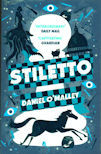
book review: Stiletto

Daniel O’Malley.
Stiletto.
Head of Zeus. 2016

Stiletto starts off where The Rook ends: Rook Myfanwy Thomas and the Checquy have declared a truce with Graaf van Suchtlen and the Grafters, and they have started the delicate process of working together. But not only are there centuries of well-stoked fear and suspicion on both sides impeding progress, there is a hidden faction actively out to sabotage the deal.

The bulk of the book alternates the viewpoint between Felicity Clements, a Chequay Pawn with aspirations to be a warrior Barghest, and Odette Leliefeld, a high ranking Grafter. After some typical Checquy-style horrors, Felicity is assigned as Odette’s bodyguard. Neither will be the same again.

I am slightly disappointed that this time round we don’t get Myfanwy’s viewpoint, except in a few scenes. And there is one scene from her point of view that doesn’t ring true for me. Myfanwy is at the Races investigating a gruesome murder, when she bumps into her brother Jonathan, and agrees to go up to his box to meet his friends later. After he leaves, she is attacked. The plot promptly proceeds to forget everything about this promised visit. Poor Jonathan, he must be worried sick!

Apart from this minor plot oversight (or maybe it is something incredibly subtle that will come back to haunt her later?) we get to see Myfanwy as others see her, in all her fearsome sarcastic efficiency. We are still in the wonderfully bizarre, dangerous, gross, complicated, surreal world of the Chequay, as two groups of people struggle to overcome perfectly understandable hatred and fear of each other, whilst surrounded by extraordinary and incomprehensible goings-on.

This is a great second book in the series. I hope it won’t be a four year wait for the third one! (There is going to be a third one, is there?)

Sunday, 12 March 2017

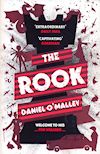
book review: The Rook

Daniel O'Malley.
The Rook.
Head of Zeus. 2012

Myfanwy Thomas wakes up in a London park surrounded by bodies, with no memory of who she is, or how she got there. She needs to find out in a hurry, as unknown people are trying to kill her. She has three advantages: letters from her previous hyper-efficient self explaining the situation, a senior position in a sinister secret organisation, and superpowers no-one believes she can use.

It is difficult to categorise this, but I enjoyed this immensely. The puzzle of what is going on, explained in turns by the letters and Myfanwy’s own investigations, is interesting. The sarcastic tone of the protagonist as she encounters her colleagues’ attitude to her previous timid self, and the increasingly bizarre situations and revelations, make this in turns intriguing, a little scary, very funny, and occasionally a bit gross (in a good way).

The single off note for me is that this is written in the third person, but from the style I kept feeling it should be first person. But I assume the author knows best.

Just as I was finishing this, I was delighted to discover a sequel had just been published. Reader, I bought it. On the one hand, I don’t have to wait the five years that readers who discovered The Rook in 2012 have had to wait. On the other hand, can O’Malley keep up the clever and bizarre content? I do hope so.

For all my book reviews, see my main website.

Friday, 27 May 2016

Justin Bieber and Beyonce are not aliens

Prof Angela Saase
On Wednesday I was down in London, for the 2016 Hopper Colloquium, and the 6th annual Karen Spärck Jones lecture. This year, the lecture was by Professor Angela Saase, Director of the UK Research Institute in Science of Cyber Security, speaking on the parlous state of computer security.

Like the previous one of these lectures I attended, this was entertaining, informative, and thought provoking.  In a nutshell: there is a lot known about how to get good computer security; most developers and their companies ignore it, and are ignorant of it.

Take passwords.  We all know that a long strong password, frequently changed, makes for good password security, right?  Wrong!  What is actually needed is a password that the user can remember, changed only when suspicious activity has been spotted, and protected via technological defence in depth.

Unusable security, including multiple long complex changing passwords, is bad security.  If your product is unusable, users will go elsewhere.  If they can’t go elsewhere (you are the only provider, or, more likely, everywhere else is just as bad), they will circumvent the process, thereby making the system less secure overall.  If they can’t circumvent, their productivity will simply plummet.

As Saase puts it: Users are Not the Enemy.  Usability is not a luxury, to be grudgingly added in when the call centres are groaning under the weight of frustrated callers.  Apparently a major company had a call centre of 100 people doing nothing but reset passwords, and it is not alone.  Talk about productivity plummeting!

The most eye-opening part of the talk was when Saase described a study of three major companies, who had volunteered to be studied because they had good processes.  In summary, they actually had: no criteria for usability; no user involvement; no usability testing; little or no security testing; no understanding of the impact of the design on productivity or sales; internal security policies violated by their own developers; …

It’s not that usability insights are new.  In 1883,  Auguste Kerckhoffs published six principles for secure cryptography; three are about usability!

The solution?  Don’t push the risks onto the users.  Engage with them.  Use technology to provide defence in depth.  Implement only provably effective security policies.  And most of all, convince the developers and their managers that usability is not a luxury: it is an essential security requirement!


Oh, and this post title?  Well, one of the talks at the Hopper Colloquium was about the relationship between post titles and click-throughs. The result: more click-throughs when the title includes famous people (these two, whoever they may be, were given as examples), and include a negative.  Let’s see how it works.

Okay, okay.  Click-bait.  I won’t do it again!

Saturday, 29 November 2014

sequestering carbon, several books at a time XXXVI

This batch we got the hard way: walking in to shops, picking books off the shelves, and physically carrying them home.


After visiting the Lego BRICK event at the ExCel, we popped into central London, first to Foyles, then to Forbidden Planet.  The Lego event explains some of the purchases...

Foyles has moved a few yards down Charing Cross Road from when I was there last.  The shop that is now in its old location has made excellent reuse of its name:


The new Foyles is rather different in style from the way it used to be.  To be fair, it had been changing even in its previous location.  But I well remember the eccentric shelving by publisher, and the three separate queues (to get the books wrapped and stored, then to pay, and then to collect the paid-for books).  Now there is only one queue, and the shelving is less idiosyncratic.  However, I did fail to find the books on Python and Processing in the Programming Languages section: the Python books were mainly under Web (and the Nutshell volumes under O'Reilly, the publisher!), and the Processing books were with Graphics.  But that’s more a problem of having to have a single physical hierarchy.

Books are heavy.

Friday, 28 November 2014

bricks galore

Today was a holiday in London, at the Lego BRICK 2014 festival, in the ExCel.  (That’s the same huge building as the SF WorldCon this summer, but in a different huge hall.)

There were some tremendous pieces, like Westminster Abbey.

Westminster Abbey
There was a good display of the latest generation of Lego Mindstorms, EV3, including a robot scorpion

beware!
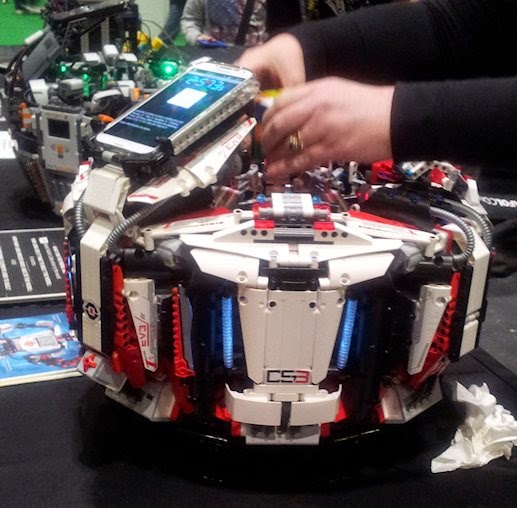
and the Cubestormer, the record-breaking Rubik’s cube solver:

watch it in action on YouTube – don’t blink!
Not everything was a massive construction.  Some smaller pieces helped demonstrate the versitility.

the Platonic solids
Small bricks are just large pixels, so there were many pictures on display.  My favourite was this transition of millennia:

Lego Lascaux, complete with Lego prehistoric artists


the original, for comparison


It’s easier to do things like this with the large palette of colours available today.

a far cry from the old black, white, red, blue, yellow and green...
Trains were much in evidence, combining two standard passions.  Possibly my favourite was the nested train systems:

nested train systems
The upper small oval track system was itself mounted on two trains, one running on the lower large oval track, the other on the central narrow blue oval.  That itself was fun and clever, but then we spotted that lower train had a wagon hosting a tiny train running on its own little track, too!

It wasn’t just the Lego itself that was a blast from the past.

Thunderbirds Are Go!
It all started getting a bit self-referential with the merchandising, though:

the videogame based on the movie based on the toy
full circle: the toy based on the movie based on the toy

We had a great time looking at all the displays, and also bought about £10 worth of bits (given the price of the entrance tickets, and the train fares, it was quite an expensive £10 purchase). Being a Friday, it wasn’t too crowded; I expect the Saturday will be packed.

Also, I can highly recommend the ExCel’s Orange and Chocolate muffins: they are delicious, and go brilliantly with the coffee.


Monday, 18 August 2014

Loncon 3 : Monday

For the sake of tradition, here is a photo from our hotel window, showing the ExCeL loading bays at the back, and the work on the new Crossrail in the front.

A Room With A View
After breakfast, we checked out of the hotel, leaving our luggage for later collection, and walked across to the ExCeL for the last day of the Worldcon.

First up was a talk by Dr Nicholas Jackson, on Knots in Non-Euclidean Space.  Nicholas has been giving interesting general talks on mathematics at Eastercons: this time it was based on some of his own work.  I got lost towards the end, but it was all done in his clear, amusing, and interesting style.

Next was a panel on The Politics of the Culture.  Banks was a fairly consistent Old Labour social democrat; reviewers seem to assume his characters’ opinions are his own, though.  Ken MacLeod told the story of The Use of Calculators as Iain’s proposed route to his Marxist communist utopia of “a stateless and classless society based on automation and abundance”. Many of the Culture novels are based on the Minds having a strong sense of the cost of backwardness, and a moral imperative to uplift, and then working through the complications and consequences with a degree of rigour.

At noon I went to see The Compleat Wrks of Wllm Shkspr (Abridged), by the RSC Shakespeare Company: 37 plays in 97 minutes, including all the comedies at once, and Hamlet several times, faster and faster, and then backwards.  I’d seen it many years ago; it was well worth seeing again.

Lunch, and then my final panel the con: The Scientific Culture.  Here no Banksian reference, just a discussion of the culture (with a small ‘c’) of science and scientists.

The end of a great Worldcon, my fourth: I went to Glasgow 2005, Glasgow 1995, and Brighton 1987.

And, coming full circle, I left the ExCel for Brighton, where tomorrow I give a tutorial on complexity and emergence at the Student Conference on Complexity Science.

And so to bed, in a different hotel, now by the seaside.


Sunday, 17 August 2014

Loncon 3 : Sunday

Sunday started out well with Dr Jenny Rohn’s great talk on antibiotic resistance in Revenge of the bugs: how bacteria have re-emerged as a serious threat to our existence.  Bacteria have been shaping our evolution by slaughtering the weak for as long as we can tell.  In the 20th century we began to fight back with antibiotics, but the bugs are out-evolving them, at an accelerating rate.  Not only that, but we’ve stopped making new antibiotics, because it’s just not financially viable: the low hanging fruit is gone, and the financial incentives are wrong.  It’s a health catastrophe on a par with climate change.  What to do?  Write to your MP demanding action!  And don’t take antibiotics for a cold.

Next was Authors Accept, Encourage, and Create Fan Works Too, a panel about fanfic.  All the panel indulged to some degree; some had learned their craft that way.  Despite some people looking down on fanfic, they pointed out that screenwriters, for example, are all playing in someone else’s sandbox.  If you do work for hire, there are restrictions: don’t kill off a major character, no explicit sex, no crossovers; so for a fan writer, why would you bother? Some authors send cease and desist letters under the mistaken impression they need to do so to protect their copyright (they don’t) or their trademark (they could authorise instead).

Next was a history panel, Seeing the Future, Knowing the Past.  Real history is messy, full of contingency, short bloodlines, and instability, so why does fantasy insist on prophesy and “rightful heirs”?  And all this “last in the long line of kings”, like Aragorn.  In reality, you are either everyone’s ancestor, or no-one’s; nearly everyone is a descendant of Genghis Khan, and he died only about 800 years ago.  However, it is a function of fiction to put order onto messiness and chaos; it provides a controlled environment where we can get answers (although this is a relatively recent trend in literature).  Also, fantasy likes grand overarching narratives.  In reality, prophesies do exist, but are often written in retrospect.  People blame Tolkien, but he didn’t do this kind of thing: he was a “messy” writer, with lots happening. Quote of the panel: “I don’t blame Tolkien; I blame Terry Brooks!”

The Secrecy in Science panel discussed to pros and cons of keeping experimental data secret until it has been fully analysed, and published by the scientists who have spent most of their career on the specific project.  NASA releases all its data immediately; ESA is more restrictive. There was also some discussion on the move to publishing the results of all drug trials, not just the successful ones, and the use of Open Access.

Lablit (laboratory literature) discussed a wide range of stories featuring scientists going about their research, as part of a contemporary story, not science fiction.

Botanical Conquistadors was an interesting panel.  The moderator asked the rest of the panel a sequence of questions designed to get them to incrementally design a terraforming strategy.  The structure worked really well, leading to musings on giant evolved tardigrades, planet-covering HeLa cells, and Japanese knotweed as a mulch.  We also learnt interesting facts about terraforming, such as the need for nitrogen, and how mosquitoes are a key species as food for birds.

We finished off the day attending the Hugo Ceremony.

And so to bed.


Saturday, 16 August 2014

Loncon 3 : Saturday

At breakfast today, we shared a table with a woman with limited mobility, who had hired a mobility scooter to traverse the ExCeL.  She amused us with descriptions of many different ways to incorporate such the scooter in a hall costume, Davros being merely the starting point.

My first panel was 1938: The Year In SF/F, discussing the retro-Hugos.  The world was different then: SF was mainly published in magazines in the US, and it was possible to read everything every month, twice!  The UK market was completely separate.  It was suggested that some of the retro awards were won because present day fans were voting for the author, not the work; one panelists suggested there should be a rediscovery award for unfairly neglected writes, and suggested Raymond Z Gallun as a nominee.  It was also noted that every book on the 1938 list was part of a series.

Next came Banksian, a  panel discussing what the term means, and who is writing it today. Ultraviolence as a feature was discussed, but it was pointed out that while Banks wrote violence, it was never the star; there was always a strong moral content, and the reader was supposed to be sickened by the violence.  Next on the list was the expansive, inventive scope and scale, of time, of events, of artefacts.  Before Banks, spaceships were 500 yards long, after, they were 500 miles.  Then the panel discussed his experimental, unusual writing techniques: the inverted story structure in Use of Weapons; the dialect in Feesum Endjinn; 2nd person narrative; epistolary structure of Excession.  Of course, anyone copying any of these styles wouldn’t be experimental!  Banksian politics is socialist utopian individualism, which needs the Minds to keep everything stable.

With a change of focus from science fiction to science, I next went to the Climate Change Narratives panel.  The discussion oscillated between how to write a compelling story about climate change, and how to redesign economics to properly account for climate change. Kim Stanley Robinson was in full flow about the way current economics says we can’t afford to save the planet (we can’t afford to leave all that valuable coal in the ground), and how that means we need a better economics: “current economics doesn’t make sense – it’s astrology in support of the rich”

Next off to a fantasy panel:  “Your ‘realistic’ fantasy is a washed out colourless emptiness compared to the Rabelaisian reality.” Discuss.  Some authors claim to write their medieval fantasies full of straight white men, because “that’s how it was back then”.  The panel of historians begged to differ (although Edward James pointed out that Rabelais wrote fantasy, not reality).  Despite this, Kari had a lovely rant about how one of the problems of being a Celticist is the Celtic fantasy novels like Marion Zimmer Bradley’s Mists of Avalon and Gael Baudino’s Gossamer Axe, promulgating the Californian neo-pagan Myth of the Celtic Woman: quote of the panel: “Celtic women were property, not radical lesbian separatists!”

I grabbed a mid-afternoon pasty before going along to the Science Fiction Encyclopedia Reunion, where we heard the fascinating story of the design and production of the Science Fiction Encyclopedia, from the first edition onwards.

Next was The Post Human Future, a talk delivered by Astronomer Royal Martin Rees.  The first part was based around his book Our Final Century (he said how the publisher cut his question mark, and the US title was Our Final Hour, maybe because they want instant gratification!), which is about all the things that could wipe us out.  He then talked about space flight, and how it would be better to commercialise it as a dangerous sport rather than as tourism, so that the inevitable accidents won’t be as traumatic.  He finished off talking about the period from when the Andormeda Galaxy crashes into ours in 4bn years, to the far future of the universe, and the multiverse.  His talk was peppered with wry jokes and science fiction references.  Quote of the talk: “I tell my students it’s better to read first rate science fiction rather than second rate science: it’s more stimulating, and no more likely to be wrong”.

We finished off the evening with the Masquerade, which demonstrated amazing creativity and attention to detail.

And so to bed.