Showing posts with label illusion. Show all posts

Monday, 12 July 2021

seeing isn't believing

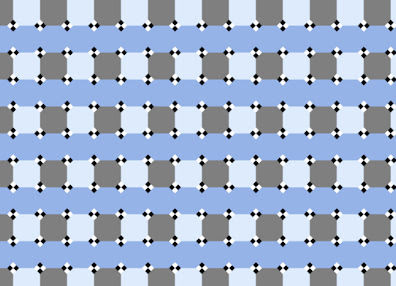
Danny Yee’s always-interesting Pathologically Polymathic blog pointed me to a great app by Michael Bach for exploring Syke’s Oblique Grating optical illusion.

Set up a grid:

Add some checkmarks:


Rotate every other checkmark by 90 degrees:


Mind. Blown.

The app allows you to explore the effects of changing checkmarks, changing the grid, and so on.  The illusion needs a very specific setup.


Friday, 16 August 2019

how tall is that?

Walking back and forth in Dublin over the last couple of days, we noticed a strange construction in O’Connell Strret.

It’s difficult to get a picture of the whole thing on a mere phone camera.  Here’s the base:

a spike with a shiny base (and, apparently, a bit of my finger).

And here’s the rest of it:

all the way to the top

How tall is that?  It seems to go up forever.  It’s a cunning optical illusion, though: The Spire of Dublin is “only” 120m tall, but the way it tapers gives a false perspective view that makes it look a lot taller from the base.  Neat.


Monday, 14 January 2019

book review: A Burglar's Guide to the City

Geoff Manaugh.
A Burglar's Guide to the City.
Farrar, Straus and Giroux. 2016

There is a standard way to use a building: enter by the doors, look though the windows. There is a standard way to use a city: travel along the roads. Burglars don’t use buildings and cities in standard way: some enter buildings though windows, drop through hatches and ceilings, cut through walls; some move around cities through tunnels, either pre-existing or self-dug. Manaugh describes many of these alternate uses: some exceedingly clever, some just plain dumb. And he describes attempts to thwart the burglars, from law-enforcement helicopter patrols to high security panic rooms.

I have come across, in fiction if not in reality, many of the concepts here, but they are all engagingly presented. One aspect I found particularly intriguing was how law enforcement could get lost in certain kinds of locations. In one case it was helicopter pilots over a regular grid of streets, in another it was officers on the ground in a huge building with several identical parts. Both were lost in “a maze of twisty little passages, all alike”. We know the solution to this: drop landmarks. Law enforcement would like home owners to paint identifiers on their roofs. Alternatively, architects could design more varied structures: “a maze of twisty little passages, all different”, with the necessary landmarks already present.

Being able to think “sideways”, like a burglar, is a useful skill when designing any artefact: it will be misused, if not on purpose, then at least accidentally. Having these misuses catered for up front in the design is a plus. Having these literally concrete examples in mind can makes for more vivid analogies when trying to think sideways.


For all my book reviews, see my main website.

Saturday, 21 April 2018

Tuesday, 12 December 2017

seeing is believing - not

Mind.  Blown.

The Remarkable “Curvature Blindness” Illusion


[h/t Danny Yee's blog]

For all my social networking posts, see my Google+ page

Friday, 9 January 2015

straight lines

Seeing is not believing. Phil Plait investigates the bulging chess board illusion.


For all my social networking posts, see my Google+ page

Thursday, 4 September 2014

peering

I've seen this kind of illusion before, but never quite as extreme as this!


h/t John Walkenbach

For all my social networking posts, see my Google+ page

Tuesday, 1 July 2014

my ears are alight

An amazing audio illusion!  (Although I admit I had a bit of difficulty understanding the “unscrambled” version.)


For all my social networking posts, see my Google+ page

Sunday, 25 September 2011

Me ears are alight

Last month I blogged on illusions, inspired by a Bad Astronomy blog entry on the "Flashed face distortion effect". In it I mentioned an aural illusion: the McGurk effect, where you perceive one of three different sounds, depending on whether you listen only, watch only, or do both.

Well, Bad Astronomy has a different example of the McGurk effect, from the BBC Horizon programme. This time, you perceive one of two different sounds, determined by the lip movements you observe whilst listening.

Interesting, of course, but what prompted my follow-up blog entry was a related comment, about mishearing song lyrics. This is accompanied to a link to O Fortuna from Carmina Burana, here transcribed as "oh, four tuna", and including lines like "some men like cheese", "Vimto can taste of kidneys", and more. Although one or two of the hypothesised lines are a little strained, the majority fit beautifully, giving a highly surreal reading.

This reminded me of a TV advert from the late 1980s (for Maxell batteries), on mishearing the lyrics to Desmond Dekker's The Israelites. Naturally, it's on You Tube.

Maxell Israelites advert

A misheard song lyric (or line of poetry, or whatever) is known as a Mondegreen. Before I ever knew the name given to this effect, I'd come across it in Maurice Dodd's Perishers cartoon strip: Baby Grumplin's teddy-bear is called "Gladly, the cross-eyed bear". There are lots of other examples I've heard from people over the years: "The ants are my friends", "Lucy in disguise", "Beelzebub has a devil for a sideboard", "Reverend Blue Jeans", and more.

Nowadays, the web makes it a lot easier to find the actual lyrics, of course. But if you don't know you've misheard it, there's no reason to look it up. (And let's face it, many lyrics are frankly unintelligible even if you know what the words are, so incomprehension is no real reason to suspect a mishearing.) Yet even after hearing a song a gazillion times, I can still sometimes suddenly hear it differently, and go, "Oh, so that's what that line is!" I doubt that my ears are more alight to the words: maybe it's because CDs are higher quality than cassette tapes and radios, even without the excuse of fading batteries?

Sunday, 7 August 2011

seeing is believing -- orly?

We've all grown up with standard optical illusions -- the Ponzo illusion of converging lines making identical objects appear to be different sizes, that kind of thing.

The squares marked A and B are the same shade of gray
These illusions have been getting more sophisticated.

There's a whole set of colour illusions. First of all there are the ones that show two identically shaded squares (A and B), but one appears white, one black, due to our vision perception "correcting" for shade. Then there are ones that make black and white photographs appear to be in colour, thanks to a persistence of vision effect.

There are aural illusions, such as the ever rising or falling Shepard tone, too.

experience the McGurk effect
Aural and optical channels can be combined. I first came across the McGurk effect a few years ago. In this a person speaks a particular simple repetitive sound, and the sound you percieve depends on whether you listen only, watch only, or do both. Weird.

Although these are fun, and weird, I feel I have some kind of handle on how, and why, these happen. I think I can see what's being fooled. But then, via Phil Plait's Bad Astronomy blog, I came across the "Flashed face distortion effect". Watch the video at You Tube. If you look at the individual faces, they look fine. But if you stare at the central cross as the faces flash up, "some faces appear highly deformed, even grotesque. The degree of distortion is greatest for faces that deviate from the others in the set on a particular dimension (eg if a person has a large forehead, it looks particularly large)."

watch this video

Now this is really weird. Disturbing, even. To me at least, some of these faces appear almost alien -- until looked at directly. I'm seeing stuff that isn't even there!

These illusions with their ever-increasing sophistication demonstrate how much better our understanding of perception and cognition is getting. And this increased understanding is showing how very fallible our perceptions can be. It graphically demonstrates the need for rigour, validation, and repeatability in observations, and just why anecdotal evidence should be so suspect.

Monday, 25 April 2011

International Space Station

I've just seen the ISS for the first time. We realised it was due to go over, so popped outside. Lovely clear evening. Bright light in the sky. Is that it? Or is it that one below it? It's the one below: it's moving! Wait, there's another one next to it, also moving! That can't be right. No, it's the bright one that's moving!

It was a very peculiar optical illusion, making the bright light seem to be still in the sky, and the fainter one seem to be moving. After the few seconds of confusion, we watched the bright light move overhead. It whipped overhead quite fast, covering half the sky in a few minutes. It was very bright, probably about magnitude -3. As it got closer to the horizon, it dimmed and brightened a few times, then disappeared.

Observing astronomical stuff is cool. But watching the ISS was quite a different feeling -- people did that! A whole other level of cool.