Vicki Hearne. Adam’s Task: calling animals by name.
Akadine Press. 1986
This is a book about taking domesticated animals seriously: training them, respecting them, and treating them as creatures with their own complex, non-human internal lives. It provides a deeply fascinating account of how domesticated animals relate to humans, and of our responsibilities to them. It is mostly about mostly dogs and horses, told through a series of in-depth stories of particular animals Hearne has trained, plus a chapter on how different cats are.
It is also a book about building a philosophy of communication with domesticated animals. No behaviourism or anthropomorphism or sentimentality, but instead a deep understanding of their existence and differences.
This is a difficult book to summarise, but it is an engrossing read. I was completely hooked, and devoured it in just two sittings. It is an inspiring view into minds simultaneously alien, and yet co-evolved with our own, so that we can communicate meaningfully, if we take the time to learn how.
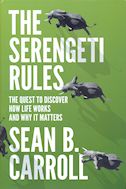
Sean B. Carroll. The Serengeti Rules
Princeton University Press. 2016
There is no actual “Balance of Nature”: everything is growing, changing, evolving, in flux.
Despite this, there is a kind of dynamic balance: our bodies maintain temperature,
animal population numbers don’t tend to grow exponentially or collapse, and so on.
These are dynamic balances, because they happen due to active processes.
Here Carroll explains how those processes have much in common from the molecular to the species level:
biological regulation is at play.
The logic of this evolved biological regulation is different from our engineered mechanical regulators:
rather than a positive logic of a process being switched on when needed,
it is often of a negative form: one process is constantly suppressing another,
and when that suppression is removed, the change occurs.
Carroll gives many examples.
Each chapter has a similar structure:
take one aspect of biology, and the scientists involved, and describe how they discovered the regulation logic.
We start at the beginning, with
Cannon’s discovery of the concept of homeostasis,
and Elton’s invention of ecology.
After these two introductory chapters, demonstrating analogous regulatory processes on vastly different scales,
we get several chapters on molecular level: lactose regulation, statins and cholesterol, and cancer.
Some of these have a “double negative” pattern of regulation –
X represses Y which represses Z, hence removing X increases Y, which then decreases Z –
so a change in one place can have a corresponding change elsewhere,
which will be unexpected unless the system is understood.
Next there are chapters about animal population regulation, keystone species, and trophic cascades:
it’s not just upward regulation by food abundance; there’s critical downward regulation by predators.
The book finishes with some positive examples about how, once we understand these negative regulatory patterns,
we can potentially reverse certain ecological collapses.
We need to identify the relevant keystone species:
wolves predate on elk, thereby allowing vegetation to survive to support other species;
bass eat minnows, reducing predation on the plankton that eat algae, which would otherwise cause blooms.
Knowing the system’s structure, we can potentially reintroduce, or at least stop destruction of,
the relevant species, to allow the ecosystem to move a healthier state.
This is a good account of a biological process that works over many orders of magnitude in scale.
Understanding how biological regulatory processes are negative,
rather than the more familiar engineered positive ones,
explains many otherwise counter-intuitive effects.
And understanding the web of interacting regulatory processes allows us to intervene in an effective manner,
allowing us to work with, rather than fight against, the system.
Today was quite relaxed, staying with friends. In the morning I looked round their smallholding, with its bees, chickens, ducks, and cows. In the afternoon we took a short trip out to Bridal Veil Falls.
We walked down a staircase by the 55m drop, stopping half way to take a panorama view:
Bridal Veil Falls, from half way down: panorama view
Then we went on down to the bottom.
Bridal Veil Falls creating rainbows
The noise was tremendous:
Yes, another portrait mode video, but it’s a portrait mode waterfall!
Then we had to walk back up the 55m of staircase…
After that, we drove up to Raglan, to wait and watch the sunset, while drinking hot chocolate.
sunset at Raglan
The reason for this wait, apart from good hot chocolate, was that I had yet to see the southern night sky, due to clouds. Even my earlier sighting of the full inverted moon had been after dawn. But tonight was forecast clear, so we waited for sunset, then post twilight, and drove to an unlit place.
The sky! Full of stars! Alien stars!! It was a most peculiar experience, seeing a sky full of completely unfamiliar star patterns. Oh yes, I identified the Southern Cross, but wasn’t the same seeing it for real as seeing a picture. For one thing, it’s tiny!
The Milky Way towards the galactic centre is splendid: broad and structured. I stayed looking up and around for quite a while.
Today was the Waitomo caves. I booked the “triple cave combo”, and drove along to the first one, the Ruakuri Cave, to join the 9am tour party. The rain was hammering down outside, but inside it was (mostly!) dry, cold, and quiet. We had an excellent guide, who knew the history of the cave system, and also had been involved in digging out mud in order to open it up to tourists.
The tour lasted nearly 2 hours, with many wondrous sights. To get in, we descended a deep shaft using a large spiral ramp.
I didn’t manage a good photo of the entry ramp, so I got a postcard
The sights started almost immediately, with wonderful stalactites (growing down) and stalagmites (growing up). We learned the water deposits new material at about a cubic centimetre a century.
Stalactites, up close
amazing coral-like structure
sheets of rock
atmospheric lighting
so many stalactites
caves within caves
a large cavern (note the handrail at the bottom, for scale)
other people enjoying the caves in their own way
a giant funnel
After walking round in dazed wonder, we re-emerged blinking into daylight. The rain had just about stopped, and it was a short drive up to the next site: the Aranui Cave. This was a shorter tour, just under an hour, but no less spectacular.
small stalactites and stalagmites, some connected
A ceiling full of spikes. Some are broken. This cave has been open longer, and in the early days, before it was known how long the stalactites took to grow, tourists were allowed to break pieces off as souvenirs.
over 6 feet high: like a vast leg
a ceiling like ice cream
a vast cavern; see handrail at bottom for scale
a petrified waterfall
I’m running out of things to say other than “wow!”
so fragile to have survived so long in a geologically active region
more petrified falling water
the huge cavern on the way back: see heads at bottom for scale!
this is what makes the stone features -- slowly
When we left this cave, not only had the rain stopped completely, but the sun had come out, and it was a beautiful day. I had no specific time on my ticket for the third cave trip, so I decided to do the short Ruakuri bush walk, which my host at last night’s B&B had told me was the “best bush walk in New Zealand”. It goes along a river which itself goes through a natural tunnel (the path goes over the top though).
The sign suggested it was a 30 minute tramp. I took an hour. (That sounds better than “it took me an hour”.)
a natural tunnel
the path goes through a twisty tunnel of its own
beautiful mossy trees
a view from inside the river tunnel (view accessed down a dark unlit staircase...)
another tunnel along the path: at least with this one, I could see the other end!
a view down to the river
the other end of the natural tunnel
Although I have no sense of direction, I did get a bit confused along this path as the river seemed to switch direction. Then I saw a map: the river performs a 180° turn in the tunnel.
On the walk I passed two other people, until I got close to the end, when I passed a noisy crowd of about 10 teenagers on a tramp. Like with my Kauri forest visit, the solitude was part of the experience. I don’t know if it is the best bush walk in New Zealand; however, it is an excellent bush walk.
Next, back down the road to the Waitomo glowworm cave. We weren’t allowed to photograph in this one, as there were a lot of parties milling about, and it gets very dark. There was a short walk through a big cavern with lots of stalactites: very impressive, then, once our eyes had adjusted, onto a boat to see the glowworms. Um, wow! There is a big cave system with a lake that the boat moves slowly and silently down, and a relatively low roof, utterly smothered in glowworms. When the boat is still, it looks like an exceptionally starry night (except that the points of light are too evenly spaced for stars). When the boat moves, the shape of the roof becomes apparent. I’m running out of superlatives, but, amazing!
Once I had done with Waitomo, I headed off to the Otorohanga Kiwi House, to see some more kiwis. This site again had a night enclosure, with four kiwis in separate pens. The largest kiwi, a mature female, was very active, strutting around her enclosure, probing the ground for food. Then it was feeding time. The keeper entered her pen with the food, and the kiwi went bonkers, running around, really fast, and kicking the keeper, really hard. The keeper told us after that she had been hospitalised twice over the years, once from a deep peck, and once when a kick hit her knee (rather than her tough boots). So much for fragile sweet little birds!
three stuffed kiwis on display; the live kiwis are in a much darker environment
There was a lot more to see, but I had had my fill for the day, and finished off with a short drive to Tamahere, where the friends I’m staying with over the weekend live.
Google Earth’s view of Wai-O-Tapu. North is to the left
And here is the brochure’s similar view, showing the various paths, and numbered features along the way:
brochure image, showing red, orange and yellow walks
I arrived about 9am. One feature is the nearby Lady Knox Geyser, which erupts at 10:15 each day. So I had about an hour to kill, and killed it by doing the “red” walk.
the Weather Pool
a panoramic view of Rainbow Crater; feature (2) on the map
the ground is steaming everywhere!
Thunder Crater (3)
the Devil’s Ink Pots (4)
the vegetation seems affected by the heat
a panorama of the Artist’s Palette (5)
While crossing the Boardwalk (7) and looking over the Champagne Pool (21), the mist in the wind fluctuated in density. At some times, the view was clear. At others, only a second later, the mist was so dense I could see nothing at all. And the denser the mist, the stronger the smell, and the stronger the feeling of choking, so watch out if you are claustrophobic!
Since I was doing only the red walk, in order to see the Lady Knox geyser erruption, once across the boardwalk I started back along the return route.
minerals being deposited along the edge of the Champagne Pool (21)
Inferno Crater (22)
a Sulphur Cave (24)
Devil’s Bath (25): see the plan view map above to get a feel of the sheer scale of this large lake
Now back at the beginning of the walk, and closer to the time of the geyser eruption, I popped in the car and drove a kilometer up the road to next car park. There a small terraced theatre had been constructed to view the geyser, and about 100 people gathered to watch. (Where they then all went I’m not sure, as I saw very few people on the main walk.) I had been wondering how the geyser could be timed. I had decided it couldn’t be natural – I could think of no mechanism that would give the exact 24 hour period – so I was wondering how it was triggered.
The answer, we all discovered, is: soap. The interior of the geyser has hot water trapped below cold water: dropping soap down it changes the surface tension, allowing the hot water to escape. The presenter dropped a bag of surfactant down the hole, and retreated. It took a couple of minutes, and then there was a bubbling, an overflow, then a gush.
Yes, I know it’s in dreaded portrait mode, but frankly, there’s nothing to see on either side!
It was still going strong 25 minutes after it first blew, when I left to return to the main site, to do the full walk.
Having already done the red walk earlier didn’t matter to me (apart from to my feet): it was well worth seeing again. But when I got to the Champagne Pool (21) again, this time I turned off to new sights along the orange and yellow tracks.
up at the Panoramic View point (11) looking down over Frying Pan Flat
now down on that bridge previously visible from above; a panorama of Flying Pan Flat (15)
the Oyster Pool (16), a natural sulphurous pool
another Sulphur Cave (17)
view over Lake Ngakoro (18)
Sulphur Mounds (20)
At this point, it started raining in earnest (sufficient to make me put on my waterproof), so I walked somewhat briskly back to the starting point, stopping a few times to admire the the Primrose Terrace (8) as I walked along its edge. Fortunately, since I had already done the red walk, I didn’t miss too much by only stopping to stare a few times.
I had lunch in the Visitor Centre, and dried off. Then I drove to the last sight of the Thermal Wonderland: the hot Mud Pools.
Since the rain looked like it would stay for a while, I decided this was now the right time to drive on to Waitomo, ready for the caves tomorrow. However, since it was only 2pm, I decided to take an indirect route, so drove round Lake Taupo on the way. Some of the bends there were marked 25, and they meant it!
from Rotorua, via Wai-O-Tapu, to Waitomo, the long way round, ~ 290km