The third day of the Worldcon saw several programme items moved to larger rooms, increasing the probability of getting into items of choice. Also, the innovation of keeping each session to 45 minutes, allowing 15 minutes of travel/queuing time, worked well.
To start the day, I went to the panel on The Times That Shaped the Science, addressing the question: How do literature/politics/art shape the way people did (or do) science? Galileo had a strong background in literature and the arts, which meant that when he looked at the moon through a telescope, he could recognise it as a round ball, and paint it as a round ball. He loved the epic poem Orlando furioso (it was the LotR of its generation, or the Alice in Wonderland, with enormous popular impact, and even fanfic). From this and other literature of the time, to Galileo a hero was someone who fights against all odds. To him, being attacked and persecuted showed he was the hero, so he would go out of his way to be attacked. Nowadays we have this history of tension between science and the organised church – narratives of Galileo and Bruno – but actually these types of encounter were incredibly rare: other less confrontational people weren’t getting into trouble, despite believing similar things. The church wasn’t interested in things that were “obviously stupid”, only in things that were “nearly true”, plausible heresies that might convince the learnèd. We tend to locate agency in individual heroes and villains – historical heroes with modern opinions – and assume that the advancement of rationalism was by firebrands, and people who look like us intellectually. There were a few like that, but major changes often came from mainstream workers, confident that their results would confirm the orthodoxy, because they believed that both religion and science were true, so couldn’t be in disagreement. We only realise in retrospect that there’s a conflict between these views. Many advances were made by quiet people we’ve never heard of, by individual boring people who are nevertheless incredibly important. The interesting questions depend on society of day, and what is a satisfying answer changes over time, too; when Newton said: I do not feign hypotheses, he was reframing what was an acceptable answer. One major change occurred as the printing press made books common: it started earlier and grew exponentially, so initially there were only a few books. But by 1700 an author could live on book sales, rather than needing a patron: reputation became dependent on the masses, rather than the elites. [Well, that was all jolly interesting: much more engaging and intelligent than history lessons at school.]
Next was a talk from Ian Stewart, the Science Guest at the con, on How to Tell the Ducks from the Rabbits, or a simple mathematical model of optical illusions. Many illusions of ambiguity (like the rabbit-duck, the spinning dancer, and the Necker cube), and illusions of binocular rivalry where different images are shown to different eyes, can be modelled with simple inhibitory/excitory networks. This was a beautiful explanation of a lot of weird perceptual processes. There’s a YouTube video of a slightly longer version of the lecture given earlier in the year: well worth watching.
Then on to a panel on The Pleasures and Pitfalls of Writing Space Opera. This is possibly the most nostalgic form of SF, and closest to fantasy without getting caught: epic tales of alien megastructures, galactic empires, space pirates… There are similarities to historical tales, now set in the oceans of space. They have a sense of wonder and romance: the oldest is the Odyssey: travels through a bunch of islands with beautiful women, updated as Star Trek. Of course, empires are fundamentally unstable forms of governance, so what makes such societies work in space? These grander schemes may form the backdrop universe, whilst the central story is focused on a single planet or ship. Hard SF and space opera can overlap, but they not the same thing. Yet hard SF can make for good space opera, because it puts limitations on the tech, and those limitations can drive the story. Series can fall into the Lensman trap: save the world, the solar system, the galaxy, the universe…!
From one extreme to the other: next was the panel on High Fantasy: Is it Still Relevant? As often, start with some definitions. High fantasy is set in a complete secondary world; low fantasy can happen in our world with added magic. High fantasy has elaborate sorcery; low can have obscure, mysterious, and intermittent supernatural events. High fantasy has consequences on the world level; low is more personal, on the city level (urban fantasy) at most. High fantasy is about the destination of the human soul en masse, a clash of powers, a vastness of magic and wonder; low is more the individual soul or life impact. Teresa Neilson Hayden defined genre fantasy as “numinous landscapes and significant personal actions”. There are exceptions to these definitions, particularly where ordinary humans travel from our world to the other, as in Narnia or Oz. [I was amazed no-one said "portal fantasy".] Some fantasy is “just” historical fiction in a secondary world context; all historical fiction involves worldbuilding, with different mindsets and worldviews. Fantasy can use the trope of the little shepherd boy/kitchen maid/apprentice who makes good: how an individual becomes great, or at least a rite of passage to adulthood. This allows the reader to discover the world along with the character. But it can also feature noble protagonists, although more usually in fairy tales. French salon fairy tales are about women in trouble in French courts, using fairy tales to explain their own upper class problems. The Grimm fairy tales are peasant folk tales about how they have survived the Napoleonic wars, and are going to rebuild German values.
Having enjoyed the previous interview with GoH Nalo Hopkinson, I went along to Nalo Hopkinson and Farah Mendlesohn: a Conversation, framed as a late night Skype call. More interesting snippets: Farah always asks interesting questions I would never think of.
How Science REALLY Happens was a panel about, well, how science really happens. There are no single lone hero (or even mad) scientists. It’s simultaneously cooperative teamwork and competitive, it’s long tedious applications for funding, it’s negotiating ethics panels, it’s slogging through field work, it’s writing papers and responding to referees, and it’s all about uncertainty.
The final panel of the day was on the Future of Doctor Who. I got into this despite a huge queue; the room seemed bigger on the inside. The hope was for more writers bringing more variety, and no jokes about the Doctor’s new gender. During the hiatus (1989-2005, ignoring the Paul McGann film) there was a lot of fan fiction, with female doctors, black doctors, and more: it was an age of endless possibilities. Dr Who changes yet remains the same, much like a football team. All the previous Doctor incarnations are still with us: will there be joint episodes as before? Recall how the last thing Bill said to the Doctor was “you know how I’m usually all about women and, and kind of people my own age”? Ooooh!
The last event of the day was the Hugo Awards Ceremonies. A lot of applause. Three of the acceptance speeches were anti-puppy: one managed to be so without even mentioning them!
Showing posts with label Narnia. Show all posts
Friday, 11 August 2017
Wednesday, 31 August 2016
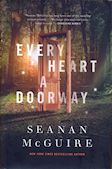
book review: Every Heart a Doorway
Labels:
books,
Narnia,
review,
science fiction
Seanan McGuire.
Every Heart a Doorway.
Tor. 2016
There are adventures to be had in fantasy lands. But what happens when you come back from Fairyland, or Narnia, or wherever? How do you readjust to Mundania? Can you readjust? Or will you break, fruitlessly searching for your lost life, your true home?
Eleanor West runs a boarding schools for those children who can’t readjust. Their parents think them damaged, or wayward, or mad. Eleanor knows better, having herself returned from a Netherworld. Most learn to cope, in the company of those who understand. A few, a very few, find their way back. But when new girl Nancy arrives, dark things start happening, and the school itself is threatened. Is Nancy the source, or the trigger, of these events?
Life After Fantasy has always struck me as an issue. The scene at the end of The Lion, the Witch and the Wardrobe, where the Pevensie children return home after decades in Narnia, always horrified me: they had been adult royalty; how did they cope with being ordinary children again? Jo Walton tackles this issue in her wonderful short story, Relentlessly Mundane. Here Seanan McGuire tackles it differently, in a 170pp novella.
Despite wanting to go to Lewis’ Narnia (for the Talking Animals, if not for the sexism, racism, classism, bad theology, and shoddy plotting), and to Phillips’ Fairyland, I didn’t find myself attracted to any of the Netherworlds described by McGuire. (And I don’t think that’s just because there are no Pauline Baynes illustrations, or that I am half a century older than when I read the originals.) However, that lack of attraction is not a problem: it just serves to illustrate how everyone is different, and what is hearts-ease for one may be horror for another. But, consistently, Mundania is home for none.
This is not a typical school story, as it does not dwell on any lessons, except for some interesting Netherworld classification schemes. Nancy as new girl allows for some expository passages, but not that many. The tale focuses mainly on the deadly goings-on that threaten the school. And even there, we do not get a lot, since this is a novella. But McGuire does paint vivid pictures of the various main characters, and the very different homes they wish to return to. I wish this was a novel rather than a novella, and you can’t say fairer than that.
For all my book reviews, see my main website.
Every Heart a Doorway.
Tor. 2016
There are adventures to be had in fantasy lands. But what happens when you come back from Fairyland, or Narnia, or wherever? How do you readjust to Mundania? Can you readjust? Or will you break, fruitlessly searching for your lost life, your true home?
Eleanor West runs a boarding schools for those children who can’t readjust. Their parents think them damaged, or wayward, or mad. Eleanor knows better, having herself returned from a Netherworld. Most learn to cope, in the company of those who understand. A few, a very few, find their way back. But when new girl Nancy arrives, dark things start happening, and the school itself is threatened. Is Nancy the source, or the trigger, of these events?
Life After Fantasy has always struck me as an issue. The scene at the end of The Lion, the Witch and the Wardrobe, where the Pevensie children return home after decades in Narnia, always horrified me: they had been adult royalty; how did they cope with being ordinary children again? Jo Walton tackles this issue in her wonderful short story, Relentlessly Mundane. Here Seanan McGuire tackles it differently, in a 170pp novella.
Despite wanting to go to Lewis’ Narnia (for the Talking Animals, if not for the sexism, racism, classism, bad theology, and shoddy plotting), and to Phillips’ Fairyland, I didn’t find myself attracted to any of the Netherworlds described by McGuire. (And I don’t think that’s just because there are no Pauline Baynes illustrations, or that I am half a century older than when I read the originals.) However, that lack of attraction is not a problem: it just serves to illustrate how everyone is different, and what is hearts-ease for one may be horror for another. But, consistently, Mundania is home for none.
This is not a typical school story, as it does not dwell on any lessons, except for some interesting Netherworld classification schemes. Nancy as new girl allows for some expository passages, but not that many. The tale focuses mainly on the deadly goings-on that threaten the school. And even there, we do not get a lot, since this is a novella. But McGuire does paint vivid pictures of the various main characters, and the very different homes they wish to return to. I wish this was a novel rather than a novella, and you can’t say fairer than that.
For all my book reviews, see my main website.
Saturday, 11 June 2016
Ana Mardoll, Suck Fairy incarnate
I’ve always read a lot, and back when I was a child I basically read everything with print on it I could find, working my way through the local library. One of my favourites was the Narnia series, by C. S. Lewis, in an edition wonderfully illustrated by Pauline Baynes.
I knew at the time they were sexist. Hey, at the time most children’s books were sexist; I was brought up on Enid Blyton, for heaven’s sake. I just ignored it as best I could. I also had an uncomfortable, but unexamined, feeling that they were racist. I didn’t spot the religious overtones until my older sister pointed them out; I ignored the most overt bits after that.
I remember the books fondly, but haven’t read them in the last several decades. I was worried whether the Suck Fairy would have taken its toll (although Marjorie Phillips’ Annabel and Bryony survived her ravages). Anyhow, I’d read them enough that I virtually knew them by heart. Or so I thought.

My main problem with the Narnia at the time was empathising with the devastating sense of loss the children must have had when they returned home. Yet absolutely nothing was made of this in the books themselves. Years later, I came across Jo Walton’s short story Relentlessly Mundane, which captures beautifully everything I’d felt.
So I was going along quite happily with these memories, when a couple of months ago I came across a reference to Ana Mardoll’s blog, which said she was going through the Narnia books, discussing them. She has indeed been discussing them, deconstructing them, in relentless detail, since mid 2011. As of current writing, she is halfway through The Horse and His Boy, having already covered The Lion, The Witch and The Wardrobe, Prince Caspian, The Voyage of the Dawn Treader, and The Silver Chair. I clicked through, gave the most recent post a cursory glance, then read it, then read the previous one, then the one prior to that, then found the index and started from the beginning, and … I have just emerged from that rabbit hole, having had some of my fondest childhood memories totally eviscerated.
The books aren’t just sexist; they are dreadfully sexist. They aren’t just racist; they are appallingly racist. And classist. They aren’t just nice little religious allegories; they present a dreadfully cruel and capricious religion. And, possibly most damning of all for my fond memories, they are just very badly written.
Ana Mardoll does a brilliant job picking apart these books.
Sexism: when women and girls do certain things, it’s wicked or evil; when boys or men do analogous things, it’s right and proper. We have bad Lucy eavesdropping in TVotDT, versus good Peter and Caspian eavesdropping in PC. We have the wicked White Witch giving Edmund magical food in TLtWatW, versus the good Coriakin serving Lucy a magical meal in TVotDT. We have the bad Aravis drugging her servant to cover her escape in THaHB, versus Caspian’s tutor the good Doctor Cornelius sending his servants into a charmed sleep for his escape. Notice how Caspian’s wife never even gets a name? And there’s much more.
Racism: well, Calormene. Need I say more? Well yes. When brown Calormen do certain things, it’s wicked or evil; when white Narnians or equivalent do analogous things, it’s right and proper. So we have the wicked slavery of Narnians by Calormenes in TVotDT, versus the good (unacknowledged) slavery of the mutilated Dufflepuds by a (white) ex-star, also in TVotDT. Also, there is the racism (or maybe “merely” classism) against the native Narnians: we have the depiction of most of the Talking Beasts as inferior, childlike, lower class. Yes, even Reepicheep. (Also, notice how Reepicheep is the only native Narnian on the Dawn Treader.) And there’s much, much more.
Religion: oh dear, the religion. So, Aslan is frankly a jerk and a bully. He leaves Narnia to freeze under the White Witch for a hundred years, only showing up to help some English schoolchildren, and set them up to rule over the natives. He then leaves Narnia for over a thousand years, to be invaded by Telmarines, who proceed with genocide against the natives, and only shows up to help some English schoolchildren help a Telmarine set himself up to rule over the natives. A few years later he shows to help the newly installed Telmarine ruler and some English school children on their boat trip. And so on. He traumatises various characters: Trumpkin, Eustace, Jill Pole, Hwin, Aravis, Bree; all for their own good, of course. And he has a hate-on for Susan. (I did notice that originally, maybe because of her name.)
Badly written: the characters are inconsistent, because they do what is needed for the plot, which does what is needed for the message to be delivered. And the world building is shoddy. Eg, how did a Dryad sing to the infant Reepicheep, since Aslan only later reawakened all the trees? Eg, there are no humans in Narnia other than Peter, Susan, Edmund and Lucy, yet in THaHB, the delegation to Tashbaan is mostly human. Maybe these are Archenlanders (and where was it during the White Witch’s reign?) who’ve emigrated to Narnia. Or maybe the book is actually set after PC, the delegation are Telmarines, and it was only moved earlier in the timeline to allow Lewis to shame Susan yet again? The timeline in TSC is frankly ludicrous. Many other plotting weakness are given in Mardoll’s deconstruction. The entire issue is that Lewis doesn’t seem to care about his characters, or the plot, only his message.
Oh dear. By the end of each of Mardoll’s blog posts, another little piece of my past has been dissected, examined to destruction, and found terribly wanting, and I am yet further appalled by what I had read as a child and simply not noticed. (I hope that I might have noticed these things if I had re-read them recently, but who can tell?)
If that were all, that would be more than enough to make Mardoll’s blog worth reading. But there’s more. At the end of each post are the comments.
Amazingly, after Mardoll’s seemingly exhaustive dismantlings, the commentariat put forward yet more examples of further horrors that she missed! But the best comments are the various head canons and fixfics that come to the rescue. There are loads of gorgeous little fragments of writing that restore Narnia as it should be from the Narnia as it is. These aren’t consistent with each other, but they provide multiple little strands of possible universes, better Narnias, better both in content and in style, that surround and help replace the appalling, inconsistent, badly-written actual Narnia. Meet the immortal Reepicheep. See Eustace as the hero. See the Dufflepuds as the hero. See Susan as the hero. Discover how Trumpkin is saving the kingdom from Caspian. Emapthise with Hwin’s backstory. Have your childhood rescued, improved, enriched.
I knew at the time they were sexist. Hey, at the time most children’s books were sexist; I was brought up on Enid Blyton, for heaven’s sake. I just ignored it as best I could. I also had an uncomfortable, but unexamined, feeling that they were racist. I didn’t spot the religious overtones until my older sister pointed them out; I ignored the most overt bits after that.
I remember the books fondly, but haven’t read them in the last several decades. I was worried whether the Suck Fairy would have taken its toll (although Marjorie Phillips’ Annabel and Bryony survived her ravages). Anyhow, I’d read them enough that I virtually knew them by heart. Or so I thought.

My main problem with the Narnia at the time was empathising with the devastating sense of loss the children must have had when they returned home. Yet absolutely nothing was made of this in the books themselves. Years later, I came across Jo Walton’s short story Relentlessly Mundane, which captures beautifully everything I’d felt.
So I was going along quite happily with these memories, when a couple of months ago I came across a reference to Ana Mardoll’s blog, which said she was going through the Narnia books, discussing them. She has indeed been discussing them, deconstructing them, in relentless detail, since mid 2011. As of current writing, she is halfway through The Horse and His Boy, having already covered The Lion, The Witch and The Wardrobe, Prince Caspian, The Voyage of the Dawn Treader, and The Silver Chair. I clicked through, gave the most recent post a cursory glance, then read it, then read the previous one, then the one prior to that, then found the index and started from the beginning, and … I have just emerged from that rabbit hole, having had some of my fondest childhood memories totally eviscerated.
The books aren’t just sexist; they are dreadfully sexist. They aren’t just racist; they are appallingly racist. And classist. They aren’t just nice little religious allegories; they present a dreadfully cruel and capricious religion. And, possibly most damning of all for my fond memories, they are just very badly written.
Ana Mardoll does a brilliant job picking apart these books.
Sexism: when women and girls do certain things, it’s wicked or evil; when boys or men do analogous things, it’s right and proper. We have bad Lucy eavesdropping in TVotDT, versus good Peter and Caspian eavesdropping in PC. We have the wicked White Witch giving Edmund magical food in TLtWatW, versus the good Coriakin serving Lucy a magical meal in TVotDT. We have the bad Aravis drugging her servant to cover her escape in THaHB, versus Caspian’s tutor the good Doctor Cornelius sending his servants into a charmed sleep for his escape. Notice how Caspian’s wife never even gets a name? And there’s much more.
Racism: well, Calormene. Need I say more? Well yes. When brown Calormen do certain things, it’s wicked or evil; when white Narnians or equivalent do analogous things, it’s right and proper. So we have the wicked slavery of Narnians by Calormenes in TVotDT, versus the good (unacknowledged) slavery of the mutilated Dufflepuds by a (white) ex-star, also in TVotDT. Also, there is the racism (or maybe “merely” classism) against the native Narnians: we have the depiction of most of the Talking Beasts as inferior, childlike, lower class. Yes, even Reepicheep. (Also, notice how Reepicheep is the only native Narnian on the Dawn Treader.) And there’s much, much more.
Religion: oh dear, the religion. So, Aslan is frankly a jerk and a bully. He leaves Narnia to freeze under the White Witch for a hundred years, only showing up to help some English schoolchildren, and set them up to rule over the natives. He then leaves Narnia for over a thousand years, to be invaded by Telmarines, who proceed with genocide against the natives, and only shows up to help some English schoolchildren help a Telmarine set himself up to rule over the natives. A few years later he shows to help the newly installed Telmarine ruler and some English school children on their boat trip. And so on. He traumatises various characters: Trumpkin, Eustace, Jill Pole, Hwin, Aravis, Bree; all for their own good, of course. And he has a hate-on for Susan. (I did notice that originally, maybe because of her name.)
Badly written: the characters are inconsistent, because they do what is needed for the plot, which does what is needed for the message to be delivered. And the world building is shoddy. Eg, how did a Dryad sing to the infant Reepicheep, since Aslan only later reawakened all the trees? Eg, there are no humans in Narnia other than Peter, Susan, Edmund and Lucy, yet in THaHB, the delegation to Tashbaan is mostly human. Maybe these are Archenlanders (and where was it during the White Witch’s reign?) who’ve emigrated to Narnia. Or maybe the book is actually set after PC, the delegation are Telmarines, and it was only moved earlier in the timeline to allow Lewis to shame Susan yet again? The timeline in TSC is frankly ludicrous. Many other plotting weakness are given in Mardoll’s deconstruction. The entire issue is that Lewis doesn’t seem to care about his characters, or the plot, only his message.
Oh dear. By the end of each of Mardoll’s blog posts, another little piece of my past has been dissected, examined to destruction, and found terribly wanting, and I am yet further appalled by what I had read as a child and simply not noticed. (I hope that I might have noticed these things if I had re-read them recently, but who can tell?)
If that were all, that would be more than enough to make Mardoll’s blog worth reading. But there’s more. At the end of each post are the comments.
Amazingly, after Mardoll’s seemingly exhaustive dismantlings, the commentariat put forward yet more examples of further horrors that she missed! But the best comments are the various head canons and fixfics that come to the rescue. There are loads of gorgeous little fragments of writing that restore Narnia as it should be from the Narnia as it is. These aren’t consistent with each other, but they provide multiple little strands of possible universes, better Narnias, better both in content and in style, that surround and help replace the appalling, inconsistent, badly-written actual Narnia. Meet the immortal Reepicheep. See Eustace as the hero. See the Dufflepuds as the hero. See Susan as the hero. Discover how Trumpkin is saving the kingdom from Caspian. Emapthise with Hwin’s backstory. Have your childhood rescued, improved, enriched.
Subscribe to:
Posts (Atom)