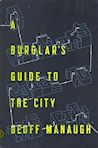
Geoff Manaugh.
A Burglar's Guide to the City.
Farrar, Straus and Giroux. 2016
There is a standard way to use a building: enter by the doors, look though the windows.
There is a standard way to use a city: travel along the roads.
Burglars don’t use buildings and cities in standard way:
some enter buildings though windows, drop through hatches and ceilings, cut through walls;
some move around cities through tunnels, either pre-existing or self-dug.
Manaugh describes many of these alternate uses: some exceedingly clever, some just plain dumb.
And he describes attempts to thwart the burglars, from law-enforcement helicopter patrols to high security panic rooms.
I have come across, in fiction if not in reality, many of the concepts here,
but they are all engagingly presented.
One aspect I found particularly intriguing was how law enforcement could get lost
in certain kinds of locations. In one case it was helicopter pilots over a regular grid of streets,
in another it was officers on the ground in a huge building with several identical parts.
Both were lost in “a maze of twisty little passages, all alike”.
We know the solution to this: drop landmarks.
Law enforcement would like home owners to paint identifiers on their roofs.
Alternatively, architects could design more varied structures:
“a maze of twisty little passages, all different”, with the necessary landmarks already present.
Being able to think “sideways”, like a burglar, is a useful skill when designing any artefact:
it will be misused, if not on purpose, then at least accidentally.
Having these misuses catered for up front in the design is a plus.
Having these literally concrete examples in mind can makes for more vivid analogies when trying to think sideways.
For all my book reviews, see
my main website.
Monday, 14 January 2019
Sunday, 13 January 2019
film review: Spider-Man: Into the Spider-Verse
Labels:
film,
review,
science fiction,
spider
Miles Morales is a nerdy kid, sent off to a high powered school,
but who prefers producing graffiti art with his shady uncle.
One time, he gets bitten by a spider, and starts manifesting strange abilities.
On returning to the place, he finds Spider-Man (Peter Parker) fighting KingPin
over a huge accelerator; Parker hands Morales a data stick that can close down the accelerator.
The accelerator has opened a rift in the space-time continuum,
and several alternate parallel universe versions of Spider-Man fall through.
Morales must gain control of his spider powers, and work with the other spiders
to close down the accelerator before the universe is destroyed.
I confess when I started watching this, I didn’t know it is an origin story,
and that there is a new Spider-Kid on the block.
That means I probably missed some in-references.
But even coming to this relatively cold, I still found it hugely enjoyable.
It takes a while to get going, as Morales’ pre-bitten character is established.
But the film is clever, and knowing, and funny, and moving, and self-referential:
every Spider-character gets an increasingly funny origin-narration;
Peni Parker and her robot are drawn subtly differently in anime style;
there’s a Stan Lee cameo;
Spider-Noir’s monochrome character is drawn using different sized black dots to make shades of grey;
the tingling spider-sense seems to be of use only to detect the various other Spider-characters;
Aunt May’s response to the various alternate Spider-beings is priceless.
I’m not sure about the message on studying: Morales has to work hard at his new school, where all the kids are bright, but to learn how to use his new powers, he seems to only need to want hard enough, and spung, he gets perfect control. No 10,000 hours of practice needed for super-hero skillz, it seems.
I did some surfing after watching the film, and discovered all these Spider-characters pre-exist in the literature. So I hope there are more films in this multi-verse: having a larger cast of the “same” super-hero riffing off each other gives very rich possibilities.
Highly recommended.
For all my film reviews, see my main website.
![]() |
| the gang’s all here |
I’m not sure about the message on studying: Morales has to work hard at his new school, where all the kids are bright, but to learn how to use his new powers, he seems to only need to want hard enough, and spung, he gets perfect control. No 10,000 hours of practice needed for super-hero skillz, it seems.
I did some surfing after watching the film, and discovered all these Spider-characters pre-exist in the literature. So I hope there are more films in this multi-verse: having a larger cast of the “same” super-hero riffing off each other gives very rich possibilities.
Highly recommended.
For all my film reviews, see my main website.
Saturday, 12 January 2019
I now have a hate-on for Decatur Public Library
Labels:
books
I buy a lot of books, many second hand, some ex-library books. I’m used to ex-library books having stickers and stamps and what-not, including “withdrawn” stamps. Such identifying marks are not pretty, but they rarely damage the book.
But this. This! THIS!!
Sheer bloody vandalism.
Decatur Public Library: shame on you.
But this. This! THIS!!
Sheer bloody vandalism.
Decatur Public Library: shame on you.
Tuesday, 25 December 2018
Monday, 24 December 2018
Monday, 17 December 2018
Hannover by night
Labels:
Christmas,
conference,
Germany,
Hanover
I've arrived in Hanover for the conference on Cognitive Computing 2018: Merging concepts with hardware, starting tomorrow. Here's a view from my hotel window around late morning, just before I went to suss out the tram system and find some lunch.
In the evening I went into the city centre, by tram, to meet up with some of the other conference delegates. Between the tram stop and the Brauhaus, I took in the Christmas lights and markets.
Looking forward to the conference starting tomorrow.
In the evening I went into the city centre, by tram, to meet up with some of the other conference delegates. Between the tram stop and the Brauhaus, I took in the Christmas lights and markets.
![]() |
| all the trees are decked with lights |
![]() |
| every open area has a little marketplace |
![]() |
| just up the street from the Brauhaus |
![]() |
| on my way back to the hotel |
Sunday, 9 December 2018
Narrating Complexity
Labels:
books,
communication,
complexity,
publishing,
research,
robots
My complimentary editor copies of our latest book have recently arrived.
This is an outcome of a fascinating collaboration we started way back in 2012.
blurb:
See the Springer site for table of contents.
(This is the first time I have produced a book in anything other than LaTeX. I won't be doing that again in a hurry. But Springer made a great job of typeseting the ... shudder ... Word sources.)
This is an outcome of a fascinating collaboration we started way back in 2012.
blurb:
This book stages a dialogue between international researchers from the broad fields of complexity science and narrative studies. It presents an edited collection of chapters on aspects of how narrative theory from the humanities may be exploited to understand, explain, describe, and communicate aspects of complex systems, such as their emergent properties, feedbacks, and downwards causation; and how ideas from complexity science can inform narrative theory, and help explain, understand, and construct new, more complex models of narrative as a cognitive faculty and as a pervasive cultural form in new and old media.
The book is suitable for academics, practitioners, and professionals, and postgraduates in complex systems, narrative theory, literary and film studies, new media and game studies, and science communication.
See the Springer site for table of contents.
(This is the first time I have produced a book in anything other than LaTeX. I won't be doing that again in a hurry. But Springer made a great job of typeseting the ... shudder ... Word sources.)
Subscribe to:
Posts (Atom)


