The latest batch:

The latest batch:
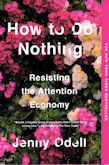
This isn’t actually about how to do “nothing”: it’s about how to do something meaningful, rather than the nothing that results from being trapped in the shallows of social media and “the attention economy”, of consumerism and incessant productivity. It’s about how to disengage from that time-suck, and how to use the resulting time beneficially.
The argument goes something like this. The attention economy is bad for us: it grabs our attention but doesn’t give anything in return; it’s like junk food engineered for craving more rather than providing nutrition. However, we can’t just walk away from the world and become a hermit: we need some contact with it to function, to keep in touch, to do our work; we are social beings. So we need to “resist in place”: do what is needed, but no more. This is of course difficult, because the digital world is engineered to make it hard to ignore; consumerism is the way our world current runs; not everyone has the resources to just stop.
Odell suggests that one way to resist is to pay “deep attention”, to go down rabbit holes. Rather than skimming over the surface glitter, dig down in one place, and notice, and think. The approach that worked for her stemmed from bird watching. Initially this was paying enough attention to distinguish species; this led to noticing where and when they turned up. From there, it was a short step to thinking about the plants and the local ecology, and further. She describes the experience as “re-rendering” her reality, seeing the world in a new, different way. Ecology is about networks, flows, and a lack of sharp, easily defined boundaries; this less sharply-defined reality needs extra attention and effort to see.
Odell suggests that deep connection with the natural world is what is needed. However, I think many more things are sufficiently fractal to work: you can pay attention and dig deep and discover more and more wherever you start: probably any initial hobby or interest can lead to ever-increasing depth and richness: from birds to ecology; from sport to physiology or economics or equipment design; from crafting to materials engineering and science, or supply chains, or sustainable raw material production; and so on. Indeed, Odell uses discovery of this ever deepening complexity and context as evidence we do not live in a context-free simulation:
[p126] Unlike the manufactured Main Street Cupertino, [the creek] is not there because someone put it there; it is not there to be productive; it is not there as an amenity. It is witness to a watershed that precedes us. In that sense, the creek is a reminder that we do not live in a simulation—a streamlined world of products, results, experiences, reviews—but rather on a giant rock whose other lifeforms operate according to an ancient, oozing, almost chthonic logic. Snaking through the midst of the banal everyday is a deep weirdness, a world of flowerings, decompositions, and seepages, of a million crawling things, of spores and lacy fungal filaments, of minerals reacting and things being eaten away—all just on the other side of the chain-link fence.
Odell finishes by talking of what comes next, after this deep attention has brought (in her case) the ecology front and centre. This ecology has been damaged, and is in need, not necessarily of restoration to some previous supposedly pristine state, but certainly of remediation, to a better, more healthy state. This requires seeing the complexity of what was there originally, and working with that complexity, in a form of “patient collaboration”. This work has no endpoint; it is a process of becoming.
I was surprised to find this turned into a book about the complexity of ecology, so soon after having read What Should a Clever Moose Eat?. They make a good pair. Even it you don’t want to turn your attention to ecology, but rather start with some other hobby or topic of choice, there is a lot to think about in this discussion. Stop consuming digital junk; pay attention to your mental nourishment!
We had been warned the weather would be poor. It isn't. So, after a day and a half in a windowless room, discussing many fascinating things to do with Time, Life, and Self Reference, a group of us went to the nearby Cape Spear, the most easterly point in Canada, for a hike. Exercising both brain and body.
 |
| getting ready to go to Cape Spear (Charles Ofria, Roger White, Penousal Machado, Wolfgang Banzhaf, Samson Abramsky) |
 |
| sea and sky |
 |
| A view back along the trail to Cape Spear, from where we have walked, and to where we will soon return for tea and cake. |
My total journey to St John's Newfoundland took 13 hours: an eight hour flight from Heathrow to Toronto, a two hour layover, and then a three hour flight directly back the way I had just come, to St John's. Pre Covid, I could have caught a direct five hour flight from London.
So I arrived in St John's late last night, with no photo opportunities. This morning, this is the view that greeted me when I looked out the window:

I am here for a small workshop on Time, Life, and Self Reference. I am one of the co-organisers, so I arrived a day early, to discuss plans with the other organisers. Then we went for a walk, first to the workshop venue (so I would know how to find it), and then to admire some of the local scenery.
 |
| view over The Narrows, the entrance to St John's harbour |
 |
| further glorious countryside |
I've travelled down to Heathrow, ready to catch a flight to Canada tomorrow morning.

This is the same hotel where we stayed for the 2022 Eastercon.
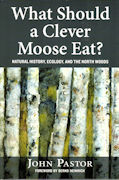
This is a collection of essays about the ecosystem known as the North Woods, a region in eastern North America. Essays cover climate, geology, vegetation, insects, herbivores, fire, and more, focussing on their complex interdependencies. It is also a book about natural history as a discipline: and how field studies are the starting point for many scientific questions: “every good problem in ecology begins with a question or observation from natural history” [p.xix].
And what becomes clear is the sheer complexity of the system: its geological history (particularly since the end of the last Ice Age) has shaped the landscape, but so has the vegetation and animals (particularly beavers); the landscape helps determine what vegetation grow, but so does other vegetation, and fires; insects and larger animals interact in a complex dance with the vegetation; there are many species of trees, plants, insects, and animals about which we know very little of their own behaviours and lifecycles, let alone their interactions with other species; and more.
[p.xxxii] Sometimes when a student comes to me asking for a research problem, I suggest that he or she take a walk in the woods and find a plant that intrigues him or her, even if only because it has pretty flowers. The aesthetic beauty of an organism will at least keep the student’s attention focused until he or she develops a sense of the beauty of the question he or she will try to answer. I then give the student a List of Questions to Ask a Plant, which includes “Who pollinates you?” “How do you grow in full sun and in shade?” “How do you grow on different soils?” “How many seeds do you make?” “Do you make the same number of seeds each year?” “Who disperses your seeds, and when and where?” “Who eats you?” “Why do they eat you?” “What other plants do you associate with?” The answers to these questions, and more, describe the natural history of the plant. Unfortunately, we do not know these answers for most plants. Our predictions of how nature will respond to timber harvesting, climate change, hunting and gathering, invasion by exotic species, and other factors are severely limited by not having answers to these questions.
This is a story of a dynamic complex system constructing itself over time: the ecosystem was not merely waiting in the south to move northwards as the ice retreated, and it is not simply going to move further north as the climate changes further.
The scientific questions that then arise are inherently cross disciplinary, because natural history does not focus on one organism or one level:
[p.xxxi] Natural history bridges observations of an organism’s life cycle, behavior, and interactions with other organisms with the geological history and structure of the landscapes in which it lives.
Each organism, or species, has its own intrinsic complexity, then there are yet more layers of complexity due to the diversity of interacting species: each species is different, with different behaviours, lifecycles, and patterns of interaction and feedbacks. Added to this is the spatial complexity of the region, with different geology and micro-climates forming a complex mosaic of habitats for the organisms that live there.
The essays illustrate this complexity by focussing here and there on different aspects of the North Woods. Each essay illustrates the complexity of its topic; the multiple essays weave together a story of larger complexity; the realisation that these cover just a tiny portion of the overall system adds a further level of understanding. And along the way, we get some amazing snippets of information that show the potential scale of seemingly unremarkable organisms: “Although northern peatlands cover only 3 percent of the earth’s land surface, they contain one third of all the carbon in the world’s soils” [p.32] “In the wilderness areas of northern Minnesota […] more than 90 percent of the water that drains into the lakes flows through at least one beaver pond.” [p.50]
Physics is a science of (relative) simplicity, and biology, a science of complexity, sometimes succumbs to ‘physics envy’ by trying to simplify the systems it studies, controlling for variation (cloned mice), interaction (isolated organisms) and complexity (no environment). This beautifully written book illustrates magnificently that “nature cannot be understood by pretending it is simple” [p.170], and how natural history can form the basis for appreciating the full complexity of biology in ecosystems. The Prologue alone provides a masterful rationale, and the following essays add layer upon layer of further evidence.


