Sunday, 29 May 2011

Philosophy, the great attractor

Wednesday's xkcd had the intriguing hovertext:
Wikipedia trivia: if you take any article, click on the first link in the article text not in parentheses or italics, and then repeat, you will eventually end up at "Philosophy".
So I tried it (as, apparently, did many other people at work that day, judging by the emails buzzing around).

graphviz picture of part of the Philosophy basin of attraction
Starting with "Spark plug" (the content of the xkcd cartoon), I got to philosophy. Starting with "Coffee" (which I was drinking at the time), I got to Philosophy. Starting with "Philosophy", I got (back) to "Philosophy". I also started with a couple of random pages, and got to "Philosophy".

Given the number of wikipedia pages, that's not much data in support of the Munroe Conjecture, but enough to blog about...

So I quickly hacked together a graphviz picture of the paths taken by my explorations, where each node represents a wikipedia page, and each edge represents the first link in that page.

First observation: If the Munroe Conjecture is true, the whole of wikipedia forms a single connected graph -- has a single "basin of attraction" -- like this picture, but with many many many routes, all eventually leading to "Philosophy".

Second observation: The "attractor cycle" at the base of all these paths contains "Philosophy", but also contains other pages, including "Science" and "Mathematics". So the conjecture could equally well mention any of these other pages.

Third observation: I understand that the number of hits on the wikipedia Philosophy page has increased dramatically since Wednesday :-)


UPDATE (12 Nov 2011): Others have put a bit more work into illustrating this.

Sunday, 22 May 2011

mangling language

I'm now inured to things like having to press the "start" button to stop Windows. But even so I boggled slightly at the message I got when I last upgraded Firefox:
"Click Finish to continue starting Firefox"
Wait, what?

Saturday, 14 May 2011

owl head stability

Yesterday I was at an interesting seminar given by Dr Tom Stafford (University of Sheffield) on "Inferring cognitive architectures from high-resolution behavioural data" -- about some interesting new results from psychological experiments on learning motor skills. Apparently it pays to be a bit rubbish at the start of learning, maybe because you're exploring more of the space.

Tom also recounted a great little anecdote about how Edward Thorndike, a late 19th century experimenter, thought the best psychological test subject was "a hungry cat": he repeatedly put the cat in a small box that had a foot pedal to release the door, and timed how long it took the cat to escape. Unsurprisingly, the cat got faster. More surprisingly, when the setup was changed to remove the foot pedal, the cat still pressed where it had been -- because it had learned where to press (or maybe it was going, "where's that fsking foot pedal gone?")

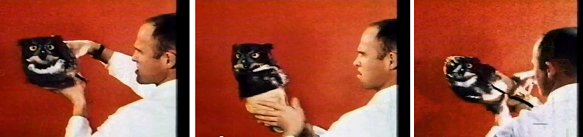
During the post-presentation conversation, the discussion turned to visual perception being hard wired for upright heads, to animals turning their heads upright even when they were upside down, to chickens keeping their heads stationary when their bodies are moved, to owls doing the same, to (inevitably) "there's a YouTube video of that!" A few minuted googling showed that indeed, there is. The bored-looking owl even keeps its head stationary when blindfolded. (The guy doing the waving about looks pretty grim, too.)

owl head stability http://www.youtube.com/watch?v=k6M-h5g3PwI

Saturday, 7 May 2011

visualising algorithms through dance

I'm nowhere near the first to post about this, but I have to advertise this. It is a wonderful set of folk dances, from AlgoRythmics, performed by a dance troupe in association with Sapientia University, Romania, that animate six different sorting algorithms. Sheer genius.

dancing shell sort

They have produced YouTube videos showing: bubble-sort via Hungarian folk dance, insert sort via Romanian folk dance, select sort via Gypsy folk dance, shell sort via another Hungarian folk dance, merge sort via German folk dance, and, almost unbelievably, quick sort with yet another Hungarian Folk dance (using hats as index pointers!)

Sunday, 1 May 2011

not shopping

I hate shopping for clothes. (Books are a very different matter.)

I hate it so much that my current clothes have to be literally falling to pieces before I will rouse myself to go hunter-gathering for more. Not only that, I'm picky. I only like certain colours (nothing bright, nothing pastel -- only browns, green, yellows, and other earth colours) and plain styles.

pile of green clothes
This Christmas vacation, I realised all my jumpers had holes in them, so I needed a new one. I grumbled out into the New Year sales, and found that Cambridge's Edinburgh Woollen Mill had a sale on. Not only plain, earth-coloured jumpers, but at half price! I used a technique my other half taught me (he's even pickier than me: he'll only buy in blue or grey): buy two. This means you have to shop only half as often. I've broadened the approach: buy four, and you have to shop only a quarter as often (and it's a great incentive to stay the same size). Four jumpers later, I sigh in relief -- no more jumper shopping for ages.

Now, this multiple purchase techniques doesn't always work. Shops often have only one or maybe two items of a given style and size. But, with the advent of the Web, this is no longer a problem. Buy the one successfully hunted down, go home, log onto the shop's website, type in the product code, buy several more, get them delivered to the door. I've used this technique successfully, too.

someone else's holey shoe; source http://blog.leffot.com/2009/09/23/the-dr-will-see-you-now/
Surprisingly, though, even this technique does not always work. When next my shoes fell apart (hole in the sole, one of the two standard failure modes), I needed another pair. Off to Clarks, where I found a comfy pair, eventually. So, I thought I'd use the same technique. (I find buying shoes even worse than buying other clothes, for some reason.) Off to the Clarks website: try to order three more pairs. It won't let me! I can order pairs in other colours or styles: I don't want other colours or styles. I can't order three identical pairs. I fire off an email to the company, pointing this out. "Yes", they say, "the site doesn't allow you to buy three identical pairs." Yes, I know; that's the problem. But why won't it let me? The only suggestion I have heard is that companies don't want you ordering a whole range of styles or colours, trying them all, then sending back all but the one you like. Okay, that might make a sort of sense. Except that this site would have let me buy three different styles; it's buying identical things that's the problem!

Oh well.

Monday, 25 April 2011

International Space Station

I've just seen the ISS for the first time. We realised it was due to go over, so popped outside. Lovely clear evening. Bright light in the sky. Is that it? Or is it that one below it? It's the one below: it's moving! Wait, there's another one next to it, also moving! That can't be right. No, it's the bright one that's moving!

It was a very peculiar optical illusion, making the bright light seem to be still in the sky, and the fainter one seem to be moving. After the few seconds of confusion, we watched the bright light move overhead. It whipped overhead quite fast, covering half the sky in a few minutes. It was very bright, probably about magnitude -3. As it got closer to the horizon, it dimmed and brightened a few times, then disappeared.

Observing astronomical stuff is cool. But watching the ISS was quite a different feeling -- people did that! A whole other level of cool.

Thursday, 21 April 2011

legal science fiction

I occasionally get emails about my website, including questions about SF. I'm no expert, but sometimes I (or more often, my other half), can provide a bit of an answer.

Here's the latest question in my inbox:
I'm writing short stories about law. The story criteria are:

1. Uninvented technology. This is, to me, the sine qua non of SF.
2. The story focuses on law. A simple reference to a statute is insufficient.
Police procedurals are unacceptable.

Examples of good stories of this sort: "A Loint of Paw," by Asimov; "The Sixth Palace," by Silverberg.

Is there a bibliography already done, the subject of which is SF law stories as I define that category?

Have you any recommendations for the bibliography? I'm a bit short on novels which fit the criteria. Only the Circuit trilogy by Snodgrass comes to mind.

I don't know of any bibliography, but I (rather, we!) can provide a few more examples, after a quick trawl through memories and bookshelves. One trope is to use a trial to get the protagonist out of the military, or out of society, so they can go off adventuring, or go undercover, or something; see, for example, E. Everett Evans, Man of Many Minds. We've tried to avoid listing such "trivial" trials that are there just to set the (otherwise unrelated) plot going, and to list ones where the trial is an integral part of the story (if not always the focus). But there is no sharp line.

Lloyd Biggle Jr, Monument, is about establishing and gathering evidence for court cases about who owns a planet, and uses an obscure point of tax law to win the day.

Miriam Allen deFord's anthology Space, Time and Crime has several relevant stories. Check out "The Adventure of the Snitch in Time"'s throwaway reference to a famous lawyer.

Cory Doctorow, Little Brother, has a trial.

There are court cases in Heinlein novels, such as whether Lummox is a pet in The Star Beast, and whether humanity should be allowed to survive, in Have Space Suit, Will Travel.

Frank Herbert's Bureau of Sabotage stories can involve court cases: see "The Tactful Saboteur" and The Dosadi Experiment.

In Larry Niven, "The Ethics of Madness", the court case is central to the plot.

Niven and Pournelle's Oath of Fealty includes a murder trial, where the defence is essentially that it's okay to kill someone who is shouting "fire" in a crowded theatre. It's not central to the plot so much as indicative of the overall philosophy of the book.

Pohl and Kornbluth, Gladiator-At-Law, might fit the brief.

Jerry Pournelle's "High Justice" features a Solicitor General.

Charles Sheffield, Space Suits, is a collection of short stories about Burmeister and Carver, Shysters-at-Law, and their legal exploits in the solar system. He has also written the short story "Humanity Test", which is at the opposite end of the humour spectrum.

Robert Sawyer, Illegal Alien, has an alien visitor tried for murder.

Cordwainer Smith, "The Crime and the Glory of Commander Suzdal", ends in a trial -- well, a verdict -- about the use of a time machine to create an entire sentient race.

There is a whole sub-genre about whether something non-human (computer, robot, alien, uplifted animal) should be given the status of human. Probably Asimov's "The Bicentennial Man" is top here, with also Heinlein's "Jerry was a Man". Scalzi's The Android's Dream includes a scene about the legal status of one of the protagonists.

MilSF is replete with courts martial. For example, there is the court martial of Pavel Young in David Weber's Field of Dishonor, and a couple of courts martial in Heinlein's Starship Troopers (one being used as an example to the hero not to request his own court martial later!).

There are alternative legal systems -- for example, ones where the whole community gets to vote on a punishment, such as in Alexei Panshin's Rite of Passage.

If we are allowed TV SF, there are some Star Trek episodes revolving around court cases, and there is the Battlestar Galactica trial of Gaius Baltar.

Any more?