Sunday, 10 July 2011

pedantry alert: signing silly declarations

I've just submitted yet another research funding proposal. As part of the bureaucracy surrounding this process, I have to sign a declaration, one clause of which states that I "confirm that I have no personal, financial or other interest in this project". I know what it means, of course, but it still feels silly to sign that I've no interest in this piece of work that has consumed the several months effort, and which, if my application is successful, will consume the next several years of my life.
"pedant": A man who likes his statements to be true.
--- Bertrand Russell. The Good Citizen's Alphabet. 1953
It's not just men, btw...

UK passport
I've also recently renewed my passport, which process required me to submit my old passport. I had to sign a declaration that said, in part (I forget the exact wording) "If I find my lost passport, I will return it immediately to the office". But I haven't lost my passport -- it's here, with this very form I'm signing -- so I don't have a lost passport to find. You might wish to argue, well, it's a joint form covering both renewal and replacement of lost passports, so if I do subsequently lose my passport, I'm saying I will return it. But I only need to return it if I've reported it missing, presumably by applying for a replacement, on a new form, where I could sign an accurate declaration.

And to cap it all, when a note was pushed through the front door saying that they had tried to deliver my new passport but I was out (they only deliver 9am-5pm Monday to Friday -- when most people are, of course, out), it said I would have to provide some ID when I went to collect it. One form of ID suggested was, you've guessed it, my passport.

Saturday, 2 July 2011

Artificial BIID

Charlie Stross, in his recent blog post "Three arguments against the singularity", made an interesting comment on how to stop advanced AIs going all Skynet on humanity, an idea he attributes to Karl Schroeder:

Consciousness seems to be a mechanism for recursively modeling internal states within a body. In most humans, it reflexively applies to the human being's own person: but some people who have suffered neurological damage (due to cancer or traumatic injury) project their sense of identity onto an external object. Or they are convinced that they are dead, even though they know their body is physically alive and moving around.

If the subject of consciousness is not intrinsically pinned to the conscious platform, but can be arbitrarily re-targeted, then we may want AIs that focus reflexively on the needs of the humans they are assigned to — in other words, their sense of self is focussed on us, rather than internally. They perceive our needs as being their needs, with no internal sense of self to compete with our requirements. While such an AI might accidentally jeopardize its human's well-being, it's no more likely to deliberately turn on its external "self" than you or I are to shoot ourselves in the head. And it's no more likely to try to bootstrap itself to a higher level of intelligence that has different motivational parameters than your right hand is likely to grow a motorcycle and go zooming off to explore the world around it without you.
I’d not come across this idea before, and when I read it first, I thought "cool, that’s an interesting solution to the problem". But the idea kept pecking away in my brain, and after a while I began to be very uneasy about it. Not because of the AIs, but because of us.

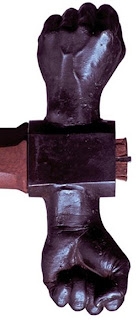
Paul Martu, Early Tools, hammer
There's a problem called Body Integrity Identity Disorder, or BIID (which I thought it was called body dysmorphia before I checked, but that seems to be somewhat different), where people want to have a limb amputated, because it does not "belong" to them. The current idea is that the limb is somehow "missing" from the brain's "map" of the body, and so really isn't part of that person's body identity.

Well, what happens to my body-map when I have all those AIs with their sense of self safely focussed on me? Now, the human brain is remarkably plastic, and we do manage to incorporate many external devices into our body-map quite freely. Canes, tools, cars, whatever, can quickly come to feel like part of our bodies. But these are all under the direct control of the very brain where the body-map resides. What of more autonomous tools with their own brains (albeit focussed on me)? What if for some reason those focussed AIs don't smoothly mesh into my body-map? Will I want to "amputate" them? And will what today seems like a natural desire sometime in the future be treated as a mental disorder on my part?

Sunday, 26 June 2011

I wouldn't stand in its way

My Sunday breakfast ritual includes reading the latest New Scientist magazine over cereal and coffee. Well, when I say "read", I mean skim through mostly, and read a few articles that catch my eye (which always includes all of Feedback, of course).

This week there is an article called "Brain Donors", on how humans can help AIs do their jobs. It includes the sentence:
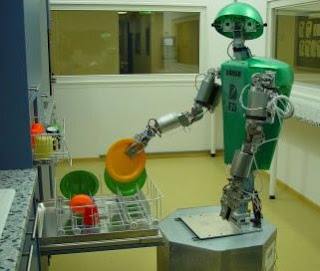
If a machine cannot understand what you are saying or move around safely, how can you expect it to load your dishwasher?
a Japanese robot washing up
This made me flash back to a plot element from Robert Heinlein's 1956 novel The Door into Summer (which I read in the 1970s, where the "present" part is set, with its "future" part being set ages away, in that shiny futuristic year 2000). In this the hero, Daniel Boone Davis, is an inventor, wanting to invent stuff to help ordinary people. He invents "Drafting Dan" to help him draft the blueprints of his inventions, and "Flexible Frank" to help around the house. In the book, the emphasis is on mechanical reproduction of the ways things are currently done by people. Drafting Dan never happened, but CAD has. Flexible Frank, washing up standing at the kitchen sink, never happened, but dishwashers have.

In other words, the technology that replaces human effort doesn't just trivially reproduce the human behaviour (washing up at the sink): it reproduces the desired effect of that behaviour (clean dishes), but in a way more appropriate to a mechanised solution.

robot loading a dishwasher (with plastic dishes)
I first experienced a dishwasher at a friend's house in 1977: despite having offered, I was delighted that I didn't have to help wash up after lunch, and thrilled instead to help load this marvellous machine. I was skeptical of the amused claim that "loading and unloading it becomes the chore". Even now, although I no longer positively enjoy the loading task, I still find in preferable to the real chore. But if a robot wanted to do it instead, I wouldn't stand in its way.

However, the moral of this tale is that technology solves our problems in ways different from how we solve them. So I should no more expect this latest chore to be eased by a robot loading a dishwasher, than to expect a robot to stand at the sink washing up.

Sunday, 19 June 2011

superluminal spiders

web crawler spiders
My previous blog post includes a quotation I had saved from a 1999 rec.arts.sf.written newsgroup. I wanted to see if I could track down the origin, for two reasons. Mainly, because I wanted to give a link. Secondly, because my record of the quotation has a misspelling of Alexei Panshin's name. I corrected this in my post, but then I wondered: was the misspelling in the original post (so maybe a subtle part of the troll itself), or my mistaken transcription?

So I googled the quotation, just a few seconds after posting it. And the top hit was that very post!


UPDATE (Oct 2011): I've now found the actual quote, and the misspelling is in the original -- so I updated my post to include the misspelling, happy it wasn't my own addition.

troll quotes

A Boing Boing post introduced me to the concept of a "troll quote": a well known quotation, misattributed to one person, along with a picture of yet another person.

Back in 1999, Michael F. Stemper contributed to the rec.arts.sf.written ultimate troll competition: "Does anybody know if Harlan Ellison will include Alexi Panshin's essay on Heinlein's views on gun control in The Last Dangerous Visions?" So when I was reading the Boing Boing comments, and came across Gulliver's suggestion at #33 --- "There ain't no such thing as a free lunch. ~ Ray Kurzweil. I'd go with Harlan Ellison for sheer piss-off factor." --- I'm afraid I just couldn't help myself.

neither of them said that

Sunday, 12 June 2011

tar ice cream

it never really got dark in Turku
I'm just back from Turku in Finland, from the Unconventional Computing conference. I had a great week listening to talks on computing with chemicals, with membranes, with weird quantum entanglement, with closed timelike curves, and more. (Did you know that if GPS didn't correct 42 microseconds a day for relativistic effects, locations would drift by 10km a day?) The weather was beautifully clear, and extremely hot (for Finland), sometimes even hitting 30C. And, of course, at this time of year, it never really got dark.

I'd been in Turku before, in 2003, at a formal methods conference (nice weather again, but nowhere near as hot). One evening a group of us went out for a meal at the Harald "Viking" restaurant (we didn't wear the helmets...). On the sweet menu was "tar ice cream". Ho, ho, ho, we went, it must be mistranslated. So we asked the server. "Tar? Like you put on the roads?" "Yes" she said. Okay, so I have to order that. It arrives: a scoop of plain white ice cream. I take a hesitant spoonful as the rest of the table watches. "It's tar!"

It had a lovely tarry flavour -- like mild creosote. It is actually pine tar, made from tree sap -- and it's very nice (although not everyone agrees!). This visit, one evening I was in a restaurant, and recognised it as that same place I'd been 8 years earlier. So I looked eagerly for the tar ice cream. Still available, and still delicious.

The next day was the conference dinner. We went to a lovely place in the archipelago, where they were serving a smoky tar drink in a wooden mug -- and the dinner included (among many other kinds of fish) herring in tar. Both nice, but not as good as that tar ice cream.