Latest publication:
Tim Hoverd, Susan Stepney.
Environment Orientation: a structured simulation approach for agent-based complex systems
Natural Computing, 2014 (online)
doi:10.1007/s11047-014-9449-2
For all my social networking posts, see
my Google+ page
Saturday, 9 August 2014


ALife publications
Labels:
complexity,
conference,
New York,
publishing,
research,
USA
Presented at the ALife XIV conference in July:
Christopher Timperley, Susan Stepney.
Reflective Grammatical Evolution.
ALife XIV, New York, NY, USA, July 2014, pp.71–78. MIT Press, 2014.
open access
Adam Nellis, Susan Stepney.
Computational novelty: Phenomena, mechanisms, worlds.
ALife XIV, New York, NY, USA, July 2014, pp.506–513. MIT Press, 2014.
open access
For all my social networking posts, see my Google+ page
Christopher Timperley, Susan Stepney.
Reflective Grammatical Evolution.
ALife XIV, New York, NY, USA, July 2014, pp.71–78. MIT Press, 2014.
open access
Adam Nellis, Susan Stepney.
Computational novelty: Phenomena, mechanisms, worlds.
ALife XIV, New York, NY, USA, July 2014, pp.506–513. MIT Press, 2014.
open access
For all my social networking posts, see my Google+ page

Friday, 8 August 2014
type the two words you see in the picture below
I was registering for on-line access to my water bill. Part of the registration process has a Captcha. I saw:

“Oh, that won’t work.” I clicked the refresh button.

“Oh. So what are the chances of that?” I clicked the refresh button.

“Oh. There seems to be a pattern here.” So I typed “200” into the text box. And got through to the next screen.
Well, I suppose that “two hundred” is, after all, two words!
“Oh, that won’t work.” I clicked the refresh button.
“Oh. So what are the chances of that?” I clicked the refresh button.
“Oh. There seems to be a pattern here.” So I typed “200” into the text box. And got through to the next screen.
Well, I suppose that “two hundred” is, after all, two words!
Thursday, 7 August 2014
compassion and Ebola
Labels:
medicine
From the Washington Post article: I’m the head nurse at Emory. This is why we wanted to bring the Ebola patients to the U.S.

For all my social networking posts, see my Google+ page
We can either let our actions be guided by misunderstandings, fear and self-interest, or we can lead by knowledge, science and compassion. We can fear, or we can care.
For all my social networking posts, see my Google+ page
Wednesday, 6 August 2014
how long is a piece of DNA?
Labels:
astronomy,
DNA,
estimation,
Neptune

This is easy to check. Wikipedia says that one nucleotide [or base] is 0.33 nm long. The same page also says that human have “3 billion base pairs of DNA arranged into 46 chromosomes”. However, other sites say that the 3 bn base pairs is the genomic contents of the 23 individual chromosomes. (This demonstrates the value of checking several sites; I also checked the 0.33nm in other places.) Since you have two copies of these chromosomes in most cells, that makes 6 bn base pairs all together. And 0.33 nm × 6 bn = 2m.
That seems ridiculous: cells are too small to see with the naked eye, so how can there be a 2m long string of DNA inside?
Well, DNA is really really thin. Wikipedia says the width of a DNA chain is 2.2–2.6 nm (and this number is confirmed elsewhere; you can check). Assuming the chain is a cylinder, and taking a mid value of 2.4 nm, this gives a volume of 2m × π × (1.2 nm)2 = 9 × 10⁻¹⁸ m3, or (2 × 10⁻⁶ m)3, that is, a cube of side 2 microns. That can fit in a cell, all folded up.
I’ve known this 2m fact for several years. I’ve also known that there are over a trillion cells in the human body. What I’d never done, until challenged by a colleague recently, was put these two together, to calculate the total length of DNA in the human body, with 2m in each of those trillion-plus cells.
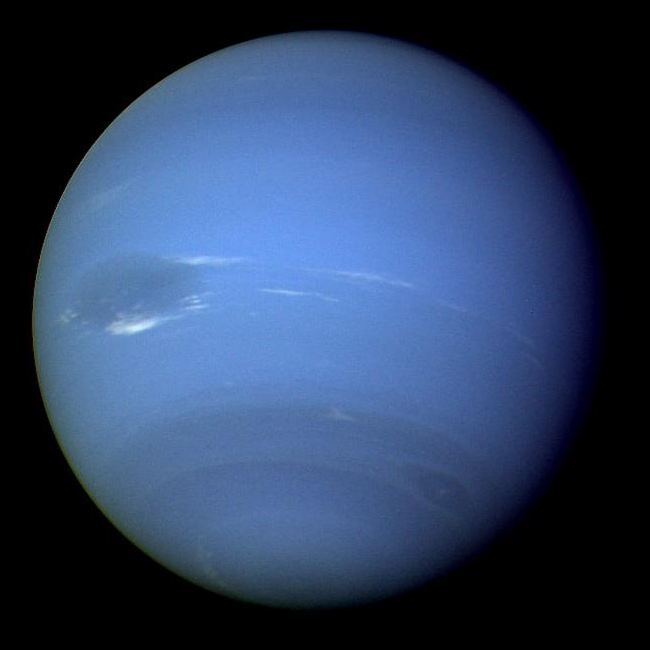 |
| Neptune: seems pretty close in comparison |
One astronomical unit, or AU, is the mean distance from the earth to the sun, about 150 million km, or 1.5 × 10¹¹ m. (I grew up knowing it as 93 million miles, but the world has changed units.) That means you have over 500 AU of DNA in your body. Neptune, the outermost planet, is 30 AU from the sun. Your total DNA is nearly 10 times the diameter of the planetary solar system!
Another way to look at it. Light travels at a speed of 3 × 10⁸ ms−1. Even at this colossal speed, it takes a while for light to get around the solar system: the moon is just over a light second away, and the sun is a full 8 light minutes away. Dwarfing these, your total DNA is 3 light days long!
And yet that astronomically long piece of DNA length has a volume of 40 trillion × 9 × 10⁻¹⁸ m3, or 360 cm3, just about the volume of a soft drink can. Really really really thin.
So, if anyone asks how much DNA there is in the human body, it’s 3 light days, or just over half a pint, depending how you want to measure it.
Monday, 4 August 2014
Subscribe to:
Posts (Atom)