Thursday, 14 August 2014

Loncon 3 : Thursday

We left home at 7:30 am to travel to Loncon 3, the 72nd World Science Fiction Convention, in London’s Docklands.  After a smooth mainline train, Tube, and Docklands Light Railway journey, we arrived at our hotel around 10 am.  It had rather confusingly changed its name from when we originally booked, but we found it, checked in, and dropped the luggage.  Then over the road into the ExCeL.  Which is HUGE.  We entered from the Custom House station end: registration was at the Prince Regent station end, so we walked the 500 or so yards through it.

There was a 45 minute queue for registration, which allowed chatting with other fans.  (This was the largest Worldcon ever, with over 7000 attending.)  Once we had our badges, we had the power to access the function rooms.  I had used the online guide previously to decide on which items to attend, so there was no need to frantically read the 240 page “pocket” programme guide.  There were up to 10 scheduled items happening at a time, so it paid to be prepared.

My first item was a panel called LOLcats in Space: Social Media, Humour, and SF Narratives.  The room was very full, and I ended up sitting on the floor at the back, and was too uncomfortable to take in much.  Full rooms were a recurring feature, but very soon signs went up: no standing, no sitting on the floors, due to fire safety regulations.  So several times I didn’t get to the event I’d planned.  However, I usually had a backup item available, given how much good stuff was programmed, or took the opportunity to grab something to eat!

Next I went to Loncon 3 Guests of Honour Discuss Iain Banks, where I did this time get a seat, as it was in one of the larger rooms.  Iain M. Banks was Loncon’s main Guest of Honour, but sadly died last year.  Here the other Guests of Honour remembered him, his work, and various previous con anecdotes.

3pm and it was time for Speculative Biology - An Introduction, part of the science programme.  This was partly about how life might be different, and partly about the history of people inventing different animals, ecosystems, and evolutionary histories.

What’s In a Name? was a panel about why writers use pseudonyms, and included Robin Hobb/Megan Lindholm, and Seanan McGuire/Mira Grant.  The reasons included: separating out different genres/sub-genres so that the public know what they are getting (particularly if writing both adult and YA books); changing persona to overcome previous poor sales; “diluting” an otherwise overwhelming presence if prolific; being a ghost writer, or house writer for a “brand” like Nancy Drew; hiding salacious content from your grandmother.  It was interesting to hear Robin Hobb describe how her name was carefully designed, to be gender neutral, to have resonances, to be short so it could be big on the cover, to begin with H to be at eye level in most book shops.  Quote of the panel: “Mira sells better than Seanan.  That really pisses me off.  I’m jealous of myself!”

The final panel of the day was Why Aliens Are Cool Again.  The panelists wondered if aliens had ever been uncool.  For example, the Doctor is an alien.  But Paul McAuley dismissed him as an example of “charismatic megafauna”.  And JarJar Binks was seriously uncool.

We finished the evening off with David Wake’s new play, The Cancellation and Re-imagining of Captain Tartan.  If you have seen previous incarnations of David Wake’s Captain Tartan series, you know what to expect.  Here Tartan is cancelled after a Blakes 7-style cliffhanger ending, only to be reimagined many years later as an American version, all in a dastardly attempt to remove the science from science fiction.  Side-splittingly hilarious.

And so to bed.


Wednesday, 13 August 2014

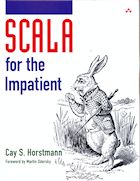
book review: Scala for the Impatient

Cay S. Horstmann.
Scala for the Impatient.
Addison-Wesley. 2012

Python is my current language of choice, but when you are writing something more substantial, having a strongly-typed language helps. One of my colleagues has been enthusing about Scala in general, and this book in particular, so I thought I’d give it a look.

Being not just the impatient of the title, but very impatient, I have frankly skim-read much of the book. Nevertheless, I’m impressed by what I’ve seem, both of the language, and its presentation here. Scala seems to be a well designed and interesting modern language, with many sophisticated and powerful features, but with no burdensome syntactic overheads.

The back-cover blurb offers a good summary of the key features described in the book. Scala compiles down to run on the JVM; it is object-oriented with functional capabilities; it allows mixin-style traits that can contain implementation code; it has support for parsing in general and XML in particular; it has extra support for concurrency through actors (thread-safe concurrent objects); and it has support for continuation programming (proceed with caution!)

The concise and focussed style of the book allows a brisk trot through many language features, whilst still containing a lot of technical meat, all introduced through code snippets. It does assume some knowledge of Java, as several of the examples contrast it with that earlier language.

A good technical read, making me want to try out the language, particularly the actors for complex systems simulations.

For all my book reviews, see my main website.

Tuesday, 12 August 2014

Fractal Experience

Eric Soderberg’s project.


(via BoingBoing)

For all my social networking posts, see my Google+ page
I snorfled at this tweet from Sean Carroll at a conference…


For all my social networking posts, see my Google+ page

Applications of Finsler Geometry to Speed Limits to Quantum Information Processing

New publication:

Benjamin Russell, Susan Stepney.
Applications of Finsler Geometry to Speed Limits to Quantum Information Processing
International Journal of Foundations of Computer Science, 25(4):489–505 2014
doi: 10.1142/S0129054114400073


For all my social networking posts, see my Google+ page

Monday, 11 August 2014

book review: Let’s Pretend This Never Happened

Jenny Lawson.
Let’s Pretend This Never Happened. 
Picador. 2012

If you already know Jenny Lawson as The Bloggess, then you will know what to expect (mostly). If you don’t, then go and subscribe to her blog immediately!

Terrifying, starling, disturbing, but mainly laugh-out-loud funny, this tells certain incidents in Lawson’s life that many might think implausible, but for which there is significant evidence (we’ve seen the photos of BeyoncĂ© the giant metal chicken, after all). It’s all (mostly) in the same breezy style as her blog, even when the incidents are what most people would think as traumatic. We see more of Jenny’s childhood, and of Victor, than in the blog posts. There’s blood, and romance, and bobcats, and panic attacks, and zombies, and stuffed animals, all rolled into one.

Great stuff.

For all my book reviews, see my main website.

Sunday, 10 August 2014

sequestering carbon, several books at a time XXVIII

The latest batch, awaiting me as I returned from my North American odyssey:


Some were already in the delivery pipeline when I left.  Some were recommended during my visits, and then ordered, while I was away.  Some are proceedings from the conferences and workshops I was at.  And some are birthday presents, ready for my return.

I need to go and replenish the delivery pipeline now.