Saturday, 11 March 2023

view inside a hotel room

My PhD student and I have arrived safely in Jacksonville, Florida.  

We had a transit through Washington DC airport: I was slightly anxious, as we only had a 90 minute layover, yet we had to go through immigration, collect and recheck baggage, and find the new gate.  I’ve had delays with all those issues before on other trips.  However, not this time.  Immigration was super swift: there is a separate "transit" immigration (I've not encountered that before in other airports) and there were four desks open for the non US passports transiting from our flight.  Then baggage collection and rechecking was even easier.  A small conveyor belt held the luggage from our flight, which was already there as we arrived from immigration: pick up suitcase, walk through "customs" (four or five paces), drop suitcase on another conveyor belt.  And we're done.  It took longer to then walk to the new gate.  I was impressed.

We had booked a "limo" from Jacksonville airport to the hotel (that seemed sensible, because originally there were supposed to be three of us; but Covid struck down one of the team).  The driver was waiting at baggage collection (I will never get over how casual local flights are in the US), so that was reassuring.  The car was a Tesla, and the driver proudly demonstrated its self-driving capabilities.  Hmm.

Then safely at the hotel, in the middle of a big strip mall.  It's just a standard mid-range conference hotel, nothing fancy, but the rooms are huuuuge, including a decent kitchen, a small dining area, and a lounge area, in addition to the expected bed/desk/bathroom:

Kitchen area with microwave, hotplate, sink, and fridge.  Small dining table visible bottom right.

Sitting area with couch and footstool/table.  Small dining table visible bottom left.
The more traditional part of the room: desk and bed, with bathroom off to the left.

Huuuuge.  (I haven't got a top range room or anything; my student's room has the same layout.)  People live in smaller places than this!

It's dark out, so the traditional view from the window will have to wait until tomorrow.  Off for something to eat (fortunately there are tons of places to eat nearby in the mall), then to crash.

Friday, 10 March 2023

view from a hotel window

At Heathrow, ready to catch the morning flight to Jacksonville, FL (via Washington), to go to the UCNC conference.  A great view of a car park!


Monday, 20 February 2023

Jupiter and Venus on camera

Jupiter and Venus were extremely bright in the sky tonight, but even so, I was surprised I got this picture with just a hand-held Pixel 4a.

18:51 GMT; bright planets, despite all the light pollution


Saturday, 4 February 2023

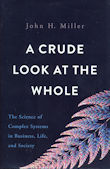
A Crude Look at the Whole

John H. Miller.
A Crude Look at the Whole: the science of complex systems in business, life, and society.
Basic Books. 2015


Most systems in the real world are complex: they are made of very many components, whose non-linear interactions result in high level emergent properties that are not simply related to the properties of those components. How to study such systems? Studying the components in isolation is insufficient: their interactions with each other and with their surroundings are key. Studying the whole system in detail is infeasible: there are too many components and interactions to grasp the whole in detail. So Miller advocates studying the whole as a whole. He devotes individual chapters to different facets of this whole – interactions, feedback, heterogeneity, noise, molecular intelligence, group intelligence, networks, scaling, cooperation, and self-organised criticality; and also the MCMC algorithm for studying these – explains how a degree of understanding can be obtained, and gives a range of examples, covering physical, biological, social, and economic systems.

There are many fascinating insights along the way. For example, many computer simulations of ‘complex’ systems use (relatively) homogeneous agents. Miller shows how heterogeneous agents (varying in some trait or property) can either stabilise a system against tipping, or cause it to tip more rapidly, depending on the sign of the feedback. So results from homogeneous simulations, and similarly simulations lacking noise, may give quite misleading results.

The chapter on molecular intelligence describes how complex adaptive behaviours (one might call this, intelligence) does not need a brain: complex molecular chemistry, feedback loops, and decay processes, all tuned by evolution, can deliver startling results. Intelligence can also arise from more complex agents interacting through feedback loops: the chapter on group intelligence discusses how swarms of bees can exhibit a group intelligence that no individual bee possesses.

There are also a few peculiarities. For example, in the chapter on noise, Miller discusses a search procedure for finding novel drug cocktails. Such cocktails can be much more effective than the drugs taken individually, since they can interact in non-linear ways (they are not just the sum of their individual effects); Miller states that:

[p92] drugs often interact with one another in surprising ways.

However, only a few pages later, he laments that

[p97] the Food and Drug Administration currently requires that cocktails be tested and approved as a cocktail—an extremely costly process—even when the drugs that make up the cocktail are all individually approved.

Well, yes. Because they often interact with one another in surprising ways.

The majority of the chapters discuss these processes in non-technical ways, and are the stuff of many a popular book on complex systems, although here illustrated with a wider range of examples than usual. The final chapter, however, moves into territory rarely explored in popular books: the MCMC (Markov Chain Monte Carlo) algorithm. (I think the explanation suffers a little in clarity from the understandable desire not to uses any mathematics.) He explains the genesis of the algorithm, invented to model distributions underlying certain physical processes, and how it can be used to understand some of the operations of a complex system:

[p215] The mechanisms that drive adaptive systems, such as evolution, have direct analogs to the key elements of the MCMC algorithm. In short, a complex adaptive system behaves as if it were implementing a MCMC algorithm.

That provides great potential for an explanatory and even predictive approach to complex systems of interacting components. However, I suspect that once the components have ‘true’ intelligence – can apply reasoning to their own actions and actions of others, and change their behaviours based on that reasoning – their recursive natures will make the system even more complex, and a more sophisticated explanatory approach will be needed.

Despite some minor caveats, this is an interesting book, well written, covering a lot of very deep and important concepts.


For all my book reviews, see my main website.

Tuesday, 27 December 2022

Slime: a natural history

Susanne Wedlich.
Slime: a natural history.
Granta. 2021


Slime is ubiquitous in living systems: as glue holding bacterial mats together, as lubricant allowing us to swallow our food, as both glue and lubricant excreted by slugs and snails to travel on, and much much more.

In this fascinating book, Wedlich explores all things slime (or mucus, or even biological aqueous hydrogel to sound more formal, if less attention-grabbing). She covers our human reaction to slime (the ick factor), and its role in art and culture; the physics of slime and how it can be both glue and lubricant; slime in organisms, particularly bacteria; the role of slime in the origin and evolution of life; and the place of slime in our ecosystems. This is all utterly fascinating, with new revelations on nearly every page. I had thought I knew at least something about the various major processes in biology: after reading this, I feel as if I have discovered a whole new kingdom.

I learned a lot, not just about organisms and evolution, but unexpected aspects like the role of slime in deserts and sea surfaces, and how climate change threatens the delicate balance of this almost unrecognised but crucial component of our biome. Highly recommended.

[Disclaimer: I was given my copy of this, in preparation for my hosting a discussion with the author during the York Festival of Ideas 2022.]


For all my book reviews, see my main website.

Monday, 26 December 2022

festive hats

Out for a walk this morning, I spotted that someone has made a festive decoration for a pillar box:

The base is knitted/crocheted; the decorations are felt-work.

I looked out for the next pillar box I passed, and sure enough:

Here the carol singers are also knitted, and some have clearly had a little too much mulled wine.

Thanks, mystery yarn-bomber, for raising a smile!