Sunday, 9 October 2022

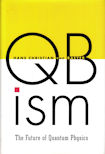
QBism: the future of quantum physics

Hans Christian von Bayer.
QBism: the future of quantum physics.
Harvard University Press. 2016


Quantum mechanics is notoriously unintuitive, with its “collapsing wavefunctions” or “many worlds” or whatever is added as an interpretation to its weird predictions. Yet those predictions belong to the most accurate physical theory known. 

Quantum mechanics seems to say we have to give up some cherished notion of the world: if we want locality (no “spooky action at a distance”, only local interactions that propagate), we can’t have realism (the idea that there is some definite thing or process there), and vice versa. Quantum Bayesianism lets go of reality, but in an interesting way. 

This brilliant little book takes the reader through a description of the weirdnesses of quantum mechanics, and the interpretation of Bayesian statistics, before applying the latter to the former. 

The key idea of Bayesian, as opposed to frequentist, statistics is that probabilities are about our knowledge of the world (we assign a prior probability to a fair coin toss of 50% of landing heads, because we don’t know all the details of the initial spin, the air currents, etc). Bayesianism defines how to update this prior knowledge (the 50/50 chance) with a new probability once we have further data (anything from more knowledge about those initial conditions, to an observation of how the coin actually landed). So in QBism the probabilistic quantum wavefunction is interpreted as our prior knowledge of the system. This gets around “wavefunction collapse”: we just update our prior with the additional observational data. It gets around “Wigner’s friend”: Wigner has one prior wavefunction, his friend, who has observed more of the the situation, has an updated, and therefore different, wavefunction. The wavefunction belongs to the observer, not to the system. 

Quantum mechanics allows us to calculate the best possible prior from our knowledge of the system. What makes quantum mechanics weird is that a calculated wave function that says a photon has a 50/50 chance of doing something, say, is the best possible knowledge we can have of the system: unlike in the classical case, it is not possible to improve the prediction by having more data about how it was set up. This is why we have to give up “reality”: the wavefunction isn’t “real”, because it is not a property of the system itself, it is just the best possible description of it. There is no underlying “real” system that “knows” what the actual answer will be (unlike the classical coin toss). Once the photon has interacted with something, the system has changed, and we can update our prior with the new observed data. 

This loss of “realism” does not mean QBism denies the existence of a real world “out there”. It instead leads to a startlingly different view of that real world. The world is not a deterministic automaton, set going at the start, trundling along a pre-determined track. It is a world undergoing constant creation by quantum systems (which may include observers) interacting. 

[p208] Understood in this way, the QBist universe is not static but dynamic; less like an intricate clockwork and more like the interior of an evolving star that is not alive in the conventional sense but bubbling with creative energy and continual surprise. It is real but veiled, objective but unpredictable, and substantial but unfinished,

von Bayer writes in a very accessible way. I admit, the sections on the delayed choice and the GHZ experiments could have gone more slowly. But overall, the exposition is brilliant: on quantum mechanics, on Bayesianism, and then on the combination. This book changed my world view.


For all my book reviews, see my main website.
Saturday, 1 October 2022

turning heads

Many minor things have changed for the first time in a lot of people’s lives, due to changing the soverign after 70 years.  His Majesty’s Government; King’s Counsel; His Majesty’s Revenue and Customs; ...  

And the coins will change.  The design of the new 50 pence has been released:

There has been a lot of discussion about the different direction the head is facing.  But that is not a change of a 70-year constancy for some of us.  On 15 February 1971 the UK “went decimal”, changing its coinage from pounds, shillings, and pence to the new decimal coinage.  (If you have ever wondered why people occasionaly say “what’s that in old money?” when asking for something in less confusing units or language, that’s because it was a very common phrase while people adjusted.)

Before 1971, there were coins from multiple reigns in circulation (and for a while after, since the old one shilling / new 5 pence and the old 2 shilling (florin) / new 10 pence coins coexisted for a while).  As children, we enjoyed finding the occassional very old coin.  Here are some pennies I found in my change in the 60s, and kept as souvenirs:

old pennies: Victoria, Edward VII, George V, George VI, Elizabeth II

So we knew the heads faced in different directions.

Coin designs didn’t change as much then, either:

only a subtle change in Britannia from 1907 to 1962

The main change was the amount of Latin, and the amount of its abbreviation, on the front.

So, the head has turned once more.


Wednesday, 21 September 2022

Mind. Blown.

 Wow.  Just ... wow.

JWST view of Neptune

The more I look at this, the more staggered I get.  I remember when pictures of Jupiter had less resolution.  These truly are the days of miracle and wonder.


Tuesday, 20 September 2022

nobody minded the spider

For all the reasons discussed earlier, I watched the state funeral of Elizabeth II yesterday on TV.  My parasocial relationship and mental model definitely got updated, if only partially for now.  

While watching the ceremonies, I realised why I actually appreciate these kinds of  displays of ceremony and pagentary: I'm a fan of what is known as "competence porn".  I usually get this from reading fiction; it's rare to see something done so well in real life.  (Having oodles of money thrown at it helps, but is certainly not sufficient.)  Although I did think that the funeral music accompanying the processions seemed a little ... jolly ... at times.  Maybe it's the brass band instruments.

Also while watching, at one point I said: "is that a spider?"  Yes, it was, crawling bemusedly on the card on the wreath.  I am not the only one who noticed.  

So, the end of an era.  And the world goes on as before.


Monday, 12 September 2022

view from a hotel window

I am in Venice, attending a workshop being run by the European Centre for Living Technology.  This is my first time in Venice, and the weather is glorious.  And the lack of traffic makes it very peaceful (except for the 8am and noon bells).

By hanging out of my hotel window and looking round the corner, I have a lovely view.

The opposite view from the corridor by my room is even better:

There are, of course, numerous canals, mostly quite narrow:

but occasionally quite large:

The workshop venue is equally spectacular:


So, my first visit, but hopefully not my last.


Saturday, 10 September 2022

On parasocial relationships, and updating mental models

I came across a new term recently: parasocial relationship.  These are “one-sided” relationships,  where person A invests some degree of time, energy and emotion in following the life of person B, yet person B is unaware of even the existence of person A.

In these relationships, person B is typically some celebrity enough in the news that person A can easily follow them.  But person B may even be fictional: people can look forward to book sequels or new TV seasons so that they can “spend more time” with their favourite characters.  More dedicated fans may even write “fan fiction” to this end.

Parasocial relationships have been categorised into three levels: (1) entertainment-social, with normal fan-like following of news; (2) intense-personal, with feelings to the point of obsession; (3) borderline-pathological, with addiction-like fantasies and behaviours.  

I would say there is also a level 0, more a form of acquaintanceship, due to existing in a culture where news of the other cannot be avoided, so they necessarily become familiar over time.  

An aspect of relationships is that we humans build mental models of our world that include models of these other people (and models of ourselves, and models of their models of us, and…).  Most of the people in our own mental model are our specific friends, relatives, colleagues, and acquaintances, plus a sea of famous people, and a sort of background of undifferentiated extras.  We each use our own model to predict and anticipate events and behaviours, and so need to keep it up to date and as correct as is needed for us to function in the world.  Differences between our model and the real world may be due to a faulty model (eg, I completely misunderstood X’s motivations), or may be due to a change in the world (eg, Y has died).  Then our model needs to be updated.  But this takes time, and it can be jarring or upsetting for us when our model keeps making incorrect predictions, for example because it is assuming that a person who has recently died is still alive.

A combination of a parasocial acquaintanceship and an uncorrected mental model can possibly explain why one feels upset, or discomforted, or just plain off balance, when a famous person dies.  A famous person such as Queen Elizabeth II, for example.

So, I will be watching the funeral.  Partly to help update my mental model through forced correctional input (when will it stop being totally weird to hear people saying “the King”?)  And partly to grieve the end of a parasocial relationship (level 0+) that I have been engaged in for over 60 years.


Wednesday, 17 August 2022

low moon rising

The very low moon is peeking through the streetlights around the carpark.  Shot on my Pixel4a in "night" mode, 2x zoom, cropped, but otherwise untouched.

21:43 BST